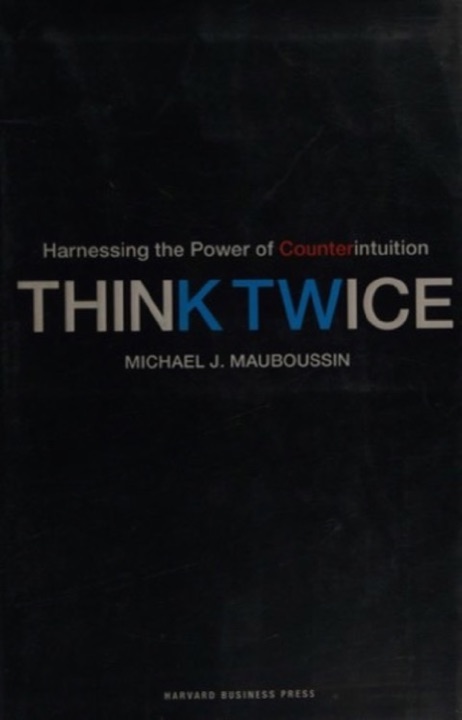
Think Twice: Harnessing the Power of Counterintuition
Applying the lessons from "Think Twice: Harnessing the Power of Counterintuition" by Michael J. Mauboussin to your life can enhance your decision-making processes and help you navigate complex situations more effectively. Here are some ways you might integrate these insights:
-
Challenge Intuition in High-Stakes Situations: Given your experiences with near-death situations and your background in emergency medicine, you likely rely on quick decision-making. However, in less time-sensitive scenarios, take a moment to question your gut instincts. Consider alternative perspectives and gather more information before making a decision.
-
Recognize and Mitigate Biases: Reflect on your decision-making history to identify any recurring cognitive biases. For instance, your tendency to make quick decisions might sometimes lead to overconfidence. By being aware of this, you can consciously slow down and seek diverse opinions, especially in complex or unfamiliar situations.
-
Embrace Uncertainty: Your belief in living in the moment aligns well with embracing uncertainty. Use this mindset to remain open to unexpected outcomes and adapt your strategies accordingly. This can be particularly useful in your advocacy work and when dealing with social issues.
-
Value Diverse Perspectives: You already value kindness and empathy, which can naturally lead to appreciating diverse viewpoints. In your professional and personal life, actively seek out and incorporate different perspectives to enhance your decision-making and problem-solving abilities.
-
Learn from Mistakes: You've mentioned that failures have been valuable learning experiences. Continue to analyze past decisions, especially those that didn't go as planned, to extract lessons and improve future choices. This reflective practice can help you refine your approach to challenges.
-
Use Structured Frameworks: Consider adopting decision-making frameworks that incorporate counterintuitive thinking. For example, when faced with a complex decision, outline the assumptions you're making and challenge them. This can help you uncover new insights and make more informed choices.
-
Balance Impulsivity with Reflection: While your impulsivity can be a strength in certain situations, balancing it with reflection can lead to better outcomes. Take time to evaluate the potential consequences of your actions, especially in areas where you feel passionate or emotionally invested.
-
Apply Counterintuition to Personal Growth: Your commitment to lifelong learning and personal growth can benefit from counterintuitive thinking. Challenge your existing beliefs and explore new ideas, even if they initially seem contrary to your instincts or experiences.
-
Enhance Communication and Collaboration: Your direct and humorous communication style can be complemented by actively listening to others' viewpoints. Encourage open dialogue and create an environment where diverse opinions are valued, which can lead to more innovative solutions.
-
Reflect on Ethical Decisions: In situations where your ethical beliefs are challenged, use counterintuitive thinking to explore alternative approaches. This can help you navigate complex moral dilemmas with greater clarity and confidence.
By integrating these lessons into your life, you can enhance your decision-making abilities, foster personal growth, and continue to make a positive impact in your professional and personal endeavors.
What the book covers
"Think Twice: Harnessing the Power of Counterintuition" by Michael J. Mauboussin is a compelling exploration of decision-making processes, emphasizing the importance of counterintuitive thinking. Mauboussin, a renowned expert in investment strategy and decision science, delves into the cognitive biases and mental shortcuts that often lead individuals and organizations astray. The book is structured around the idea that by understanding and countering these biases, one can make more informed and effective decisions.
Summary:
-
Understanding Cognitive Biases: Mauboussin begins by explaining how cognitive biases and heuristics influence our decision-making. He highlights common biases such as overconfidence, anchoring, and confirmation bias, illustrating how they can lead to flawed judgments. By recognizing these biases, individuals can begin to mitigate their effects.
-
The Role of Counterintuition: The core premise of the book is that counterintuitive thinking can lead to better decision-making. Mauboussin argues that our instincts and gut feelings are often misleading, especially in complex situations. He provides examples from various fields, including business, sports, and science, where counterintuitive approaches have led to success.
-
Case Studies and Real-World Examples: Throughout the book, Mauboussin uses case studies to demonstrate the power of counterintuitive thinking. These examples illustrate how successful individuals and organizations have challenged conventional wisdom and achieved remarkable results. The case studies serve as practical illustrations of the book's concepts.
-
Frameworks for Better Decision-Making: Mauboussin offers frameworks and tools to help readers apply counterintuitive thinking in their own decision-making processes. He emphasizes the importance of questioning assumptions, considering alternative perspectives, and embracing uncertainty. These strategies can help individuals make more rational and informed choices.
-
The Importance of Diverse Perspectives: The book underscores the value of diversity in decision-making. Mauboussin argues that diverse teams are more likely to challenge prevailing assumptions and consider a wider range of possibilities. This diversity of thought can lead to more innovative and effective solutions.
-
Learning from Mistakes: Mauboussin stresses the importance of learning from past mistakes. He encourages readers to analyze their decision-making processes, identify where they went wrong, and apply those lessons to future decisions. This reflective approach can help individuals improve their judgment over time.
Key Takeaways and Lessons:
-
Challenge Intuition: Trusting your gut can be risky, especially in complex situations. It's crucial to question intuitive judgments and consider alternative perspectives.
-
Recognize Biases: Awareness of cognitive biases is the first step in mitigating their impact. By understanding how biases influence decisions, individuals can take steps to counteract them.
-
Embrace Uncertainty: Uncertainty is an inherent part of decision-making. Embracing it rather than fearing it can lead to more robust and adaptable strategies.
-
Value Diversity: Diverse perspectives can enhance decision-making by challenging assumptions and broadening the range of possible solutions.
-
Learn from Experience: Reflecting on past decisions and learning from mistakes is essential for improving judgment and decision-making skills.
-
Use Frameworks: Applying structured frameworks can help in systematically evaluating options and making more informed decisions.
In summary, "Think Twice" encourages readers to adopt a more analytical and reflective approach to decision-making. By harnessing the power of counterintuition, individuals and organizations can improve their ability to navigate complex challenges and achieve better outcomes.