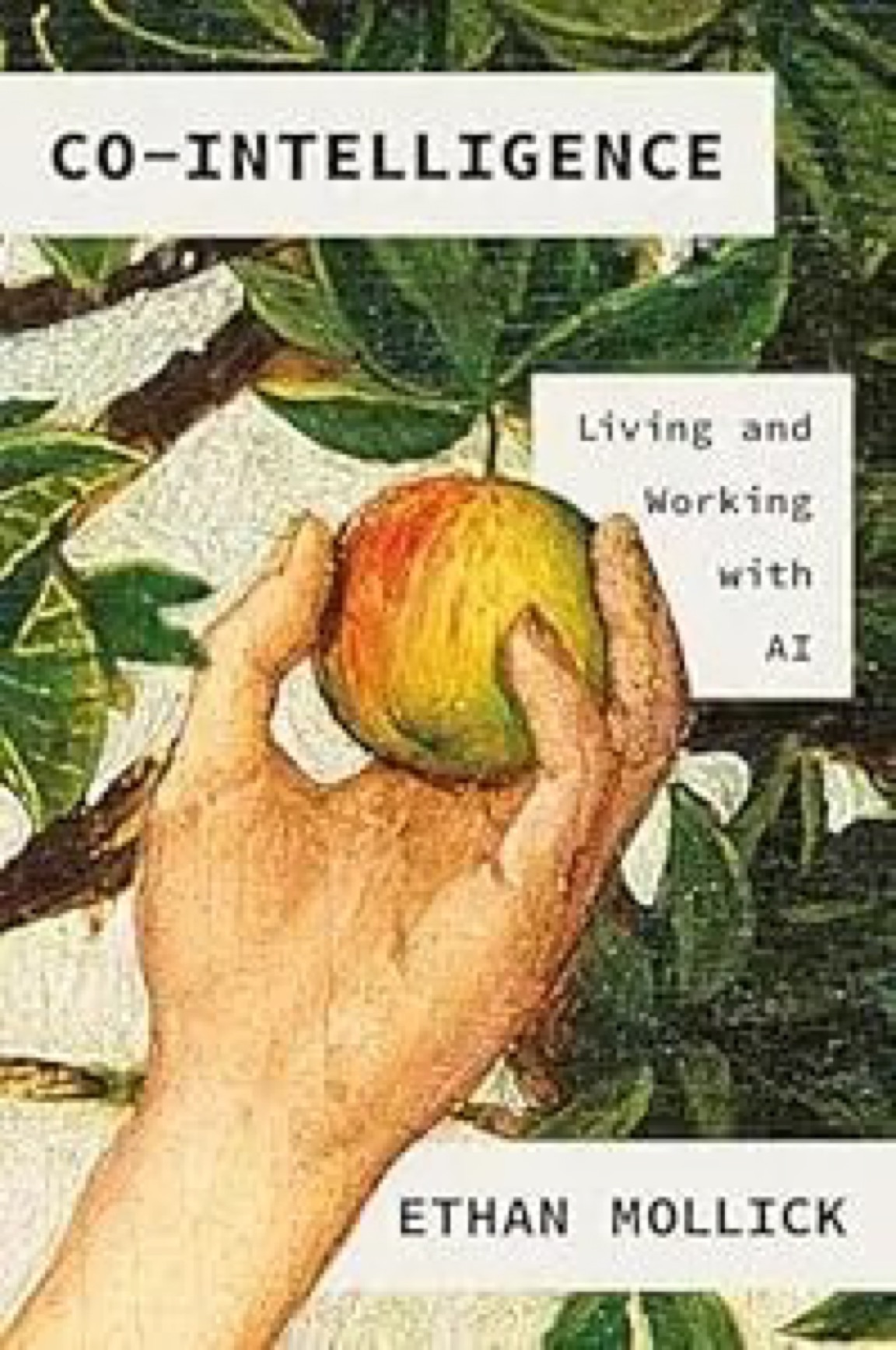
Co-Intelligence: Living and Working with AI
Applying the lessons from "Co-Intelligence: Living and Working with AI" by Ethan Mollick to your life can be a transformative step toward future-proofing your career and expanding your cognitive reach. Here are some ways you might integrate these lessons:
- Embrace Constant Experimentation: - You should treat AI like a new set of flight controls; you cannot understand its nuances by reading a manual alone. By using AI for daily tasks—from drafting emails to brainstorming business strategies—you build the "muscle memory" required to navigate the "jagged frontier" of its capabilities.
- Leverage the Leveling Effect: - As an entrepreneur, recognize that AI can elevate the performance of your junior staff more than your senior experts. Use this to your advantage by automating routine cognitive tasks, allowing your team to focus on the high-level, empathetic, and strategic aspects of healthcare and business that machines cannot replicate.
- Maintain the "Human-in-the-Loop" for High-Stakes Decisions: - In medicine and law, AI can be a powerful diagnostic and research partner, but you must remain the final authority. Use AI to generate a wide range of possibilities or to check for blind spots, but always apply your professional judgment to verify its outputs and ensure ethical compliance.
- Adopt a "Cyborg" Leadership Style: - Move beyond simply delegating to AI and start integrating it into your thought process. This means using AI as a cognitive exoskeleton to expand your capacity for complex problem-solving, whether you are managing a VC fund or navigating the intricacies of a new legal case.
- Cultivate Intellectual Humility and Hunger: - True to your mantra, stay hungry to learn how AI is shifting your industries while staying humble enough to realize that your current expertise may need to be reinvented. AI is a "co-intelligence" that challenges you to find new ways to add value as a human leader.
- Enhance Personal Growth Through Simulation: - Use AI as a low-stakes training ground for your personal and professional development. Whether you are practicing a difficult conversation with a colleague or exploring a new area of study, AI can act as a sophisticated sparring partner that prepares you for real-world interactions.
By integrating these lessons, you position yourself as a "Cyborg" leader who views technology not as a threat, but as a cognitive exoskeleton. This approach ensures you remain at the forefront of your various disciplines—medicine, law, and business—by leveraging the speed of AI while maintaining the discernment and "Stay Hungry, Stay Humble" mindset that defines true leadership.
What the book covers
"Co-Intelligence: Living and Working with AI" by Ethan Mollick is a seminal exploration of the symbiotic relationship between humans and Large Language Models (LLMs). Mollick, a professor at the Wharton School, argues that AI should not be viewed as a mere tool but as a co-intelligence that requires active partnership. The book provides a practical and philosophical framework for navigating the rapidly evolving landscape of generative AI, emphasizing that the best results come from those who learn to work alongside these systems rather than against them.
Summary:
- The Concept of Co-Intelligence: - Mollick introduces the radical idea that we should treat AI not as a traditional software tool but as a partner or "co-intelligence." He argues that because LLMs are trained on the sum of human knowledge, they possess a social and conversational intelligence that requires a shift from "using" technology to "working with" an entity.
- Navigating the Jagged Frontier: - The author defines the "jagged frontier" as the unpredictable boundary of what AI can and cannot do. Some tasks that seem hard for humans are easy for AI, while simple human tasks can baffle it; Mollick insists that the only way to find this frontier is through constant, hands-on experimentation.
- Centaur and Cyborg Workflows: - Mollick categorizes the two primary ways humans integrate with AI: "Centaurs" maintain a clear division of labor, switching between human and machine tasks, while "Cyborgs" completely integrate AI into their creative process. He suggests that becoming a Cyborg allows for a more seamless flow, though it requires a deeper level of trust and technical fluency.
- The Four Essential Rules for AI Interaction: - The book provides four practical rules: Always use AI (even for things you think it can’t do), be the human in the loop to prevent errors, treat AI like a person (but don't trust it), and realize this is the worst AI you will ever use. These principles are designed to help users remain adaptable as the technology rapidly evolves.
- AI as a Creative Catalyst: - Mollick describes AI's ability to act as a tireless brainstorming partner that can help overcome the "blank page" syndrome. By generating hundreds of ideas in seconds, AI allows the human to shift their role from a primary creator to a curator and editor, focusing on high-level vision and refinement.
- The Democratization of Expertise: - A key argument in the book is that AI acts as a "leveler," providing a greater performance boost to lower-skilled workers than to high-performers. This shift challenges traditional notions of professional value and suggests that future competitive advantages will come from unique human insights rather than basic technical proficiency.
- Revolutionizing Education and Training: - Mollick, an educator, explores how AI makes traditional homework and testing obsolete. He advocates for a new model where AI acts as a personalized tutor for students, forcing a move toward "flipped classrooms" where the focus is on the application of knowledge rather than just its acquisition.
- Managing Hallucinations and Risks: - The book warns about the dangers of "automated complacency," where humans trust AI outputs too much. Mollick emphasizes the necessity of maintaining "meaningful human control" to catch hallucinations—errors where the AI confidently asserts false information—which is critical in fields like medicine and law.
Mollick concludes that we are at an inflection point where our willingness to adapt will define our future success. "Co-Intelligence" serves as both a roadmap and a call to action for anyone seeking to thrive in a world where the line between human and machine intelligence is increasingly blurred.