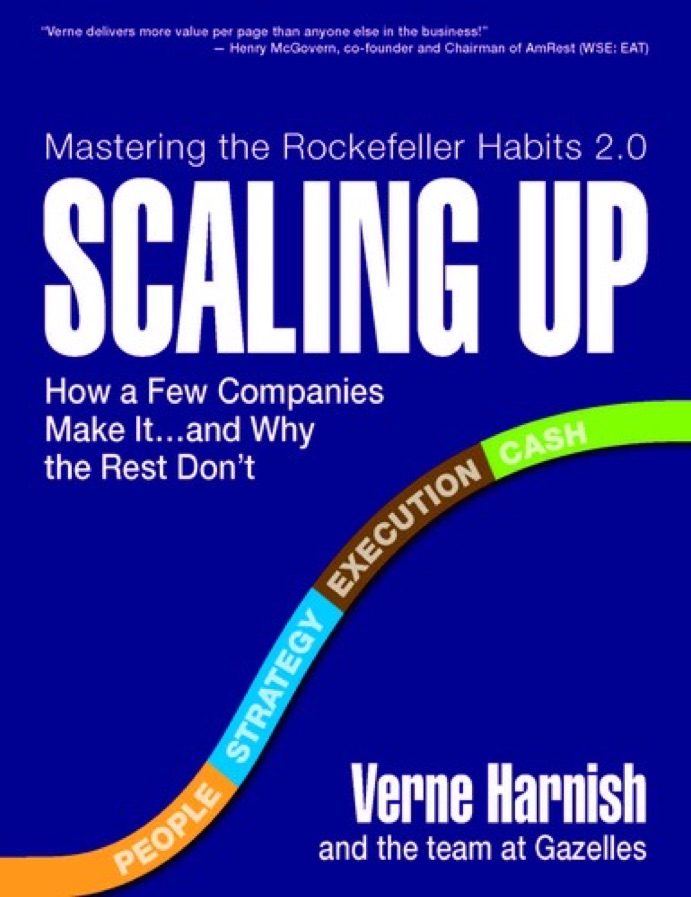
Scaling Up: How a Few Companies Make It... and Why the Rest Don't (Rockefeller Habits 2.0)
Applying the lessons from "Scaling Up: How a Few Companies Make It... and Why the Rest Don't (Rockefeller Habits 2.0)" by Verne Harnish to your life can be the catalyst for moving from a state of constant firefighting to one of strategic excellence. Here are some ways you might integrate these lessons:
- Adopt a High-Performance Talent Mindset: - Whether you are leading a multi-specialty medical practice, a law firm, or a venture capital group, you must treat recruitment and retention as your primary strategic advantage. You should focus on "Topgrading" your team, ensuring that every role is filled by someone who not only possesses the technical proficiency—be it clinical expertise or financial acumen—but also fits your core organizational values.
- Identify Your Professional BHAG: - As a lifelong learner and serial entrepreneur, you should define a Big Hairy Audacious Goal that spans the next decade. This vision should be so clear that it dictates your daily priorities, helping you filter out high-distraction opportunities and focus your energy on the initiatives that will truly move the needle in healthcare delivery or technology.
- Implement a Rigorous Meeting Rhythm: - Much like a pilot’s pre-flight checklist or an emergency department hand-off, you can integrate a disciplined "rhythm of execution" into your various ventures. By instituting brief, daily huddles and weekly tactical meetings, you create a pulse for your organizations that ensures alignment and allows you to pivot quickly when market conditions or regulations change.
- Optimize Your Cash Conversion Cycle: - In the world of healthcare startups and venture capital, cash is the oxygen that permits innovation. You should look for ways to shorten your cash conversion cycle—minimizing the time between spending a dollar on R&D or marketing and receiving that dollar back from a customer—thereby increasing your ability to self-fund growth and maintain control.
- Simplify Your Strategic Communication: - Use the "One-Page" philosophy to streamline your communication with stakeholders, from board members to frontline staff. By boiling down complex legal, medical, or business strategies into a single, accessible document, you ensure that everyone is operating from the same playbook and that your mission remains humble and focused.
- Prioritize "The Main Thing": - Avoid the trap of initiative overload by identifying the single most important priority for each of your roles. Whether you are in the cockpit, the boardroom, or the clinic, keeping "the Main Thing the Main Thing" prevents the fragmentation of your attention and ensures that you are always moving toward your most significant objectives.
By integrating these lessons, you can transform your diverse portfolio of interests into a cohesive, high-output ecosystem. Embracing the discipline of scaling allows you to amplify your impact on the world while maintaining the mental space to continue your journey as a pilot, attorney, and student of life.
What the book covers
"Scaling Up: How a Few Companies Make It... and Why the Rest Don't (Rockefeller Habits 2.0)" by Verne Harnish is a definitive guide for entrepreneurs and executives looking to navigate the complexities of organizational growth. As an evolution of Harnish’s seminal work, "Mastering the Rockefeller Habits," this book provides an updated, comprehensive framework known as the "Four Decisions" methodology. It is designed to help mid-market companies transition from small-scale operations to industry leaders by focusing on the core pillars of People, Strategy, Execution, and Cash. Through practical tools and actionable insights, Harnish offers a roadmap for scaling a business while reducing the friction and chaos often associated with rapid expansion.
Summary:
- The Four Decisions Framework: - Harnish posits that every successful scale-up must master four critical areas: People, Strategy, Execution, and Cash. If any of these pillars are weak, growth becomes unsustainable or leads to organizational burnout. The book provides a series of checklists and tools, such as the One-Page Strategic Plan (OPSP), to help leadership teams align their efforts and ensure that every stakeholder is moving in the same direction.
- People: Attracting and Keeping the Right Talent: - This decision focuses on the human element, emphasizing that a company is only as good as its team. Harnish introduces the concept of "Topgrading" to ensure that the "right people are in the right seats" doing the right things with enthusiasm. He argues that leaders must define their core values and purpose clearly to attract high-performers who fit the culture and to proactively manage those who do not.
- Strategy: Creating a Sustainable Competitive Advantage: - Scaling requires a differentiated strategy that is easy to explain but difficult for competitors to mimic. Harnish encourages companies to identify their "Big Hairy Audacious Goal" (BHAG) and use the "7 Strata of Strategy" to dominate their specific niche. The goal is to move beyond mere incremental growth and establish a unique position in the marketplace that drives long-term value and high margins.
- Execution: The Power of Routine and Habit: - To scale effectively, a company must translate its strategy into daily habits. This section details the importance of establishing a meeting rhythm—daily, weekly, monthly, and quarterly—to ensure clear communication. By identifying key performance indicators (KPIs) and ensuring every employee has a single "priority" for the day, a culture of accountability and transparency is created where roadblocks are identified and cleared early.
- Cash: Accelerating the Growth Engine: - Growth requires capital, and Harnish warns that many companies fail because they run out of liquidity while expanding. He introduces the "Cash Conversion Cycle" (CCC) and the "Power of One," tools designed to help leaders improve their cash position by making small, incremental changes to pricing, volume, and expenses. The focus is on generating internal capital to fuel growth without relying solely on outside debt or equity.
- The One-Page Strategic Plan (OPSP): - Central to the book's methodology is the OPSP, a document that distills the entire business strategy onto a single sheet of paper. This tool is designed to eliminate complexity and ensure that every person in the organization understands the vision, the goals, and their specific role in achieving them. It serves as a living document that guides decision-making and keeps the team focused on the "Main Thing."
"Scaling Up" is significant because it provides a repeatable system for management that bridges the gap between a startup's agility and a large corporation's discipline. By focusing on repeatable processes and clear alignment, Harnish empowers leaders to grow their companies with confidence, clarity, and sustainable profitability.