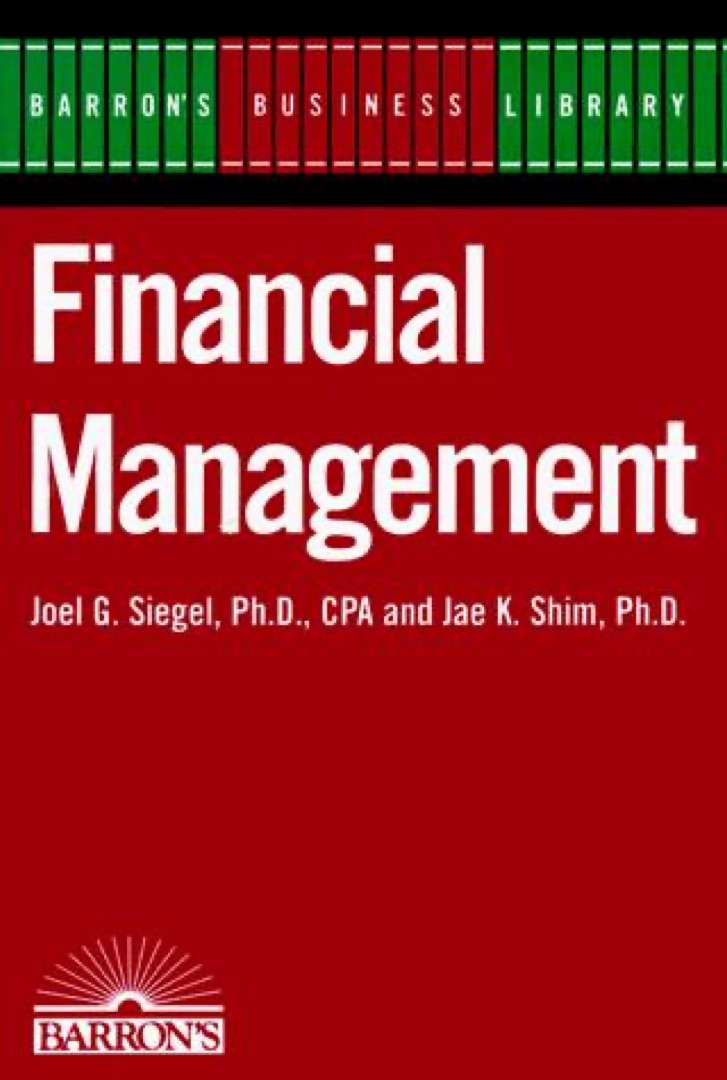
Financial Management
Applying the lessons from "Financial Management" by Jae K. Shim and Joel G. Siegel to your life can be the difference between operating on intuition and leading with calculated precision. Here are some ways you might integrate these lessons:
- Develop a Diagnostic Mindset for Business: - Just as you would use a series of tests to diagnose a patient in the emergency room, you should use financial ratios to diagnose the health of your companies. Regularly reviewing your liquidity and solvency ratios ensures that your ventures can weather economic storms and that you are never blindsided by a lack of resources when you need to pivot.
- Objectively Evaluate Every Opportunity: - Whether you are considering a new venture at your VC firm or a personal investment, use capital budgeting tools like Net Present Value to quantify expected cash flows. By discounting these for risk, you can make dispassionate decisions about where to spend your most valuable resources, preventing the "sunk cost fallacy" from clouding your professional judgment.
- Manage Your Personal and Professional Risk Profile: - Understand the relationship between risk and return in all your pursuits, from the cockpit of a plane to the courtroom. Recognize that while high-risk ventures offer potential for high rewards, they require a higher rate of return to be viable, and use diversification to ensure a failure in one area of your portfolio doesn't jeopardize your overall security.
- Optimize Your Capital Structure for Growth: - Evaluate how you fund your expansion, balancing the benefits of debt with the security of equity to maintain a low cost of capital. As an attorney and MBA, you can appreciate the legal and financial implications of different funding sources, ensuring you stay "hungry and humble" while maintaining the flexibility needed to scale.
- Master the Flow of Operational Capital: - Pay obsessive attention to your working capital, particularly in the fast-paced worlds of urgent care and telehealth where cash flow is king. You must ensure that your cash conversion cycle is optimized so that your business remains liquid and agile, ready to capitalize on new opportunities the moment they arise.
- Commit to Lifelong Financial Literacy: - Treat financial management as a dynamic, continuous learning process rather than a static skill set. This intellectual humility allows you to adapt your strategies as the healthcare and venture capital landscapes shift, ensuring your leadership remains relevant and your organizations remain robust.
By integrating these lessons, you move beyond the role of a practitioner or a manager and become a true architect of value. Financial mastery provides the structural integrity required to build a lasting legacy across multiple industries, ensuring that your hunger for innovation is always matched by the stability of your foundations.
What the book covers
"Financial Management" by Jae K. Shim and Joel G. Siegel is a foundational text designed to demystify complex financial concepts for managers, entrepreneurs, and business students. The book provides a rigorous yet accessible framework for understanding how capital is raised, allocated, and managed to create organizational value. It moves beyond simple accounting to offer a strategic perspective on financial health, making it an essential tool for leaders who must navigate complex economic landscapes with precision and foresight.
Summary:
- Financial Analysis and Performance Metrics: - The authors emphasize financial statement analysis as the diagnostic foundation for any business, detailing how to use liquidity, activity, and profitability ratios. By mastering these metrics, a leader can identify "red flags" in a balance sheet or income statement before they become systemic failures, allowing for proactive rather than reactive management.
- Valuation and the Time Value of Money: - A core tenet of the book is that a dollar today is worth more than a dollar tomorrow, providing the mathematical foundations of present value, future value, and annuities. This section provides the groundwork for evaluating everything from personal retirement accounts to the valuation of a multi-million dollar medical practice acquisition or venture capital investment.
- Capital Budgeting and Decision Models: - The text outlines methodologies used to evaluate long-term investment projects, such as Net Present Value (NPV) and Internal Rate of Return (IRR). These models allow managers to objectively compare competing projects and choose those that provide the highest return relative to their cost, reducing reliance on intuition in favor of data-driven strategic planning.
- Risk, Return, and Portfolio Theory: - Shim and Siegel dive into the trade-off between risk and reward, utilizing the Capital Asset Pricing Model (CAPM) to explain how market risk influences the required rate of return. They argue that understanding the variance of returns is essential for managing a diversified portfolio of assets, ensuring that the potential upside of a new venture justifies the professional and financial exposure.
- Cost of Capital and Capital Structure: - This section explores how firms determine their Weighted Average Cost of Capital (WACC) and the optimal mix of debt and equity financing. The authors explain how different financing structures impact a firm's overall risk profile and its attractiveness to investors, teaching leaders how to leverage debt responsibly while maintaining long-term stability.
- Working Capital and Short-Term Financing: - The authors stress the importance of managing current assets and liabilities, such as inventory and accounts receivable, to ensure daily operational continuity. For healthcare providers and entrepreneurs, this is the "oxygen" of the business that prevents sudden insolvency despite a company being profitable on a long-term paper basis.
- Dividend Policy and Corporate Growth: - The book addresses how companies should distribute earnings back to shareholders versus reinvesting them for growth, which involves a delicate balance between immediate value and future expansion. It provides a strategic lens through which to view the lifecycle of a company and its ongoing commitment to its various stakeholders.
This work is significant because it democratizes the tools of corporate finance, making them available to non-specialists and transforming financial data into a forward-looking strategic asset. For any leader, "Financial Management" provides the quantitative literacy necessary to bridge the gap between visionary entrepreneurship and sustainable execution.