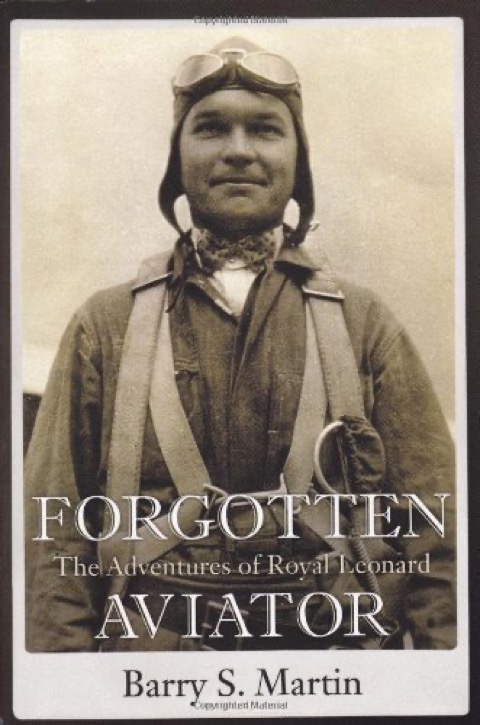
Forgotten Aviator: The Adventures of Royal Leonard: Mail Pilot, Racer, China Aviator
Applying the lessons from "Forgotten Aviator: The Adventures of Royal Leonard: Mail Pilot, Racer, China Aviator" by Barry S. Martin to your life can be a profound catalyst for embracing high-stakes leadership and maintaining a spirit of relentless curiosity. Here are some ways you might integrate these lessons:
-
Cultivate Mastery Under Pressure: - Leonard’s ability to navigate the "Hell Stretch" of the air mail routes was not based on luck, but on a deep, technical understanding of his aircraft and the environment. In your professional life—whether in the ER or the boardroom—you must develop a level of mastery that allows your intuition to take over when the margin for error disappears.
-
Embrace the Role of the "Silent Architect": - Much of Leonard’s greatest work was done behind the scenes, ensuring the safety of world leaders and the success of international logistics without seeking the spotlight. You can find immense value and legacy by focusing on the impact of your work rather than the public recognition it brings, embodying the "Stay Humble" mantra.
-
Pivot Toward Global Opportunities: - When Leonard moved to China, he stepped into a completely foreign cultural and political landscape, yet he flourished by applying his core competencies to new problems. You should remain open to "lateral leaps" in your career, where your specialized skills can solve unique problems in entirely different industries or geographic regions.
-
Build Trust Through Reliability: - Leonard became the Generalissimo’s personal pilot because he was unfailingly reliable in life-or-death situations. In entrepreneurship and medicine, your "reliability quotient" is your most valuable currency; people will follow you into the most difficult circumstances if you have proven that you can deliver results consistently.
-
Balance Risk with Preparation: - As a racer and a wartime pilot, Leonard took massive risks, but they were always calculated and backed by rigorous preparation. You should approach your ventures with the same mindset: recognize that while risk is inherent to growth, the difference between a pioneer and a casualty is often the depth of your pre-flight checklist.
-
Adapt to Evolving Technology: - Leonard saw the transition from wood-and-fabric biplanes to pressurized metal transports and mastered each. To stay relevant in a fast-changing world, you must remain a lifelong learner, constantly updating your "mental software" to keep pace with technological and structural shifts in your field.
By integrating these lessons, you can emulate Royal Leonard’s rare combination of daring and discipline, ensuring that you not only reach the heights of your chosen profession but also provide the steady hand necessary to lead others through times of turbulent change.
What the book covers
"Forgotten Aviator: The Adventures of Royal Leonard: Mail Pilot, Racer, China Aviator" by Barry S. Martin is a comprehensive restoration of the life and legacy of one of the Golden Age of Aviation’s most significant yet overlooked figures. The book meticulously reconstructs the career of Royal Leonard, tracing his progression from the dangerous early days of the U.S. Air Mail Service to his high-stakes role as the personal pilot for Generalissimo Chiang Kai-shek. Martin utilizes Leonard’s personal logs, letters, and historical records to paint a portrait of a man whose technical skill and quiet courage placed him at the epicenter of global conflict and aviation innovation.
Summary:
-
The Crucible of the Air Mail Service: - The narrative begins with Leonard’s entry into the burgeoning world of aviation, specifically the hazardous task of flying mail across the United States. During this era, pilots flew open-cockpit biplanes with primitive instruments, often through treacherous weather that claimed the lives of many of his peers. - These formative years established Leonard’s reputation for preternatural navigational skills and mechanical intuition. Martin illustrates how these early experiences in the "Hell Stretch" of the air mail routes developed the resilience and technical adaptability that would define Leonard’s later career in international theater.
-
The High-Stakes World of Air Racing: - Leonard emerged as a prominent figure in the 1930s air racing circuit, a period when aviation was the ultimate spectator sport and a primary driver of aerodynamic innovation. He competed against legendary figures and participated in the Bendix Trophy races, pushing airframes to their absolute limits. - This section explores the intersection of celebrity and engineering, showing how Leonard’s participation in racing wasn't merely for glory but served as a testing ground for the long-range flight technologies that would soon become essential for transcontinental travel and military operations.
-
Transition to Commercial Pioneer at TWA: - As aviation moved from barnstorming to a structured industry, Leonard became a key pilot for Western Air Express and later Transcontinental & Western Air (TWA). He played a vital role in establishing the safety protocols and flight paths that would standardize commercial air travel. - Martin details how Leonard worked alongside aviation giants like Charles Lindbergh and Jack Frye to prove the viability of passenger service. His work during this period helped transition the public perception of flying from a death-defying stunt to a reliable mode of transportation.
-
The Call to China and the Soong Connection: - The book takes a dramatic turn when Leonard is recruited to fly for the Chinese government in the mid-1930s. He became the personal pilot for Chiang Kai-shek and his wife, Soong Mei-ling, placing him inside the inner circle of the Kuomintang leadership during the Japanese invasion. - Leonard served as more than just a pilot; he was a trusted advisor on aviation infrastructure. He witnessed the complexities of Chinese politics and the early stages of the Second Sino-Japanese War, often flying dangerous missions to transport high-ranking officials through active combat zones.
-
Aviation Diplomacy and Wartime Operations: - During the war, Leonard was instrumental in organizing the Chinese Air Force and maintaining logistics under extreme pressure. He was involved in the harrowing evacuations as Japanese forces advanced, often flying the Generalissimo to safety just as cities were falling. - Martin highlights Leonard's role in the precursor to the "Flying Tigers" and his efforts to secure American support for China's defense. His unique position allowed him to provide Western intelligence and military leaders with invaluable insights into the capabilities and challenges of the Chinese resistance.
-
The Legacy of the Hump and Beyond: - The final chapters cover Leonard’s involvement in the logistical miracle of flying over "The Hump"—the dangerous Himalayan air route. His expertise in high-altitude, long-distance flight was critical in ensuring that supplies reached the interior of China when all other routes were blocked. - Despite his massive contributions to both American commercial aviation and the Allied war effort in the Pacific, Leonard largely avoided the limelight. Martin concludes by analyzing why such a pivotal figure was nearly lost to history, emphasizing Leonard’s preference for professional excellence over personal fame.
"Forgotten Aviator" serves as a vital historical correction, offering a detailed look at the evolution of flight through the eyes of a man who lived its most dangerous and transformative moments. It is an essential read for understanding the geopolitical importance of aviation and the silent heroes who shaped the modern world.