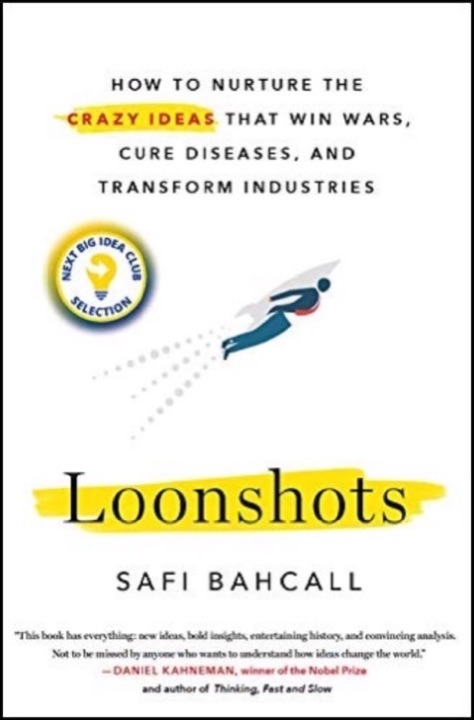
Loonshots: How to Nurture the Crazy Ideas That Win Wars, Cure Disease, and Transform Industries
Applying the lessons from "Loonshots" by Safi Bahcall to your life can be a transformative process, especially given your diverse experiences and interests. Here are some ways you might integrate these concepts:
-
Embrace Loonshots in Your Personal and Professional Life: - Identify and nurture your own "loonshots," whether they are innovative ideas in your medical practice, new hobbies, or personal projects. Given your interest in CRISPR and its potential, consider how you might support or engage with cutting-edge research or initiatives in this field.
-
Balance Loonshots and Franchises: - In your career and personal life, strive to balance radical, innovative ideas (loonshots) with more stable, incremental improvements (franchises). This might involve pursuing new medical techniques or technologies while maintaining the core practices that have proven effective.
-
Create a Supportive Environment: - Foster an environment that encourages experimentation and tolerates failure, both in your professional setting and personal life. This could mean mentoring younger colleagues or family members to explore their ideas without fear of failure.
-
Leverage Your Leadership Skills: - Use your leadership skills to protect and nurture loonshots within your sphere of influence. As someone who values kindness and empathy, you can create a safe space for others to share and develop their unconventional ideas.
-
Structure Over Culture: - Focus on creating structures that support innovation. This might involve setting up systems or routines that allow you to explore new ideas, such as dedicating time each week to learning about new technologies or medical advancements.
-
Embrace Failure as a Learning Opportunity: - Given your resilience and humor, continue to view failures as opportunities for growth. Encourage this mindset in others around you, reinforcing the idea that setbacks are part of the journey toward success.
-
Dynamic Balance in Life: - Maintain a dynamic balance between your various interests and responsibilities. This could involve setting aside time for your hobbies, such as flying and cooking, while also pursuing new challenges like skydiving.
-
Support Both P-Type and S-Type Loonshots: - Recognize and support both product and strategy loonshots in your life. For example, explore new medical technologies (P-Type) while also considering innovative approaches to healthcare delivery or patient interaction (S-Type).
-
Reflect on Your Experiences: - Use your past experiences, such as surviving plane crashes and your medical career, to inform your approach to nurturing loonshots. Your ability to remain calm and composed in stressful situations can be a valuable asset in managing innovative projects.
-
Incorporate Lessons into Advocacy and Activism:
- Apply the principles of nurturing loonshots to your advocacy work, whether it's related to domestic abuse, anti-human trafficking, or equality. Encourage innovative solutions and strategies within these fields.
By integrating these lessons into your life, you can continue to foster an environment where radical ideas can flourish, ultimately contributing to personal growth and societal advancement.
What the book covers
"Loonshots: How to Nurture the Crazy Ideas That Win Wars, Cure Disease, and Transform Industries" by Safi Bahcall is a compelling exploration of how groundbreaking innovations, or "loonshots," can be cultivated and harnessed to drive significant advancements in various fields. Bahcall, a physicist and entrepreneur, uses his scientific background to analyze the dynamics of innovation and organizational behavior, drawing parallels between the behavior of molecules and the behavior of teams and companies.
Summary:
Introduction:
Bahcall introduces the concept of "loonshots," which are radical ideas that initially seem crazy but have the potential to transform industries, win wars, or cure diseases. He contrasts loonshots with "franchise" ideas, which are more incremental improvements on existing products or services.
Key Concepts:
-
Phase Transitions: Bahcall uses the analogy of phase transitions in physics (e.g., water freezing into ice) to explain how small changes in structure or environment can lead to significant changes in behavior. He suggests that organizations can undergo similar transitions that affect their ability to innovate.
-
Two Types of Loonshots: - P-Type (Product) Loonshots: These are innovations in products or technologies. - S-Type (Strategy) Loonshots: These involve changes in business strategies or models.
-
The Bush-Vail Model: Bahcall discusses the historical example of Vannevar Bush and Theodore Vail, who successfully managed loonshots in their respective fields (military technology and telecommunications). He emphasizes the importance of separating the phases of nurturing loonshots and executing franchises.
-
The Loonshot Pipeline: Bahcall outlines the process of nurturing loonshots, which involves creating a balanced ecosystem where both loonshots and franchises can coexist and thrive. This includes fostering a culture that encourages experimentation and tolerates failure.
-
The Role of Leadership: Effective leaders, according to Bahcall, are those who can manage the delicate balance between loonshots and franchises. They must protect loonshots from premature criticism and allocate resources wisely to support both types of innovation.
Case Studies:
Bahcall provides numerous historical and contemporary examples to illustrate his points, including: - The development of radar technology during World War II. - The rise of Bell Labs as a hub of innovation. - The success of companies like Apple and Amazon in balancing loonshots and franchises.
Key Takeaways and Lessons:
-
Structure Matters More Than Culture: Bahcall argues that the structure of an organization is more critical than its culture in determining its ability to innovate. By adjusting structural elements, organizations can better support loonshots.
-
Separate Phases: Successful organizations separate the phases of nurturing loonshots from executing franchises. This separation allows for the protection and development of radical ideas without disrupting ongoing operations.
-
Embrace Failure: Innovation requires a tolerance for failure. Organizations should create environments where experimentation is encouraged, and failures are seen as learning opportunities.
-
Dynamic Balance: Leaders must maintain a dynamic balance between loonshots and franchises, ensuring that neither is neglected. This balance is crucial for long-term success and adaptability.
-
Nurture Both P-Type and S-Type Loonshots: Organizations should recognize and support both product and strategy loonshots, as both are essential for transformative innovation.
In conclusion, "Loonshots" provides a framework for understanding and managing innovation within organizations. By drawing on principles from physics and real-world examples, Bahcall offers actionable insights for leaders seeking to foster environments where radical ideas can flourish and drive significant change.