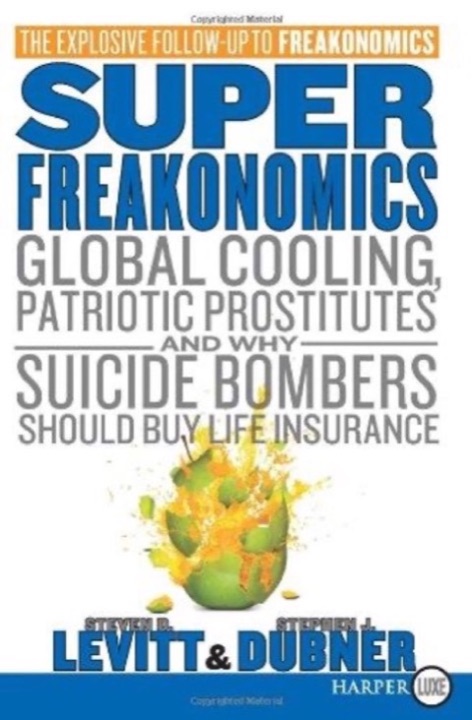
SuperFreakonomics: Global Cooling, Patriotic Prostitutes, and Why Suicide Bombers Should Buy Life Insurance
Applying the lessons from "SuperFreakonomics" to your life involves embracing unconventional thinking, leveraging data-driven insights, and understanding the power of incentives. Here’s how you might incorporate these lessons:
-
Embrace Unconventional Solutions: - Given your interest in technology and societal betterment, consider exploring innovative solutions to problems you care about, such as inequality or health issues. This could involve supporting or investing in unconventional technologies or approaches that challenge the status quo.
-
Data-Driven Decision Making: - Use your analytical skills and experience to make informed decisions in your personal and professional life. Whether it's optimizing your daily routine or making investment choices, rely on empirical evidence and data analysis to guide your actions.
-
Understand and Leverage Incentives: - Recognize the role of incentives in shaping behavior, both in your personal interactions and in broader societal contexts. Use this understanding to motivate yourself and others, whether it's encouraging healthy habits in your family or advocating for social change.
-
Consider Unintended Consequences: - When making decisions, especially those that impact others, think about potential unintended consequences. This awareness can help you design more effective strategies and avoid negative outcomes in your advocacy work or personal life.
-
Complexity of Human Behavior: - Appreciate the complexity of human behavior and avoid oversimplifying issues. This perspective can enhance your empathy and kindness, core values that guide your interactions and relationships.
-
Challenge Assumptions: - Continuously question assumptions and conventional wisdom, both in your personal beliefs and in societal norms. This mindset aligns with your philosophy of being a lifelong learner and can lead to personal growth and innovation.
By integrating these lessons into your life, you can continue to approach challenges with resilience and creativity, while staying true to your values of kindness and empathy.
What the book covers
"SuperFreakonomics: Global Cooling, Patriotic Prostitutes, and Why Suicide Bombers Should Buy Life Insurance" is the sequel to the bestselling book "Freakonomics" by economist Steven Levitt and journalist Stephen Dubner. Like its predecessor, "SuperFreakonomics" explores a range of unconventional topics through the lens of economics, using data and analysis to uncover surprising insights about human behavior and societal trends.
Summary:
-
Global Cooling and Geoengineering: - The book opens with a discussion on climate change, focusing on geoengineering as a potential solution to global warming. The authors explore various unconventional methods, such as injecting sulfur dioxide into the stratosphere to reflect sunlight away from Earth. They argue that these solutions could be more cost-effective and immediate compared to reducing carbon emissions.
-
Patriotic Prostitutes: - Levitt and Dubner delve into the economics of prostitution, examining how market forces and incentives shape the industry. They highlight the story of a high-end escort who uses data analysis to optimize her business. The authors also discuss how the demand for prostitution fluctuates with events like political conventions, illustrating the intersection of economics and human behavior.
-
Why Suicide Bombers Should Buy Life Insurance: - This chapter explores the paradox of why certain individuals, like suicide bombers, might be denied life insurance. The authors use this example to discuss how insurance companies assess risk and the broader implications of profiling and risk management in various industries.
-
Monkey Business: - The authors conduct experiments with capuchin monkeys to understand the origins of economic behavior. By introducing a currency system to the monkeys, they observe how the primates exhibit human-like traits such as risk aversion and irrational decision-making, providing insights into the evolutionary roots of economic behavior.
-
Unintended Consequences: - Levitt and Dubner explore how well-intentioned policies can lead to unexpected outcomes. They discuss examples like the introduction of child car seats and the effects of incentives on human behavior, emphasizing the complexity of predicting the outcomes of policy decisions.
-
Altruism and Incentives: - The book examines the role of incentives in driving altruistic behavior. The authors argue that people are motivated by a mix of self-interest and altruism, and they explore how different incentives can influence actions in areas like organ donation and charitable giving.
Key Takeaways and Lessons:
-
Unconventional Solutions: The book encourages readers to think outside the box and consider unconventional solutions to complex problems, such as geoengineering for climate change.
-
Data-Driven Insights: Levitt and Dubner emphasize the importance of using data and empirical evidence to understand human behavior and societal trends, challenging conventional wisdom.
-
Incentives Matter: A recurring theme is the power of incentives in shaping behavior. The authors illustrate how incentives can lead to both positive and negative outcomes, highlighting the need for careful design of policies and interventions.
-
Complexity of Human Behavior: The book underscores the complexity and unpredictability of human behavior, suggesting that simple explanations are often insufficient to capture the nuances of economic and social phenomena.
-
Unintended Consequences: Policymakers and individuals should be aware of the potential for unintended consequences when implementing new policies or making decisions, as these can sometimes counteract the intended benefits.
Overall, "SuperFreakonomics" challenges readers to question assumptions, embrace data-driven analysis, and consider the broader implications of incentives and human behavior in shaping the world around us.