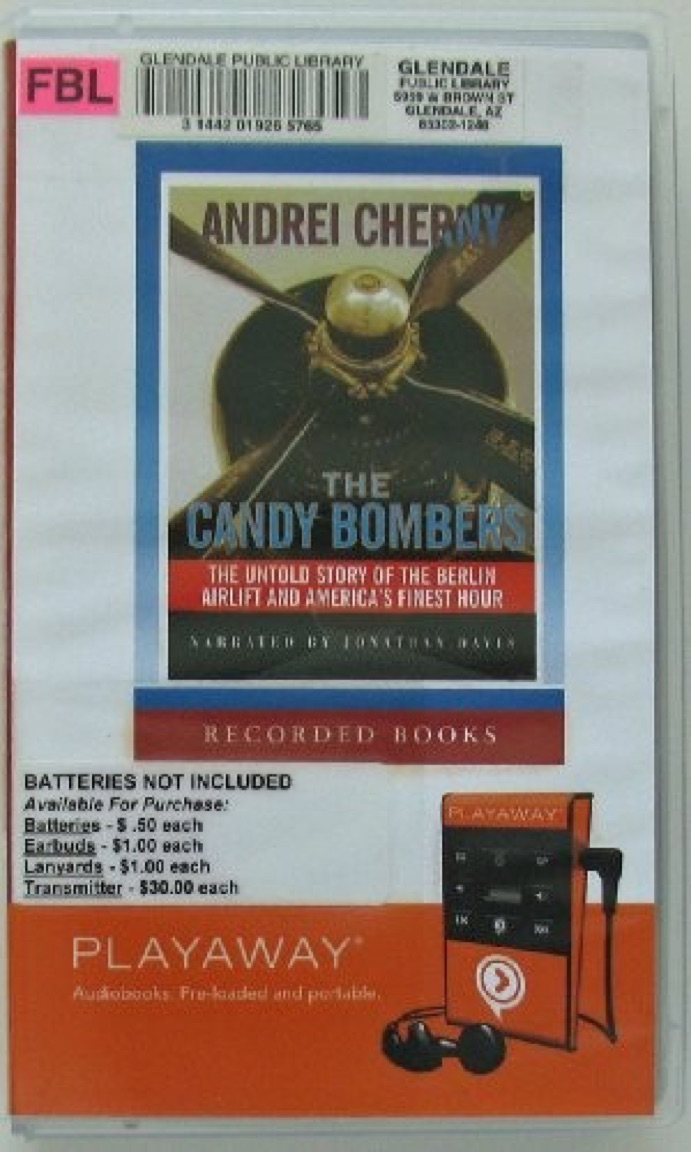
The Candy Bombers: The Untold Story of the Berlin Airlift and America's Finest Hour
Applying the lessons from "The Candy Bombers" by Andrei Cherny to your life can be a powerful way to rethink the relationship between operational excellence and human impact. Here are some ways you might integrate these lessons:
-
Operationalize Your Empathy: - In both medicine and business, high-level logistics must never lose sight of the individual human experience. Just as Gail Halvorsen’s candy drops humanized a massive military operation, you should look for "small wins" and personal gestures that can make complex systems—like a large healthcare organization or a VC firm—feel accessible and compassionate to those they serve.
-
Master the Conveyor Belt of Productivity: - General Tunner’s success came from turning a crisis into a repeatable, optimized process. Whether you are managing an emergency department or scaling a startup, you should strive to eliminate bottlenecks and standardize high-frequency tasks so that your team can maintain peak performance under sustained pressure without burning out.
-
Lead with Moral Clarity in Ambiguity: - Truman’s refusal to abandon Berlin despite the logistical impossibilities serves as a reminder to lead from your "North Star." When faced with high-stakes decisions in law or entrepreneurship, identify the non-negotiable moral outcome first, then challenge your team to build the operational framework necessary to make that outcome a reality.
-
Turn Former Adversaries into Partners: - The transformation of Berliners from enemies to allies highlights the power of shared goals. In the business world, look for ways to align interests with competitors or skeptics through transparency and mutual benefit, proving through your actions that a partnership with you is more valuable than opposition.
-
Leverage the Power of the Narrative: - The airlift was as much a battle of stories as it was of supplies. As a leader and author, you must understand that how a mission is perceived is often as important as the mission itself; ensure that your "why" is communicated clearly enough to inspire both your internal team and the external public.
-
Innovate Within Scarcity: - The pilots of the airlift succeeded despite having old planes and crumbling runways. You should view constraints not as barriers, but as the primary drivers of innovation, forcing you to find more efficient ways to deploy capital, medical resources, or legal strategies.
By integrating these lessons from the Berlin Airlift, you can refine your approach to leadership by balancing the cold hard facts of logistics with the warm reality of human need. This synthesis of head and heart is what allows a leader to navigate the most difficult blockades and emerge not just successful, but respected.
What the book covers
"The Candy Bombers: The Untold Story of the Berlin Airlift and America’s Finest Hour" by Andrei Cherny is a sweeping narrative that details the first major confrontation of the Cold War and the remarkable humanitarian effort that defined it. Cherny chronicles how, in 1948, the United States and its allies responded to a Soviet blockade of West Berlin by launching a massive aerial supply mission to keep two million civilians alive. The book explores the transition of the U.S. military from a force of destruction to one of salvation, focusing on the political courage of Harry Truman and the ingenuity of the pilots on the ground. It is a story of how logistical precision and individual acts of kindness helped win the peace in a post-war world teetering on the edge of another global conflict.
Summary:
-
The Post-War Power Struggle: - Following the defeat of Nazi Germany, Berlin became a divided city deep within the Soviet occupation zone, serving as a friction point between Western democracy and Eastern communism. As tensions rose, Joseph Stalin implemented a total land and water blockade of West Berlin in June 1948, intending to starve the city into submission and force the Western Allies to retreat from the German capital.
-
Truman’s Risky Stand: - President Harry Truman faced immense pressure from his advisors to either abandon Berlin to avoid World War III or to force an armed convoy through the blockade. Instead, he chose a third path: a sustained aerial bridge to supply the city. This decision was a massive political gamble, as most military experts believed it was impossible to fly in the sheer volume of coal, food, and medicine required to sustain a population of millions through a harsh German winter.
-
Operation Vittles and the Logistics of Scale: - The book highlights the organizational genius of General William H. Tunner, who transformed a chaotic flight operation into a synchronized "conveyor belt" of supply. Tunner applied industrial efficiency to the airlift, mandating strict flight paths, maintenance schedules, and landing intervals—sometimes as frequent as one plane every ninety seconds—to maximize the tonnage delivered to the beleaguered city.
-
Gail Halvorsen and the Wiggly Wings: - A central figure in Cherny’s narrative is Lieutenant Gail Halvorsen, an American pilot who, on his own initiative, began dropping small bundles of chocolate and gum attached to handkerchief parachutes for the children of Berlin. What began as a personal act of empathy evolved into "Operation Little Vittles," a massive PR success that fundamentally changed how the German people viewed their former occupiers.
-
The Battle for German Hearts and Minds: - The airlift served as a powerful psychological tool, demonstrating the superiority of Western resources and the depth of the Allies' commitment to freedom. By choosing to feed their former enemies rather than abandon them, the Americans transformed the German population from a defeated, hostile populace into some of the West’s most loyal Cold War allies, effectively neutralizing the Soviet propaganda machine.
-
The Soviet Capitulation: - After nearly a year of the Allies successfully defying the blockade and increasing the daily tonnage beyond what had previously been delivered by rail, Stalin realized the blockade had failed. The Soviets lifted the restrictions in May 1949, marking a significant strategic and moral victory for the West and solidifying the formation of the Federal Republic of Germany.
Ultimately, Cherny argues that the Berlin Airlift was the moment the United States found its moral compass as a global superpower. The success of the mission proved that logistical excellence, when paired with a clear humanitarian purpose, could achieve strategic objectives that military force alone could not. It remains a definitive example of how a nation can lead through service and ingenuity.