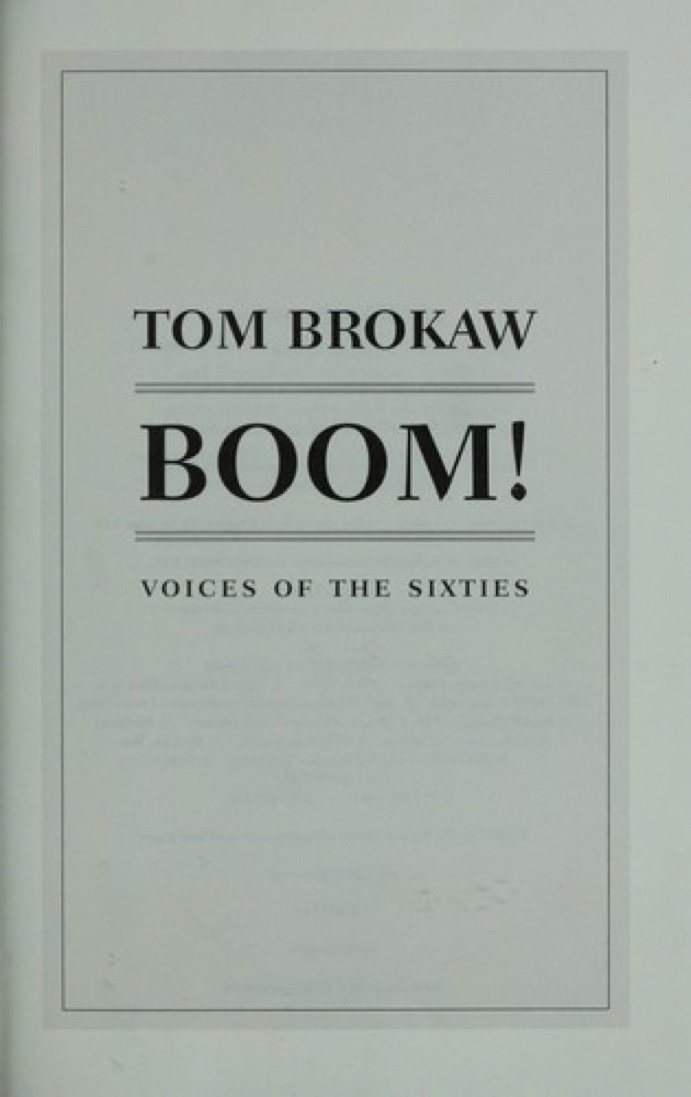
Boom!: Voices of the Sixties—Personal Reflections on the '60s and Today
Applying the lessons from "Boom!: Voices of the Sixties—Personal Reflections on the '60s and Today" by Tom Brokaw to your life can be a catalyst for understanding how individual courage and collective action drive systemic change. Here are some ways you might integrate these lessons:
-
Harness Disruption as a Strategic Advantage: - In the worlds of healthcare and venture capital, rapid cultural and technological shifts—much like those seen in the 1960s—are often the best indicators of opportunity. You should view periods of intense change not as threats to your business model, but as the optimal moments to introduce disruptive innovations that challenge the status quo and improve the lives of others.
-
Prioritize Ethical Leadership and Integrity: - The 60s demonstrated that a "credibility gap" can destroy the relationship between leaders and their constituents. As a physician and CEO, you must ensure that your transparency and commitment to the truth are absolute; in an era of skepticism, the most humble and honest leader is the one who gains the most enduring influence and trust.
-
Build Multigenerational Teams: - To truly "Stay Hungry," you must bridge the gap between the veterans of your industry and the new wave of talent. By fostering an environment where the wisdom of experience meets the fire of new ideas, you create a resilient culture that can navigate complex legal, medical, and financial landscapes without losing sight of its original mission.
-
Master the Art of Impactful Storytelling: - Brokaw’s work proves that data alone doesn't change history—human stories do. Whether you are advocating for a legal client or pitching to potential investors, you should frame your objectives within a compelling narrative that connects with the listener’s values and shared history, making your vision both relatable and urgent.
-
Maintain Resilience Through Persistence: - The major victories of the 1960s, from civil rights to the moon landing, were not achieved overnight but through years of grueling work and repeated failure. You should apply this perspective to your own long-term ventures, recognizing that "overnight success" is usually the result of a decade of relentless effort and an refusal to abandon the mission during difficult seasons.
-
Synthesize Technology with Human Needs: - The Space Race succeeded because it combined cutting-edge engineering with a profound human aspiration. As you look at new medical technologies or investment opportunities, you should ask not just "what can this do," but "how does this elevate the human experience," ensuring that your innovations solve real problems while inspiring progress.
By integrating these lessons, you can navigate the modern "booms" of healthcare technology and venture capital with a nuanced understanding of how historical cycles influence current trends. Embracing the resilience and visionary spirit of the sixties allows you to lead with a perspective that is both grounded in history and fiercely focused on the future, ensuring you remain both hungry for progress and humble in the face of history.
What the book covers
"Boom!: Voices of the Sixties—Personal Reflections on the '60s and Today" by Tom Brokaw is a sweeping oral history that examines the profound social, political, and cultural shifts of the 1960s through the firsthand accounts of those who defined the era. Brokaw assembles a mosaic of perspectives, ranging from household names like Bill Clinton and Newt Gingrich to the unsung activists, nurses, and veterans who stood on the front lines of change. The book explores how the collisions of that decade—over war, race, gender, and authority—did not merely end when the calendar turned, but instead forged the architecture of modern American life. By juxtaposing the idealism of the youth movement with the sobering reflections of these individuals forty years later, Brokaw provides a vital roadmap for understanding the roots of our current national identity.
Summary:
-
The Cultural Tectonic Shift: - The transition from the buttoned-down 1950s to the psychedelic 1960s is framed as a period of unprecedented individual exploration. Brokaw describes how the rise of rock music, the introduction of the birth control pill, and the experimentation with drugs shattered traditional social constraints, leading to a broader questioning of institutional authority that still resonates in contemporary culture.
-
The Civil Rights Crucible: - Brokaw highlights the visceral struggle for racial equality through interviews with leaders like Andrew Young and John Lewis. He explores the strategic brilliance of the non-violent movement and the immense personal courage required to confront state-sanctioned segregation, illustrating how these efforts forced a fundamental reassessment of the American democratic promise and led to landmark legislative victories.
-
The Shadow of the Vietnam War: - The conflict in Southeast Asia is presented as the primary source of the era’s deep-seated national trauma. Through the stories of both those who fought and those who protested, the book examines how the draft and the "credibility gap" between the government and the public fundamentally eroded trust in federal leadership and created a lingering rift in the American psyche.
-
The Feminist Revolution: - The book charts the evolution of women's roles, moving from domestic expectations to the fight for equal pay and reproductive rights. Brokaw interviews women who broke glass ceilings in media, law, and politics, demonstrating how the "personal became political" and how the era’s feminist movements redefined the American workforce and family structure for generations to come.
-
A Year of Fire (1968): - A significant portion of the narrative focuses on the catastrophic events of 1968, including the assassinations of Martin Luther King Jr. and Robert F. Kennedy. Brokaw analyzes how these tragedies, combined with the chaos of the Democratic National Convention in Chicago, signaled a turning point where the decade’s early idealism began to give way to deeper political polarization.
-
Technological Optimism and the Space Race: - Despite the domestic turmoil, the decade was marked by the immense achievement of the Apollo moon missions. Brokaw discusses how the Space Race served as a unifying force and a testament to American ingenuity, providing a sense of collective purpose and showcasing the nation’s capacity to achieve the impossible through intense scientific and industrial collaboration.
-
The Roots of Modern Activism: - The book connects the student protests of the 60s to the birth of modern environmentalism and the LGBTQ+ rights movement. By examining the first Earth Day and the aftermath of the Stonewall riots, Brokaw shows how the tactics of the civil rights and anti-war movements were adapted to advocate for a broader range of human rights and ecological protections.
-
The Echoes of Conflict Today: - In concluding his historical survey, Brokaw looks at how the "Boom" generation continues to influence today’s political landscape. He explores how the ideological divides established in the 60s—between traditionalists and progressives—continue to define the primary fault lines in modern American discourse, suggesting that the decade’s conversations remain a central part of the current cultural war.
"Boom!" provides a panoramic view of a decade that challenged every American institution. By documenting the voices of change-makers and witnesses alike, Brokaw illustrates how the upheaval of the 1960s created the foundation for the complex social and political realities of the twenty-first century. It is an essential read for anyone seeking to understand the historical DNA of modern America and the enduring power of individuals to reshape their world.