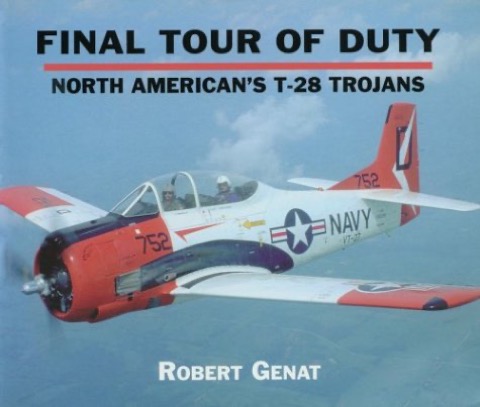
Final Tour of Duty: North American's T-28 Trojans
Applying the lessons from "Final Tour of Duty: North American's T-28 Trojans" by Robert Genat and Lisa Hanks to your life can be a transformative exercise in understanding how systems designed for one purpose can excel in entirely new contexts through adaptation and resilience. Here are some ways you might integrate these lessons:
-
Embrace the Power of the Pivot: - Just as the T-28 was reimagined from a student's trainer to a warrior's tool in Vietnam, you should remain open to repurposing your core competencies. In business or medicine, a tool or skill set developed for a specific routine might provide the competitive edge or life-saving solution in an entirely different, high-stakes environment if you are willing to adapt its application.
-
Build for Durability and Reliability: - The Trojan’s longevity is a direct result of its over-engineered, rugged construction. Whether you are building a healthcare startup or a legal case, focus on creating a foundation that can withstand unforeseen stress; a robust structure allows for future modifications and ensures that your work remains relevant and functional long after the initial launch.
-
Master the Fundamentals First: - The T-28 existed to bridge the gap between old and new technology, proving that mastering the basics of flight was essential before moving to high-performance jets. You must respect the "trainer" phase of your own career; never let your pursuit of advanced technology or complex strategy lead you to neglect the fundamental principles of your craft, as these are what will save you when systems fail.
-
Optimize for Versatility: - The aircraft’s success across different branches of the military and various international theaters highlights the value of being a multi-role asset. In your professional life, aim to be the "T-28"—capable of performing diverse tasks with excellence, making yourself indispensable across multiple departments or industries.
-
Cultivate a Legacy of Mentorship: - Thousands of pilots owe their careers to the T-28's role as a teacher. As a leader, recognize that your most significant impact often comes from the training and support you provide to those following in your footsteps; your "final tour of duty" is defined not just by your personal achievements, but by the capability of the people you have helped prepare for the future.
By integrating these lessons, you can develop a career and personal life characterized by the same ruggedness, adaptability, and enduring influence that defined the T-28 Trojan’s storied history in the skies.
What the book covers
"Final Tour of Duty: North American's T-28 Trojans" by Robert Genat and Lisa Hanks is a comprehensive historical and technical chronicle of one of the most versatile aircraft in American aviation history. The book explores the development, military service, and civilian afterlife of the T-28 Trojan, an aircraft that bridged the gap between the piston-engine era and the jet age. Through detailed archival research and stunning photography, the authors highlight how this rugged platform transitioned from a basic trainer into a formidable counter-insurgency weapon and, eventually, a beloved civilian warbird.
Summary:
-
The Evolution of the Training Mandate: - Following World War II, the United States military required a more advanced trainer to prepare pilots for the increasing speeds and complexities of the emerging jet era. The T-28 was designed to replace the aging T-6 Texan, incorporating a tricycle landing gear and a more powerful Wright R-1300 radial engine to mimic the handling characteristics of modern fighters.
-
Engineering the Variants (A, B, and C): - The authors detail the technical specifications of the three primary American versions: the Air Force T-28A, the Navy T-28B with its more powerful R-1820 engine, and the T-28C, which featured a tailhook for carrier landings. Each iteration reflected the specific needs of its branch, demonstrating how a single airframe could be optimized for vastly different operational environments from land bases to flight decks.
-
The Nomad and Counter-Insurgency Roles: - A significant portion of the book focuses on the T-28D "Nomad," a modified version used extensively in Southeast Asia during the Vietnam War. These aircraft were fitted with underwing hardpoints for ordnance, transforming a trainer into a Close Air Support (CAS) and counter-insurgency (COIN) platform that proved essential in the rugged terrain of Laos and South Vietnam.
-
International Service and Global Impact: - Beyond the United States, the T-28 found a second life in the air forces of nations such as France, where the Fennec version was utilized during the Algerian War. Genat and Hanks provide context on how the aircraft's reliability and ease of maintenance made it an ideal export for allies requiring a sturdy, multi-role aircraft for internal security and defense.
-
The Transition to Civilian Warbird Status: - As the military retired the T-28 in the 1980s, the aircraft became a staple of the civilian warbird community. The book captures the dedication of restorers and private pilots who maintain these machines, noting that the T-28's heavy-duty construction and high performance make it a favorite for airshow performers and aerobatic enthusiasts today.
-
Operational Legacy and Pilot Perspectives: - The narrative is enriched by accounts of the pilots who flew the Trojan in both training and combat roles, emphasizing its forgiving flight characteristics and its reputation for being "built like a tank." These perspectives illustrate why the aircraft remained in active service for over three decades and continues to be a respected icon in the aviation world.
This volume serves as a vital record for aviation historians and enthusiasts alike, documenting the T-28's unique position as both a classroom in the sky and a warrior in the field. By detailing its journey from the drawing boards of North American Aviation to the hangars of modern collectors, Genat and Hanks celebrate an aircraft that defined the transitional period of mid-century flight.