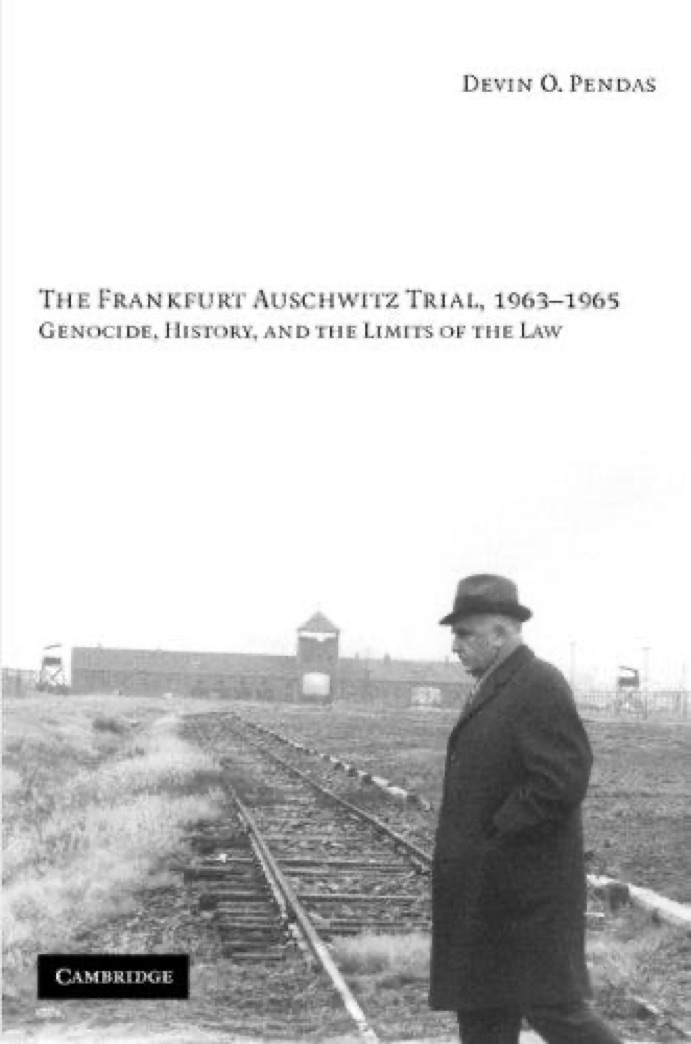
The Frankfurt Auschwitz Trial, 1963–1965: Genocide, History, and the Limits of the Law
Applying the lessons from "The Frankfurt Auschwitz Trial, 1963–1965" by Devin O. Pendas to your life can be a profound exercise in understanding the relationship between institutional systems, individual ethics, and the pursuit of truth. Here are some ways you might integrate these lessons:
-
Recognize the Limitations of Systems: - Just as the West German legal system struggled to address the scale of the Holocaust, you must recognize when the frameworks you operate within—whether in medicine, law, or corporate structures—are insufficient for the moral or practical challenges at hand. As a leader, you should be prepared to advocate for systemic change when traditional rules fail to provide a just or effective outcome.
-
Uphold Individual Accountability: - The trial underscores that being part of a large organization does not absolve you of personal responsibility. In your career as an entrepreneur or physician, always maintain an internal ethical compass that operates independently of the 'orders' or 'norms' of a hierarchy, ensuring that your actions remain aligned with your core values even when the system is compromised.
-
Value the Power of First-Hand Testimony: - The importance of survivor testimony in the trial highlights the value of listening to the 'boots on the ground' and those most affected by a system's failures. In business and medicine, prioritize the voices of patients, employees, and stakeholders over abstract data or high-level reports to get a true sense of the impact of your decisions.
-
Navigate Complexity with Persistence: - Fritz Bauer’s persistence in bringing the trial to fruition despite immense social and political pressure is a masterclass in long-term vision. When facing complex, multi-year projects in venture capital or legal battles, maintain your focus on the ultimate objective, understanding that significant change often requires weathering years of procedural friction.
-
Confront Uncomfortable Truths: - The trial forced a society to look at its past; similarly, personal and organizational growth requires an honest, sometimes painful, audit of past mistakes. Whether you are reviewing a failed business venture or a clinical error, resist the urge to minimize the 'excess' and instead look at the systemic failures that allowed the issue to occur.
-
Balance Technical Precision with Moral Clarity: - As a pilot or attorney, you rely on technical precision, but this book reminds you that technicalities should never become a shield against moral reality. Ensure that your mastery of the 'rules of the game' is always used to serve a higher purpose rather than to obscure a difficult truth.
By integrating these lessons, you will develop a more nuanced understanding of how to lead with integrity in flawed systems, ensuring that your pursuit of 'staying hungry' for excellence is always tempered by the 'humble' recognition of your responsibility to humanity and justice.
What the book covers
"The Frankfurt Auschwitz Trial, 1963–1965: Genocide, History, and the Limits of the Law" by Devin O. Pendas is a comprehensive scholarly examination of one of the most significant legal proceedings in post-war German history. The book explores the complexities of prosecuting Nazi war criminals under the West German domestic legal system, rather than international military law. Pendas meticulously details how the trial attempted to reconcile the horrific scale of the Holocaust with the narrow, technical requirements of traditional criminal statutes.
Summary:
-
The Legal Framework and Constraints: - The trial was conducted under the West German penal code of 1871, which meant that defendants were tried for individual acts of murder rather than for participating in a collective genocide. This required the prosecution to prove specific individual intent and personal participation in killings, a high bar that often ignored the systemic nature of the camp's operations. - Pendas argues that this legal framework fundamentally limited the court's ability to address the totality of the crimes at Auschwitz, as the law treated the Holocaust as a series of isolated criminal acts rather than a state-sponsored program of extermination.
-
The Vision of Fritz Bauer: - Attorney General Fritz Bauer was the driving force behind the trial, viewing it as a pedagogical tool to force the German public to confront the reality of the Nazi past. Bauer sought to use the courtroom to document the entire history of the camp, moving beyond the specific guilt of the defendants to provide a broader historical narrative. - Despite Bauer's intentions, the procedural requirements of the trial often pulled the focus back to minute forensic details, creating a tension between the trial's legal goals and its educational aspirations.
-
The Defendants and the 'Banality of Evil': - The twenty-two defendants ranged from high-ranking camp officials to low-level 'capos' and guards, representing a cross-section of the camp's hierarchy. Their defenses typically relied on 'orders from above' or denials of personal involvement, reflecting a widespread refusal to accept moral responsibility. - Pendas highlights how the trial debunked the idea that these men were merely cogs in a machine; instead, evidence often revealed a high degree of personal cruelty and individual initiative in the commission of atrocities.
-
The Power of Survivor Testimony: - For the first time in a German court, the voices of Auschwitz survivors were central to the proceedings, with over 350 witnesses testifying. Their accounts provided a harrowing look at the daily reality of the camp, though their memories were often subjected to aggressive cross-examination by defense attorneys. - The testimony created a permanent historical record of the victims' experiences, even when the legal system struggled to translate these testimonies into convictions for specific murders.
-
The Verdict and the Limits of Justice: - The final verdicts, delivered in 1965, resulted in several life sentences but also many lighter terms and some acquittals. The court’s insistence on proving 'base motives' or 'cruelty' for a murder conviction led to results that many observers felt were inadequate compared to the scale of the crimes. - Pendas analyzes the sentencing as a reflection of the legal system's failure to adapt to 'administrative mass murder,' where the law punished the 'excess' killers more harshly than those who efficiently operated the gas chambers.
-
The Trial’s Legacy in West German Society: - The trial marked a turning point in how West Germany engaged with its Nazi history, ending a period of relative silence and forcing a national conversation. It served as a catalyst for future investigations and legal reforms regarding crimes against humanity. - However, Pendas concludes that the trial also exposed the inherent limitations of using domestic law to provide justice for state-sponsored genocide, as the legal technicalities often obscured the moral magnitude of the events.
Ultimately, this work serves as a vital critique of the intersection between law and history, demonstrating how the pursuit of justice is often constrained by the very institutions tasked with upholding it. It remains a definitive account of the struggle to hold individuals accountable for the darkest chapters of human history.