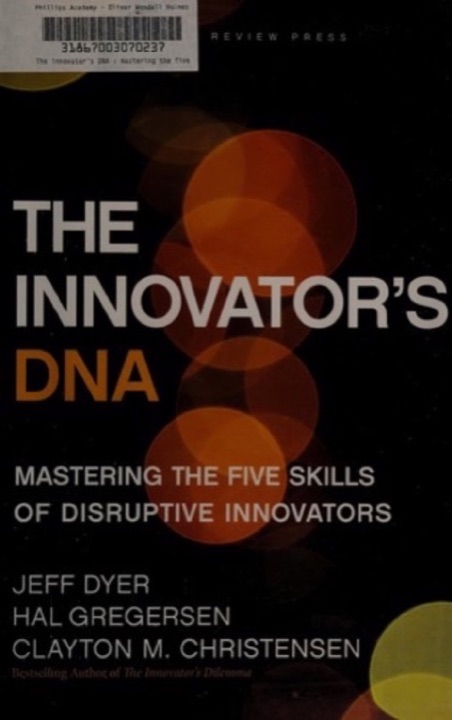
The Innovator's DNA: Mastering the Five Skills of Disruptive Innovators
Applying the lessons from "The Innovator's DNA: Mastering the Five Skills of Disruptive Innovators" by Jeffrey H. Dyer, Hal B. Gregersen, and Clayton M. Christensen to your life can be a powerful catalyst for evolving from a practitioner-manager into a truly disruptive visionary. Here are some ways you might integrate these lessons:
-
Synthesize Your Diverse Expertise through Associating: - You possess a unique background spanning medicine, aviation, law, and business; use the skill of associating to intentionally bridge these sectors. By looking at a healthcare problem through the lens of a pilot's checklist or an attorney's risk assessment, you can find non-obvious solutions that others in a single-discipline silo would overlook.
-
Develop a Systematic Practice of Questioning: - In your roles as a physician and VC leader, challenge the "way things have always been done" by dedicating time to ask "What if?" about standard delivery models. Treat every inefficiency you encounter as a prompt for a questioning exercise, ensuring you never settle for an incremental improvement when a disruptive overhaul is possible.
-
Engage in Radical Observation of the User Experience: - Move beyond data reports and spend time on the front lines of your healthcare startups to observe how patients and providers actually interact with technology. Look for the friction points—the workarounds people create—as these are the most fertile grounds for identifying your next major venture or product improvement.
-
Expand Your Discovery Network Beyond Your Industry: - Actively seek out conversations with individuals in fields completely unrelated to yours, such as art, agriculture, or heavy manufacturing. These interactions will provide the diverse mental inputs required to trigger new associations, helping you maintain a competitive edge in your venture capital decisions by seeing trends before they hit the mainstream.
-
Foster an Experimental Mindset in Every Venture: - Adopt a "pilot" mentality for your business ideas by launching small-scale, low-risk experiments to test your hypotheses quickly. Encourage your portfolio companies to value the learning gained from failed experiments as much as the success of proven models, ensuring that the fear of failure never stifles the courage to innovate.
-
Instill the DNA of Innovation in Your Teams: - Focus on the "3 P’s" by hiring people who demonstrate strong discovery skills, creating processes that reward curiosity, and championing a philosophy that innovation is everyone's job. By building an environment where questioning and observing are celebrated, you ensure your organizations remain agile and resilient.
By integrating these lessons, you will refine your natural instincts into a disciplined methodology for breakthrough discovery. This commitment to maintaining the innovator’s DNA—staying hungry for new insights and humble enough to constantly question your own assumptions—will allow you to continue leading at the intersection of diverse disciplines with unparalleled impact.
What the book covers
"The Innovator's DNA: Mastering the Five Skills of Disruptive Innovators" by Jeffrey H. Dyer, Hal B. Gregersen, and Clayton M. Christensen is a seminal work that demystifies the process of generating creative business ideas. Based on an eight-year study of the world's most innovative companies and leaders, the authors argue that creativity is not a genetic predisposition but a set of behavioral skills that can be developed. The book provides a practical framework for identifying and strengthening the discovery skills necessary to drive innovation in any field.
Summary:
-
The Foundation of Innovation: - The authors introduce the concept that the ability to generate innovative ideas is roughly one-third genetic and two-thirds learned behavior. This challenges the myth of the "creative genius" and posits that anyone can become more innovative by practicing five specific discovery skills: associating, questioning, observing, networking, and experimenting.
-
Associating – The Core Skill: - This is the cornerstone of the innovator's DNA, described as the ability to successfully connect seemingly unrelated questions, problems, or ideas from different fields. Innovators often find inspiration in the intersection of disparate disciplines, allowing them to synthesize new insights that others miss because they are trapped in departmental silos or specific industry paradigms.
-
Questioning – Challenging the Status Quo: - Innovators are characterized by their constant habit of asking "Why?", "Why not?", and "What if?" to provoke a different way of looking at a problem. The book highlights how disruptive leaders spend a significant amount of time questioning common wisdom and imagining alternatives, which serves as the primary catalyst for associative thinking and new discoveries.
-
Observing – Noticing Small Details: - This skill involves carefully watching the world around you—including customers, products, and services—to identify new ways of doing things. The authors argue that discovery-driven leaders are intense observers of behavioral nuances, often uncovering "jobs to be done" that customers themselves cannot articulate through traditional market research or surveys.
-
Networking – Seeking Diverse Perspectives: - Unlike traditional networking for resources or career advancement, "idea networking" focuses on talking to people with different backgrounds and perspectives to extend one's own knowledge. By intentionally seeking out individuals from different geographies, industries, and social classes, innovators gain access to unique insights that challenge their internal biases and spark creative connections.
-
Experimenting – The Bias Toward Action: - Innovation requires a willingness to try new experiences, take things apart, and test prototypes. The authors detail how successful innovators use intellectual, physical, and digital experiments to gather data and fail fast. This process of constant trial and error is essential for refining ideas and determining which concepts have the potential for real-world disruption.
-
The DNA of Innovative Organizations: - The final portion of the book shifts from the individual to the collective, exploring how companies can institutionalize these five discovery skills. It examines the "3 P's"—People, Processes, and Philosophy—and explains how organizations can hire discovery-driven talent, build processes that encourage experimentation, and foster a culture that views failure as a necessary byproduct of innovation.
The Innovator's DNA is significant because it provides a data-driven taxonomy for creativity, transforming it from an abstract concept into a repeatable practice. By bridging the gap between theoretical disruption and practical execution, it offers a roadmap for leaders to cultivate the cognitive agility required to survive and thrive in an increasingly volatile global economy.