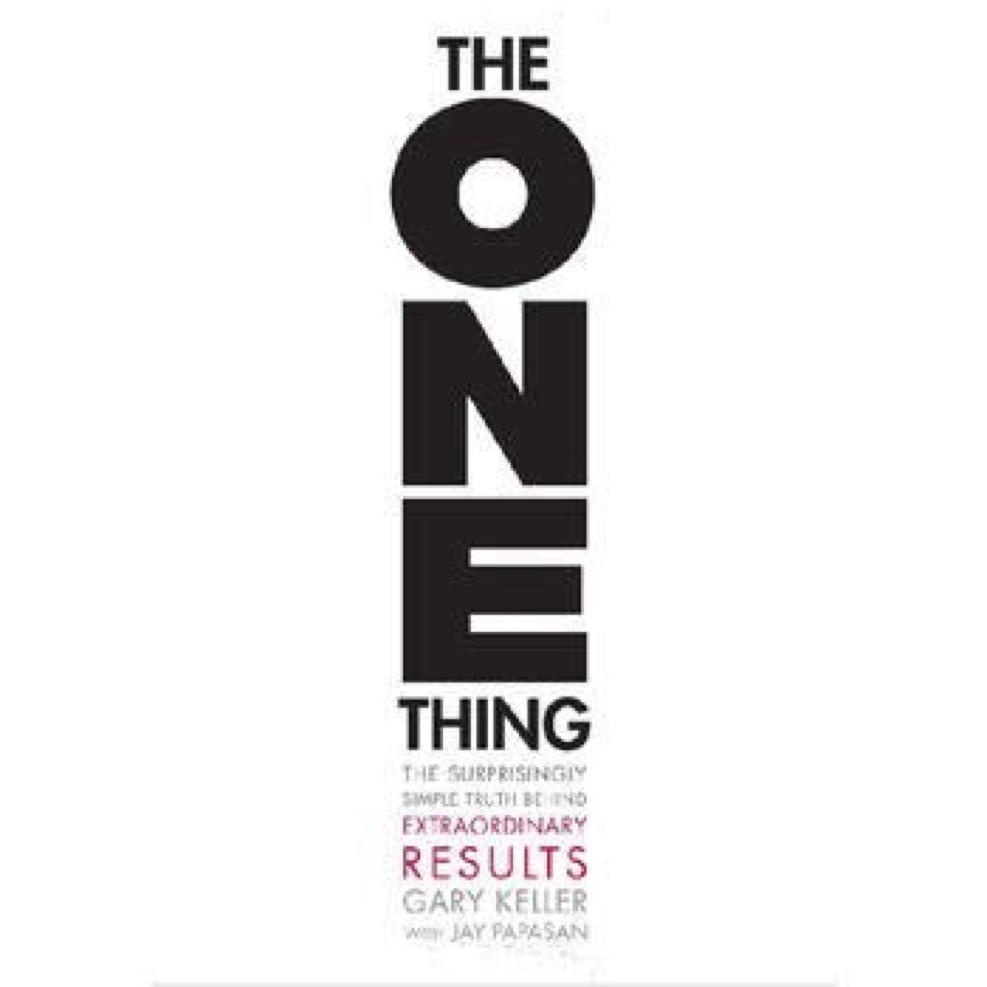
The ONE Thing: The Surprisingly Simple Truth Behind Extraordinary Results
Applying the lessons from "The ONE Thing: The Surprisingly Simple Truth Behind Extraordinary Results" by Gary Keller and Jay Papasan to your life can be the catalyst for moving from being busy to being effective. Here are some ways you might integrate these lessons:
-
Refining the Venture Thesis: - In the world of venture capital and entrepreneurship, you are often presented with a myriad of "good" opportunities. You must use the Focusing Question to identify the one investment or the one strategic pivot that will yield the highest return for Xcellerant Ventures, allowing you to ignore the noise of mediocre prospects and double down on the lead domino.
-
Precision in Medicine and Law: - Whether you are in the ER or the courtroom, high-stakes environments demand clarity. You can apply the ONE thing by identifying the single most critical variable in a complex case. By isolating the primary driver of a medical outcome or a legal strategy, you ensure that your most potent cognitive resources are applied where they can save the most lives or win the most cases.
-
Cockpit Discipline and Systemic Simplicity: - As a pilot, you know that during critical phases of flight, focus is the difference between safety and catastrophe. Integrate this mindset into your daily routines by treating your "deep work" time with the same sanctity as a sterile cockpit. When you are working on your ONE thing, eliminate all other inputs to ensure maximum operational safety and performance.
-
Protecting Your Willpower as an Asset: - Given your multifaceted career, your willpower is your most valuable currency. You should schedule your most intellectually demanding task—whether it is writing a book or analyzing a complex deal—for the first thing in the morning when your resolve is highest. Treat your health and sleep not as luxuries, but as the fuel that replenishes this finite resource.
-
The Power of the Strategic "No": - As a lifelong learner and serial entrepreneur, your natural inclination is to explore every avenue. However, to stay humble and hungry, you must master the art of saying "no" to tasks that are merely "good" so you can say "yes" to the one thing that is "great." This protects your bandwidth for the projects that truly align with your legacy.
-
Time Blocking for Mastery: - To achieve extraordinary results in a new domain, you must block off four hours a day to focus solely on your ONE thing. This isn't just about scheduling; it's about building a bunker around that time. Ensure that your staff and partners understand that during these blocks, you are unreachable, allowing you to reach a state of flow that produces 10x results.
By integrating these lessons, you transform your diverse expertise from a collection of disparate skills into a unified force, ensuring that your hunger for new challenges is always matched by the humble realization that greatness requires the courage to focus on one thing at a time.
What the book covers
"The ONE Thing: The Surprisingly Simple Truth Behind Extraordinary Results" by Gary Keller and Jay Papasan is a masterclass in the power of singular focus and the elimination of distraction. The book argues that the path to extreme success is not found by doing more things, but by doing the right things with concentrated effort. By identifying the lead domino in any endeavor, Keller and Papasan demonstrate how individuals can achieve disproportionate results while reducing stress and complexity.
Summary:
-
The Domino Effect: - Success is sequential, not simultaneous. Just as a single two-inch domino can topple a significantly larger one, small, focused actions build momentum that eventually knocks down massive obstacles. To achieve extraordinary results, you must find the "lead domino"—the first step that makes subsequent steps easier or unnecessary.
-
The Focusing Question: - The core of the philosophy is a specific query: "What's the ONE Thing I can do such that by doing it everything else will be easier or unnecessary?" This question must be applied at two levels: the macro (the big picture goal) and the micro (what must be done right now). It serves as both a map for long-term vision and a compass for immediate action.
-
The Six Lies Between You and Success: - The authors debunk common myths that hinder productivity, such as the idea that everything matters equally, the fallacy of multitasking, and the belief that a disciplined life requires constant willpower. They argue that multitasking is merely a recipe for fragmented attention and that willpower is a finite resource that must be managed and used on your most important tasks early in the day.
-
The Four Thieves of Productivity: - Extraordinary results are often stolen by four specific culprits: the inability to say "no" to distractions, a fear of the chaos that ensues when you focus on one thing at the expense of others, poor health habits that drain energy, and an environment that does not support your goals. Mastery requires guarding your time and energy against these intrusions.
-
Goal Setting to the Now: - This process involves connecting your "someday" goal to your "right now" action through a series of intermediate steps. By visualizing where you want to be in five years, one year, one month, and one week, you can ensure that your current task is directly aligned with your ultimate purpose, creating a clear line of sight to success.
-
The Three Commitments: - To achieve the results promised by the ONE thing, you must commit to the path of mastery, move from an "entrepreneurial" approach (doing what comes naturally) to a "purposeful" approach (doing what is required), and live the cycle of accountability. Mastery is a journey of continuous improvement rather than a destination.
-
Living for Purpose: - Productivity without purpose is hollow. The authors suggest that our "big why" provides the foundation for our priority, which in turn drives our productivity. When your daily actions are rooted in a deep sense of purpose, you gain the stamina and clarity necessary to sustain long-term excellence.
-
The 80/20 Rule Applied: - Building on Pareto's Principle, the book suggests that a small minority of your activities contribute to the vast majority of your success. However, Keller takes it further, suggesting you should take your top 20 percent and find the top 20 percent of that, continuing until you arrive at the single most impactful task.
This book is a significant contribution to the literature of productivity because it rejects the "more is better" culture of the modern workplace. It provides a practical, iterative framework for reclaiming one's schedule and ensuring that every ounce of effort is directed toward a meaningful, high-leverage objective.