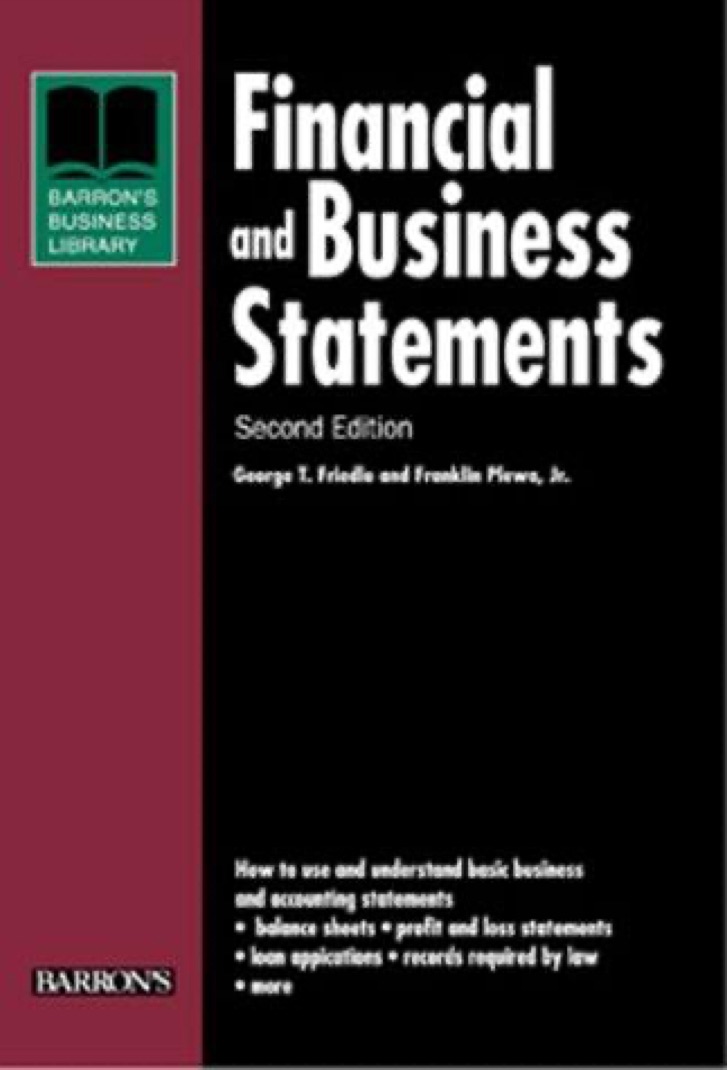
Financial and Business Statements
Applying the lessons from "Financial and Business Statements" by George T. Friedlob and Franklin J. Plewa Jr. to your life can be a transformative step toward achieving financial literacy and operational excellence in your professional ventures. Here are some ways you might integrate these lessons:
- Master the Instruments of Business: - Just as you rely on flight instruments to navigate through low visibility in aviation, you must rely on financial statements to navigate the complexities of your business ventures. Treat the balance sheet and income statement as your primary dashboard, ensuring you understand every metric before making high-stakes decisions in your medical practices or startups.
- Execute Rigorous Due Diligence: - In your role leading a venture capital firm, use the ratio analysis techniques from the book to peer behind the marketing narratives of potential investments. Look for sustainable growth patterns and healthy liquidity ratios rather than just focusing on top-line revenue, ensuring that your capital is deployed into businesses with a solid fundamental foundation.
- Prioritize Cash Flow over Accounting Profit: - In the healthcare and telehealth sectors, where billing cycles can be complex, remember that cash flow is the lifeblood of the organization. Use the Statement of Cash Flows to monitor the actual movement of money in and out of your companies, ensuring that you maintain the liquidity necessary to weather market shifts and pursue new expansion opportunities.
- Optimize Asset and Tax Strategy: - Apply the book’s lessons on depreciation and inventory valuation to your more capital-intensive projects, including aircraft management or medical facility expansion. By understanding how these accounting choices impact your bottom line and tax obligations, you can make more tax-efficient decisions that preserve capital for future growth.
- Enhance Fiduciary and Legal Oversight: - Leverage your legal background to ensure that your organizations adhere to the highest standards of financial transparency. By deeply understanding GAAP and the nuances of financial reporting, you can provide better oversight as a leader and board member, protecting your ventures from regulatory risks and ethical pitfalls.
- Adopt a Life-Long Learner’s Financial Audit: - Apply the "Stay Humble" mantra to your personal financial life by conducting regular audits of your own personal balance sheet. By viewing your personal investments and liabilities through the same rigorous lens as a corporate entity, you maintain the financial discipline required to remain "hungry" for the next great challenge.
By integrating these lessons, you will develop a more profound sense of financial intuition, allowing you to spot opportunities and risks that others might miss. This mastery of financial statements bridges the gap between visionary leadership and sustainable operational success, reinforcing your ability to lead with both confidence and humility in every arena of your multifaceted career.
What the book covers
"Financial and Business Statements" by George T. Friedlob and Franklin J. Plewa Jr. is a comprehensive guide to understanding and analyzing the primary financial documents used in the corporate world. It serves as an essential primer for business students and professionals, breaking down complex accounting principles into digestible components. The book provides a clear framework for interpreting balance sheets, income statements, and cash flow reports to evaluate a company's financial health. Through practical examples and clear explanations, the authors demystify the language of accounting, making it accessible for those without a formal background in finance.
Summary:
- The Conceptual Framework of Accounting: - The authors begin by establishing the fundamental principles that govern financial reporting, specifically the Generally Accepted Accounting Principles (GAAP). They explain that these rules exist to ensure consistency, reliability, and comparability across different organizations and industries, providing a "common language" for the global business community. - They emphasize the importance of the accrual method of accounting over the cash basis, explaining how revenue recognition and the matching principle provide a more accurate picture of a company’s economic activity during a specific period regardless of when cash changes hands.
- Deconstructing the Balance Sheet: - This section focuses on the fundamental accounting equation where assets must always equal the sum of liabilities and owner’s equity. The authors break down current assets like cash and accounts receivable versus long-term assets such as property and equipment, explaining how they are valued and reported on the statement. - They also detail the liabilities side, distinguishing between short-term obligations and long-term debt. This structural analysis helps the reader understand the "snapshot" of a company's financial position at a single point in time and its underlying capital structure and solvency.
- Analyzing the Income Statement: - The book describes the income statement as a "motion picture" of a company’s operations over time. It guides the reader through the calculation of gross profit, operating income, and net income, highlighting the impact of operating expenses and non-operating items like interest and taxes. - Friedlob and Plewa explain how to interpret various margins and why the distinction between recurring operating income and "one-time" gains or losses is critical for forecasting a firm's future earnings potential and operational sustainability.
- The Critical Role of Cash Flows: - One of the most vital sections covers the Statement of Cash Flows, which reconciles net income back to actual cash movements. The authors categorize activities into three distinct buckets: operating, investing, and financing activities. - They argue that while the income statement shows profitability, the cash flow statement reveals true liquidity. Understanding these dynamics is crucial for identifying companies that may be profitable on paper but are actually facing an existential crisis due to poor collections or excessive capital expenditures.
- Financial Ratio Analysis and Performance Metrics: - The authors introduce a suite of ratios—liquidity, activity, leverage, and profitability—to help readers perform quantitative assessments. They explain how ratios like the Current Ratio, Debt-to-Equity, and Return on Equity provide necessary context that raw numbers cannot. - They also demonstrate how to use these ratios for horizontal analysis (comparing a company to itself over time) and vertical analysis (comparing a company to its industry peers), which are essential for identifying long-term trends and potential financial red flags.
- Inventory, Assets, and Valuation Methods: - The book explores the complexities of inventory valuation methods, such as FIFO (First-In, First-Out) and LIFO (Last-In, Last-Out), and how these choices affect both the balance sheet and the corporate tax burden. - It also covers depreciation and amortization, explaining how companies allocate the cost of tangible and intangible assets over their useful lives and the resulting impact on reported net income and asset book value.
"Financial and Business Statements" is a foundational text that empowers leaders to look beyond the surface of corporate reports. By mastering these analytical tools, decision-makers can navigate the complexities of modern business with greater precision, ensuring that their strategic choices are backed by sound financial logic and an accurate understanding of economic reality.