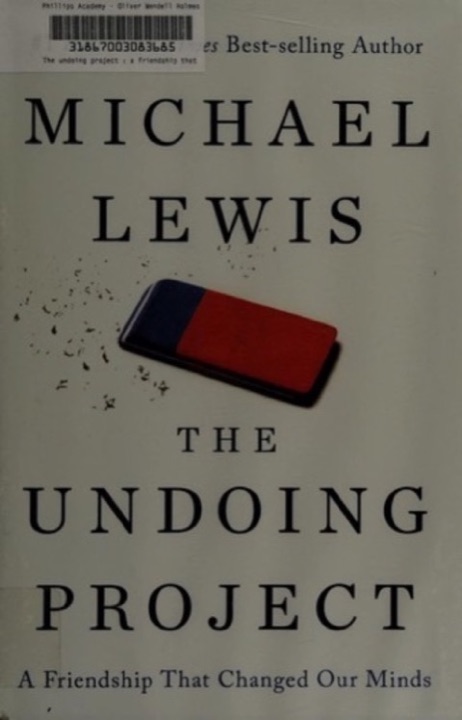
The Undoing Project: A Friendship That Changed Our Minds
Applying the lessons from "The Undoing Project" to your life can be a rewarding endeavor, especially given your rich experiences and values. Here are some ways you might integrate the insights from Kahneman and Tversky's work into your personal and professional life:
-
Embrace Cognitive Awareness: - Recognize and reflect on your own cognitive biases and heuristics. Given your background in medicine and emergency situations, understanding how these mental shortcuts can influence decision-making might help you make more informed choices, especially in high-pressure environments.
-
Value Interdisciplinary Collaboration: - Like Kahneman and Tversky, seek out collaborations with individuals from different fields or with diverse perspectives. This can lead to innovative solutions and enrich your understanding of complex issues, whether in your professional work or personal projects.
-
Challenge Assumptions: - Continue to question and challenge conventional wisdom, as you have done with your views on organized religion and politics. This mindset can lead to personal growth and a deeper understanding of the world around you.
-
Foster Deep Relationships: - The friendship between Kahneman and Tversky was central to their success. Nurture your relationships with family and friends, valuing loyalty and presence, as you already do. These connections can provide support and inspiration in your endeavors.
-
Apply Behavioral Insights: - Use the principles of behavioral economics to improve decision-making in your daily life. For example, understanding loss aversion might help you make more balanced choices in personal and financial matters.
-
Cultivate Resilience and Humor: - Your resilience and humor are strengths that align with the themes of the book. Continue to use these qualities to navigate life's challenges, finding joy and learning in every experience.
-
Live in the Moment: - One of your aspirations is to live in the moment. The book's exploration of human decision-making can remind you to be mindful and present, appreciating each experience as it comes.
-
Promote Equality and Social Justice: - Your passion for social issues aligns with the book's themes of challenging norms and assumptions. Continue your advocacy work, using insights from behavioral economics to influence positive change in society.
-
Reflect on Personal Growth: - Like the personal dynamics explored in the book, reflect on your own growth and relationships. Consider how your experiences, both successes and failures, have shaped who you are today.
-
Pursue Lifelong Learning:
- Embrace the idea of being in a constant state of beta, as you mentioned. Continue to seek knowledge and understanding, drawing inspiration from thinkers like Marcus Aurelius and Socrates.
By integrating these lessons into your life, you can continue to grow, make informed decisions, and contribute positively to the world around you.
What the book covers
"The Undoing Project: A Friendship That Changed Our Minds" by Michael Lewis is a compelling exploration of the collaboration between two Israeli psychologists, Daniel Kahneman and Amos Tversky, whose groundbreaking work in the field of behavioral economics challenged conventional understandings of human decision-making and judgment.
Summary:
Background and Context: The book begins by setting the stage for the meeting of Kahneman and Tversky, both of whom had unique backgrounds and personalities. Kahneman, a Holocaust survivor, was introspective and deeply interested in understanding human behavior. Tversky, on the other hand, was charismatic, confident, and had a sharp analytical mind. Their partnership began in the late 1960s at the Hebrew University of Jerusalem.
Collaboration and Research: Kahneman and Tversky's collaboration led to the development of several key theories that challenged the prevailing assumptions of rational decision-making in economics. Their research focused on cognitive biases and heuristics—mental shortcuts that often lead to errors in judgment. They demonstrated that people often rely on these heuristics, leading to systematic deviations from rationality.
Key Theories and Concepts: 1. Prospect Theory: One of their most influential contributions, Prospect Theory, describes how people make choices in situations involving risk and uncertainty. It highlights that people value gains and losses differently, leading to irrational decision-making.
-
Heuristics and Biases: They identified several cognitive biases, such as the availability heuristic, where people judge the probability of events based on how easily examples come to mind, and the representativeness heuristic, where people assess the likelihood of an event based on how similar it is to a prototype.
-
Loss Aversion: Their work showed that people tend to prefer avoiding losses over acquiring equivalent gains, a concept that has profound implications for understanding economic behavior.
Impact and Legacy: The book delves into how their work laid the foundation for the field of behavioral economics, influencing a wide range of disciplines, including economics, medicine, and public policy. Their insights have been applied to various real-world problems, from financial markets to healthcare decisions.
Personal Dynamics: Lewis also explores the personal dynamics between Kahneman and Tversky, highlighting their intellectual synergy and the eventual strain on their friendship. Despite their differences, their collaboration was marked by mutual respect and a shared passion for understanding the human mind.
Key Takeaways and Lessons:
-
Understanding Human Irrationality: Kahneman and Tversky's work underscores the importance of recognizing and understanding the cognitive biases that influence human decision-making. This awareness can lead to better decision-making in personal and professional contexts.
-
Interdisciplinary Collaboration: The book highlights the power of collaboration across disciplines. Kahneman and Tversky's partnership brought together psychology and economics, leading to groundbreaking insights that neither could have achieved alone.
-
Challenging Assumptions: Their research challenges the assumption of human rationality that underpins traditional economic theories. This has led to a more nuanced understanding of human behavior and has influenced policy-making and business strategies.
-
The Role of Friendship in Innovation: The story of Kahneman and Tversky illustrates how deep intellectual partnerships and friendships can drive innovation and creativity, even in the face of personal and professional challenges.
-
Legacy and Influence: The impact of their work continues to be felt today, as it has reshaped how we understand decision-making and has paved the way for further research in behavioral economics.
In summary, "The Undoing Project" is not only a tribute to the remarkable partnership between Kahneman and Tversky but also a profound exploration of how their insights have transformed our understanding of the human mind and decision-making processes.