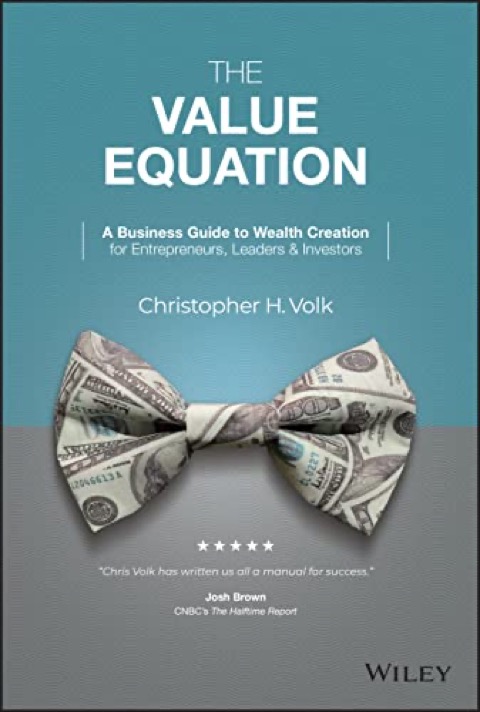
The Value Equation: A Business Guide to Wealth Creation for Entrepreneurs, Leaders & Investors
Applying the lessons from "The Value Equation: A Business Guide to Creating Wealth for Everyone" by Christopher H. Volk to your life can be a transformative step toward achieving professional mastery and financial independence. Here are some ways you might integrate these lessons:
- Adopt a Multi-Disciplinary Financial Mindset: - You should treat your business or medical practice not just as a service provider, but as a financial engine. By viewing your operations through the lens of the six variables—sales, margins, asset efficiency, debt, leverage, and equity—you can identify "blind spots" that may be hindering your growth. Much like an emergency physician uses a systematic approach to diagnose a patient, you can use the V-Formula to diagnose the health of any venture you lead or invest in.
- Optimize for Asset Efficiency in Every Venture: - Whether you are running an urgent care center or a VC firm, you must focus on the "capital intensity" of your operations. You should constantly ask if there are ways to generate higher returns without proportional increases in fixed assets. In your aviation pursuits, this might mean evaluating the cost-to-utility ratio of your equipment; in business, it means ensuring that every dollar of capital is working as hard as possible to produce revenue.
- Master the Art of Strategic Leverage: - You can use your legal and MBA background to navigate the complexities of debt with precision. You should recognize that debt is a tool; when the cost of capital is lower than the return on assets, leverage can accelerate your mission, whether that’s expanding a healthcare network or scaling a tech startup. However, you must always maintain a "margin of safety" to ensure that unforeseen economic turbulence doesn't lead to a financial stall.
- Focus on Per-Share Value and Personal Focus: - You should apply the concept of share management to your personal time and professional output. Just as a company avoids diluting its shares unnecessarily, you should avoid "diluting" your focus across too many low-impact projects. By focusing your "equity"—your time, energy, and reputation—on high-value activities, you increase your personal and professional valuation over time.
- Cultivate Financial Literacy in Your Teams: - As a leader who values mentorship, you can empower your staff by teaching them the basics of value creation. When your team understands how their daily actions impact operating margins or asset efficiency, they become more engaged and invested in the collective success. This transparency fosters a culture of ownership and shared purpose, which is vital for any entrepreneurial or clinical endeavor.
By integrating these lessons, you can move beyond simple management to true value creation, ensuring that every venture you touch is built on a foundation of financial integrity and sustainable growth. This disciplined approach to business and life reflects the "Stay Hungry" drive for excellence while maintaining the "Stay Humble" awareness of the fundamental principles that govern success.
What the book covers
"The Value Equation: A Business Guide to Creating Wealth for Everyone" by Christopher H. Volk is a comprehensive guide to understanding the financial mechanics that drive successful business models. Volk, a veteran CEO of multiple public companies, breaks down the complexities of corporate finance into an accessible framework centered around six fundamental variables. The book serves as a toolkit for anyone looking to build, lead, or invest in businesses that generate sustainable, long-term wealth.
Summary:
- The Foundation of the Value Equation: - Volk introduces the "V-Formula," a mathematical representation of how businesses create value through the interaction of six key variables. These variables include sales, operating margins, asset efficiency (capital intensity), debt costs, financial leverage, and the number of shares outstanding. By understanding this formula, business leaders can pinpoint exactly where their model is succeeding or failing to generate a return on equity.
- Sales and Operating Margins: - The book emphasizes that while revenue is the lifeblood of a company, it is meaningless without efficient conversion into profit. Volk explains how operating margins—the percentage of sales remaining after paying for the cost of goods and operating expenses—act as a primary indicator of a business's competitive advantage and operational health. He argues that even small improvements in margins can have a disproportionate impact on the overall value equation.
- The Importance of Asset Efficiency: - One of the most overlooked aspects of business success is how effectively a company utilizes its assets to generate revenue. Volk teaches readers to evaluate "capital intensity," or the amount of investment required to produce a dollar of sales. He demonstrates that businesses with high asset turnover—those that generate significant revenue from a relatively small asset base—are inherently more valuable and easier to scale than capital-heavy enterprises.
- Leveraging Debt Wisely: - Volk provides a nuanced view of debt, moving beyond the simplistic narrative that all debt is inherently dangerous. He shows how the cost of debt and the degree of financial leverage can magnify returns on equity, provided the return on assets exceeds the interest rate. The book highlights the risks of over-leveraging and explains how to find the optimal point where debt serves as a catalyst for growth without endangering the company's solvency.
- The Role of Equity and Share Management: - A critical component of the Value Equation is how a company manages its share count and equity issuance. Volk explains that wealth creation is ultimately measured on a per-share basis, and dilution can often offset the benefits of expansion if not managed strictly. He discusses the impact of using retained earnings versus issuing new shares, emphasizing that every financial decision must be viewed through the lens of increasing shareholder value.
- Democratizing Financial Literacy: - Beyond corporate strategy, Volk argues that understanding these financial principles is essential for individual economic empowerment. He suggests that if employees, managers, and even entry-level workers understand how their company creates value, they are better positioned to contribute to its success. This shared knowledge fosters a culture of ownership and financial literacy that benefits the entire organization.
The significance of "The Value Equation" lies in its ability to strip away the jargon of Wall Street and provide a clear, actionable blueprint for business success. Christopher H. Volk offers a timeless methodology that bridges the gap between accounting and entrepreneurship, making it an essential read for anyone committed to the "Stay Hungry, Stay Humble" philosophy of lifelong learning and excellence.