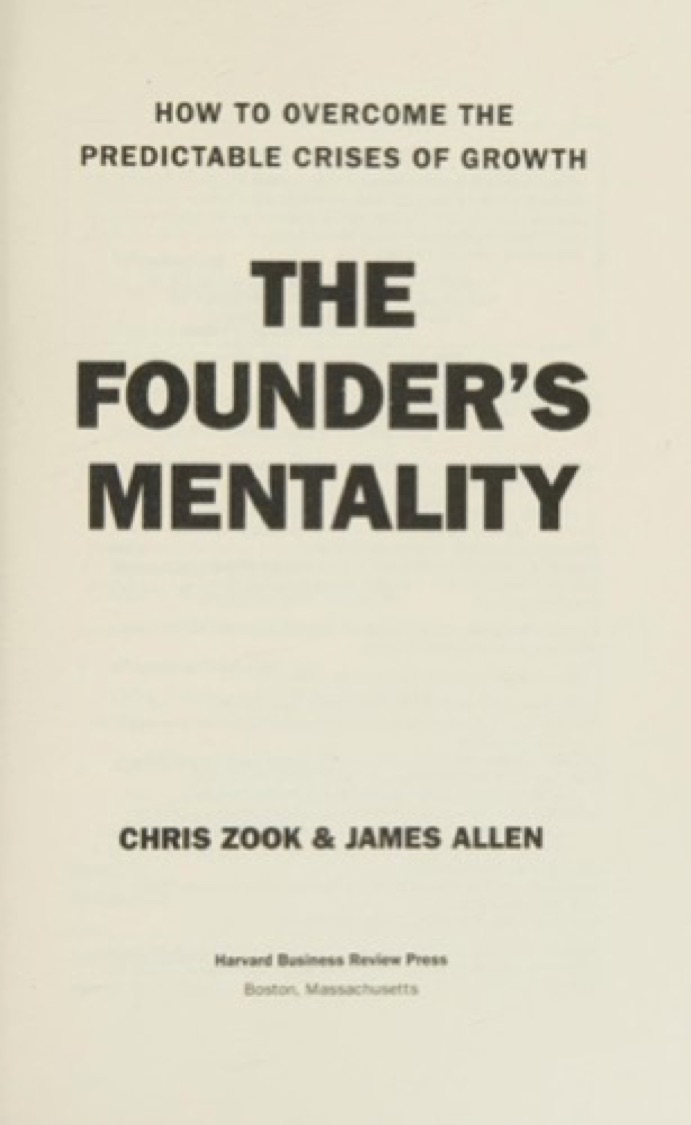
The Founder's Mentality: How to Overcome the Predictable Crises of Growth
Applying the lessons from "The Founder's Mentality" by Chris Zook and James Allen to your life can be a transformative exercise in reclaiming focus and purpose. Here are some ways you might integrate these lessons:
- Rediscover Your Insurgent Mission: - Whether you are running a medical practice, a venture firm, or a new startup, you must define exactly what makes your approach unique. Ask yourself: if your organization didn't exist, who would miss it and why? In medicine or law, this means moving beyond the routine to remember the specific problem you set out to solve for your patients or clients.
- Obsess Over the Front Line: - In any leadership role, do not let your status or title distance you from the "trench" work. If you are an entrepreneur, regularly engage with the newest hire or the most difficult customer. If you are a physician-leader, stay grounded in the clinical reality of the ER; the most important insights come from the direct delivery of care, not the boardroom.
- Combat Complexity with Radical Simplification: - Use your MBA and legal training to identify where processes have become hurdles rather than helps. Actively hunt for "complexity creep" in your personal and professional systems. Strip away redundant layers in your workflows to ensure that your energy is focused on high-impact decisions rather than administrative maintenance.
- Cultivate an Owner’s Mindset in Everything: - Treat every project, investment, or legal case with the personal accountability of a founder. Avoid the "renter's" mindset where you simply fulfill a role. This means taking responsibility for outcomes even when they fall outside your direct job description, fostering a culture where speed and frugality are celebrated as virtues.
- Identify Your Predictable Crises: - Anticipate the "overload" that comes with serial entrepreneurship. As you launch new ventures or take on new roles like piloting or writing, recognize when your internal capacity is being stretched. Use the book’s frameworks to diagnose whether a slowdown is a temporary hurdle or a fundamental stall-out that requires a strategic pivot.
- Stay Hungry and Humble Through Continuous Learning: - The "Founder's Mentality" is ultimately a mindset of perpetual curiosity. Just as you approach aviation or medicine with a student's heart, apply that same humility to your businesses. Don't let past success make you an incumbent; keep the "stay hungry" drive that characterized your first venture.
By integrating these lessons, you can ensure that your diverse pursuits remain aligned with a core purpose, preventing the dilution of your impact as your influence and responsibilities grow. Embracing the founder's mentality allows you to scale your organizations while keeping the spirit of innovation and speed that defined your early career.
What the book covers
"The Founder's Mentality: How to Overcome the Predictable Crises of Growth" by Chris Zook and James Allen is a seminal business strategy work that explores why companies often lose the very edge that made them successful as they scale. Based on a multi-year study of companies across the globe by Bain & Company, the authors argue that the vast majority of growth-related failures are caused by internal, rather than external, factors. By identifying three core traits shared by successful young companies, the book provides a roadmap for established organizations to rediscover their "insurgent" spirit and avoid the pitfalls of corporate bureaucracy.
Summary:
- The Core Pillars of the Founder's Mentality: - The authors identify three key traits that define a successful organization: an insurgent mission, a front-line obsession, and an owner’s mindset. An insurgent mission provides a clear sense of purpose and a unique value proposition that challenges the status quo of an industry. - Front-line obsession ensures that the leadership remains intimately connected to the customer experience and the employees who deliver it. An owner’s mindset fosters a culture of speed, frugality, and personal accountability, where everyone acts as if the company's capital is their own.
- The Paradox of Growth: - The book introduces the central paradox: growth creates complexity, and complexity is the silent killer of growth. As companies expand, they add layers of management, standardized processes, and silos that eventually distance the leadership from the front line and the original mission. - This internal complexity leads to a loss of the very qualities that fueled early success, resulting in what the authors call "the muddled middle," where companies become slow, bureaucratic, and vulnerable to more agile competitors.
- The Crisis of Overload: - Overload occurs during a period of rapid scaling when the internal systems and culture cannot keep pace with external growth. This usually manifests as a breakdown of the company’s core values and an inability to hire or train people fast enough to maintain the original standard of excellence. - Leaders often respond by adding more rules and hierarchy, which ironically exacerbates the problem by further stifling the entrepreneurial spirit that the company needs to navigate the transition.
- The Crisis of Stall-Out: - Stall-out is a sudden drop in growth that affects many large, successful companies. It is characterized by the "complexity creep" that makes the organization too slow to react to market changes and too internally focused to notice shifting customer needs. - The authors provide tools for diagnosing stall-out early, emphasizing the need to radically simplify the business model and eliminate the "energy vampires"—unnecessary layers of management that add no value to the customer.
- The Crisis of Free Fall: - Free fall is the most dangerous stage, occurring when a company's core business model is no longer viable and its growth has stopped entirely. At this point, the organization has lost its insurgent mission and is often being disrupted by newer, leaner competitors. - To survive free fall, a company must undergo a "re-founding," which involves identifying the small core of the business that still possesses the founder’s mentality and rebuilding the entire organization around that core.
- The Power of the Front Line: - A recurring theme is that the most important information in a company resides with the people dealing directly with customers. Successful leaders prioritize the front line by elevating its status above the corporate staff and ensuring that feedback loops are direct and unfiltered. - This obsession prevents the "ivory tower" syndrome, where executives make decisions based on abstract data and spreadsheets rather than the reality of the marketplace.
- Maintaining the Owner's Mindset: - Sustaining growth requires a culture of "radical self-responsibility." The authors highlight the need for a bias toward action and a hatred of bureaucracy, encouraging leaders to maintain a lean corporate center and push decision-making power back to the edges of the organization.
"The Founder's Mentality" serves as a critical diagnostic tool for leaders who feel their organizations are drifting toward mediocrity. It highlights that the greatest threat to a company’s longevity is not the competition, but its own internal evolution from an agile insurgent into a bloated incumbent.