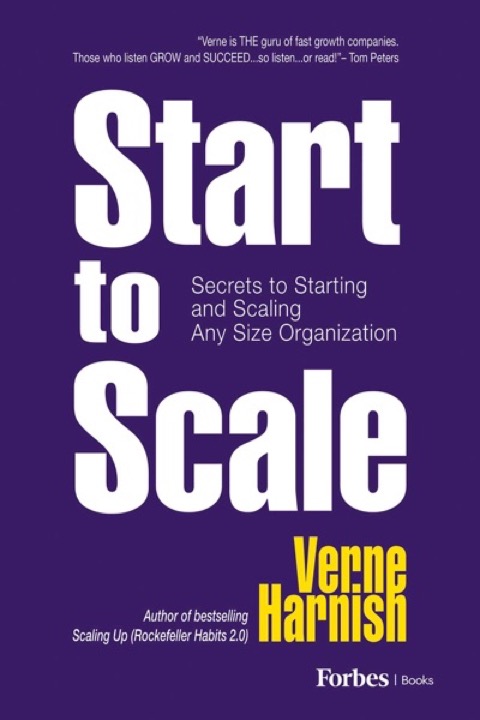
Start to Scale: Secrets to Starting and Scaling Any Size Organization
Applying the lessons from "Start to Scale: Secrets to Starting and Scaling Any Size Organization" by Verne Harnish to your life can be the catalyst for transforming your professional ventures from fragile startups into enduring, high-impact institutions. Here are some ways you might integrate these lessons:
-
Adopt a One-Page Mindset: - Just as you utilize checklists in the cockpit or clinical protocols in the ER, you should apply the One-Page Strategic Plan (OPSP) to your business and personal goals. Distill your complex multi-industry ventures into a single, visible page that clarifies your BHAG and your immediate priorities. This prevents "entrepreneurial drift" and ensures that your legal, medical, and venture capital efforts are all pulling in a synchronized direction.
-
Hire for Values, Not Just Credentials: - Whether you are staffing a new urgent care clinic or building a VC team, prioritize cultural alignment and "A-Player" potential over technical skills alone. In high-stakes environments like healthcare or aviation, you need a team that shares your core values and can exercise independent judgment when you are not in the room. Use Harnish’s Topgrading techniques to ensure your "bus" is filled with people who enhance your culture rather than dilute it.
-
Implement a High-Frequency Communication Rhythm: - Borrow the concept of the daily huddle to keep your various teams aligned. In a fast-paced career spanning law, medicine, and business, short, standing meetings (15 minutes or less) can eliminate email bottlenecks and surface roadblocks before they become crises. This rhythm creates a predictable organizational heartbeat that allows for the agility you need to pivot in a volatile market.
-
Master Your Cash Conversion Cycle: - As a serial entrepreneur, you know that cash is the oxygen of any venture. Apply Harnish's focus on the Cash Conversion Cycle to your healthcare and tech startups. Look for ways to shorten the time between an investment of effort and the realization of revenue. This financial discipline allows you to fund innovation internally, reducing your dependence on outside investors and keeping you in the pilot's seat of your own destiny.
-
Scale Your Personal Leadership: - Embrace the transition from a hands-on practitioner to a strategic leader. Your mantra of "Stay Hungry, Stay Humble" fits perfectly with Harnish’s advice to continuously upgrade your own skills. Use your MBA and legal training not just for technical tasks, but to build more robust systems that allow your organizations to function—and thrive—without your constant direct intervention.
-
Focus on Execution Discipline: - A great strategy is worthless without disciplined execution. Set one or two "Critical Numbers" for each of your entities—whether it's patient satisfaction scores in your clinics or deal-flow quality in Xcellerant Ventures. By obsessing over these metrics and the habits required to move them, you turn abstract goals into tangible results.
By integrating these lessons, you will move beyond the role of a founder who starts companies to becoming a master scaler who builds legacy-grade organizations. Mastering the balance between the Four Decisions—People, Strategy, Execution, and Cash—will allow you to expand your reach across healthcare and finance while maintaining the humility and hunger that define your career.
What the book covers
"Start to Scale: Secrets to Starting and Scaling Any Size Organization" by Verne Harnish is a comprehensive guide designed to help entrepreneurs navigate the treacherous waters between a startup’s initial success and its eventual maturation into a market leader. Drawing on the principles of the Rockefeller Habits and his expansive "Scaling Up" framework, Harnish provides a modular blueprint for growth that focuses on four critical pillars: People, Strategy, Execution, and Cash. The book acts as both a tactical manual and a strategic manifesto, urging leaders to simplify their operations while maintaining the disciplined focus required to handle the increasing complexity of a growing enterprise.
Summary:
-
The Four Decisions Framework: - Harnish argues that every organization must get four specific areas right to scale successfully: People, Strategy, Execution, and Cash. He posits that if any of these pillars is weak, the company will eventually plateau or fail, regardless of how innovative the original product or service might have been. - The framework is designed to provide a common language for leadership teams, ensuring that every executive is aligned on the same priorities and understands the trade-offs required to move from one stage of growth to the next without losing organizational integrity.
-
People: Building a Culture of Accountability: - A major focus of the book is the recruitment and retention of "A-Players" who align with the organization’s core values. Harnish emphasizes that as a company scales, the founder must transition from being the primary problem-solver to a leader who builds systems where others can solve problems effectively. - He introduces tools for evaluating talent and stresses that a company’s culture is its ultimate competitive advantage, serving as the immune system that protects the organization during periods of rapid, often chaotic, expansion.
-
Strategy: The One-Page Strategic Plan: - Harnish advocates for the One-Page Strategic Plan (OPSP), a tool designed to distill complex long-term goals into actionable, short-term priorities. This approach ensures that every member of the organization understands the "Big Hairy Audacious Goal" (BHAG) and how their daily tasks contribute to it. - The strategy section focuses on identifying a unique selling proposition and a "Sandwich" strategy that protects margins while capturing market share, forcing leaders to say no to distractions that do not align with the core mission.
-
Execution: The Power of Meeting Rhythms: - To ensure strategy is actually implemented, Harnish highlights the necessity of disciplined execution through a rigorous meeting rhythm, including daily huddles, weekly tactical meetings, and quarterly planning sessions. This cadence creates a heartbeat for the company, allowing for rapid course corrections. - He emphasizes the use of Key Performance Indicators (KPIs) and "Critical Numbers" to provide real-time visibility into the health of the business, ensuring that management is proactive rather than reactive.
-
Cash: The Oxygen of Growth: - Harnish provides a sobering look at the financial realities of scaling, noting that growth often sucks cash out of a business before it yields a return. He introduces the "Cash Conversion Cycle" (CCC) as a vital metric for entrepreneurs to master. - By improving the speed at which cash moves through the business—from spending a dollar to receiving it back—companies can fund their own growth without relying solely on external capital, thereby maintaining greater control and equity.
-
The Transition from Founder to CEO: - The book concludes by addressing the personal evolution required of the leader. Scaling an organization requires the founder to scale their own leadership capacity, moving away from micro-management toward strategic coaching and vision-casting. - Harnish encourages leaders to stay humble and continuously seek out mentors and peer groups, as the skills that got a company to its first million dollars are rarely the same skills needed to get it to its first hundred million.
This work is significant because it demystifies the mechanics of hyper-growth, offering a structured, repeatable methodology that replaces the chaotic "winging it" approach common in early-stage startups. By emphasizing discipline and clarity, Harnish provides a roadmap for turning an entrepreneurial vision into a sustainable, scalable institution.