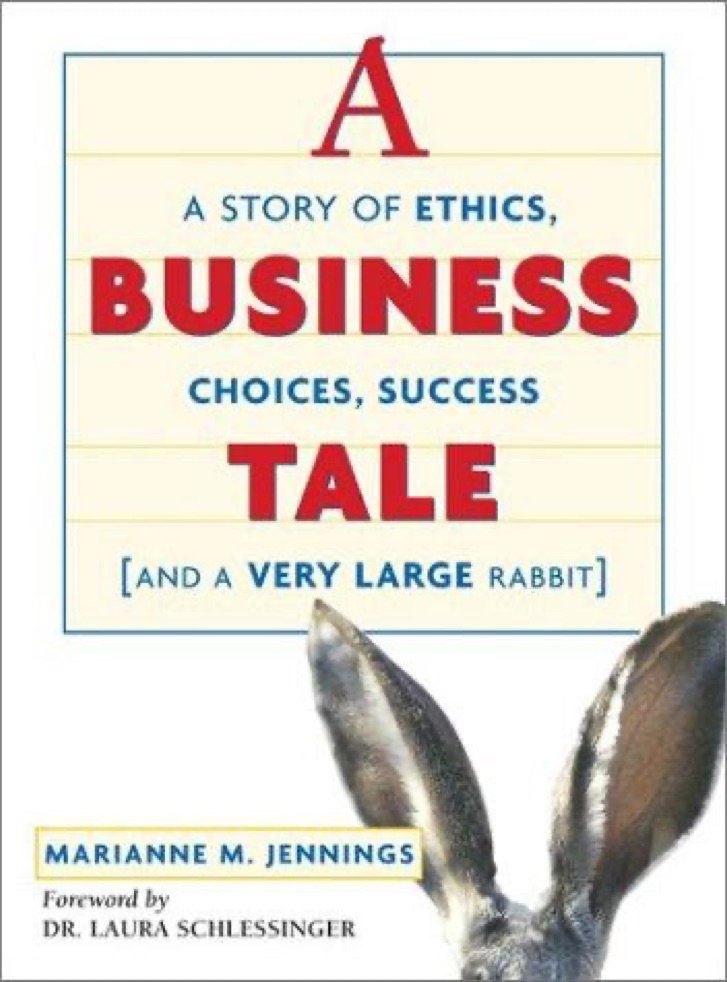
A Business Tale: A Story of Ethics, Choices, Success, and a Very Large Rabbit
Applying the lessons from "A Business Tale: A Story of Ethics, Choices, Success, and a Very Large Rabbit" by Marianne M. Jennings to your life can be a powerful catalyst for aligning your professional actions with your deepest personal values. Here are some ways you might integrate these lessons:
- Heed Your Internal Alarm: - You must recognize that your intuition is often the first responder to an ethical crisis, acting like the "pooka" in the story before your mind begins to rationalize a compromise. Whether you are in the ER, the courtroom, or a board meeting, make it a habit to pause and investigate any feeling of moral discomfort rather than dismissing it as stress or a lack of business acumen.
- Watch the Incremental Compromises: - You should audit your daily routines for small deviations from your core values, as these are the "slippery slopes" that lead to major failures of character. In high-pressure environments, you might be tempted to cut a corner "just this once" to meet a deadline or a metric, but you must realize that these small acts eventually define your professional identity.
- Set the Ethical Standard as a Leader: - As an entrepreneur or executive, you must understand that your team will mirror what you tolerate more than what you preach. If you signal that results are the only thing that matters, you are effectively dismantling the ethical guardrails of your organization; instead, you should proactively reward integrity and transparency, even when it complicates the path to profit.
- Find the Courage to Dissent: - You will inevitably face situations where a group consensus leans toward an unethical or questionable choice, and you must have the fortitude to be the lone voice of opposition. Integrating Jennings' lessons means accepting that your reputation for integrity is far more valuable than temporary social or professional alignment with a misguided majority.
- Broaden Your Definition of Success: - You should shift your focus from purely external metrics, such as acquisitions or net worth, to internal metrics of character and service. Ask yourself if the success you are chasing is something you would be proud to detail to a mentor or your family, ensuring that your professional achievements do not come at the cost of your personal peace.
- Commit to Regular Self-Audit: - You must engage in consistent self-reflection to ensure you haven't become "blind" to the ethical realities of your industry. Like Dr. Shufeldt’s mantra of "Stay Hungry, Stay Humble," this book encourages a lifelong practice of questioning your motives and maintaining a humility that keeps your ego from overriding your conscience.
By integrating these lessons, you ensure that your professional journey is not just a series of tactical achievements, but a consistent testament to your character. Aligning your ambition with the "invisible rabbit" of your conscience provides a resilient framework for a life lived with purpose, ensuring that your success is both substantial and sustainable.
What the book covers
"A Business Tale: A Story of Ethics, Choices, Success, and a Very Large Rabbit" by Marianne M. Jennings is a compelling business fable that explores the complex landscape of corporate morality through the lens of a high-stakes professional environment. The story follows Ben, an executive who encounters a six-foot-three-inch invisible rabbit named Harvey, a pooka who serves as a manifestation of Ben’s long-dormant conscience. By blending storytelling with rigorous ethical principles, Jennings provides a framework for understanding how the pressure for financial results can lead to the gradual erosion of personal integrity. The book serves as a cautionary tale for modern leaders, demonstrating that true professional success is inseparable from the choices one makes when no one else is looking.
Summary:
- The Appearance of the Pooka: - Ben is a successful executive who has spent his career navigating the competitive world of corporate politics, often prioritizing advancement over his inner values. His life changes when he begins to see Harvey, a giant invisible rabbit inspired by the classic play, who challenges Ben’s ethical shortcuts and forces him to confront the moral reality of his business decisions. Harvey represents the persistent voice of conscience that many professionals learn to suppress in favor of corporate expediency.
- Corporate Culture and the Performance Trap: - The narrative highlights the intense environment of Ben’s company, where the relentless pursuit of "hitting the numbers" creates a culture of ethical blindness. Jennings illustrates how senior leadership can subtly encourage a environment where results are the only metric of worth, leading employees to ignore regulatory gray areas and safety concerns. Ben finds himself caught between his desire for a promotion and the objective, often uncomfortable, observations made by his invisible companion regarding the company's true health.
- The Slippery Slope of Incrementalism: - A central theme of the book is that major ethical failures rarely begin with grand conspiracies but rather with small, rationalized decisions. Through Ben’s interactions with his colleagues, the reader sees how "just this once" becomes a standard operating procedure for misrepresenting data or manipulating expenses. These minor infractions gradually build into a systemic failure of character, demonstrating that once the line of integrity is crossed, it becomes increasingly difficult to find the way back.
- Organizational Blindness and Peer Rationalization: - Jennings explores the psychological phenomenon of groupthink, where teams collectively ignore unethical behavior because it serves the bottom line or mirrors the behavior of others. Ben observes his peers using justifications such as "everyone else is doing it" or claiming that their actions are necessary for the survival of the firm. The presence of the rabbit serves as a stark contrast to this collective delusion, forcing Ben to see the actual impact of his actions without the protective filter of corporate jargon.
- The Ultimate Ethical Decision: - The story reaches its climax when Ben is faced with a significant contract that requires a blatant breach of ethics and the potential endangerment of others. This moment serves as the ultimate test of his character, where he must decide if he is willing to risk his high-paying career to maintain the integrity he has rediscovered. This section emphasizes that ethical courage is not the absence of pressure, but the active decision to do what is right despite the potential for personal or professional loss.
- Redefining Success and Integrity: - In the concluding chapters, Ben learns that success is not merely a destination or a financial figure, but a continuous process of making choices he can live with. The rabbit, initially a source of confusion and frustration, becomes a symbol of his reclaimed self-respect and clarity of purpose. By standing up for his values, Ben undergoes a transformation that alters his perspective on leadership, personal responsibility, and the legacy he wishes to leave behind.
The significance of "A Business Tale" lies in its ability to humanize the often-dry subject of ethics through a relatable and imaginative narrative. By utilizing the fable format, Marianne M. Jennings makes complex moral philosophies accessible to busy professionals in fields like medicine, law, and entrepreneurship. The book reminds readers that in the high-stakes world of business, the most important partner one possesses is their own conscience, and maintaining its clarity is the only path to sustainable, long-term success.