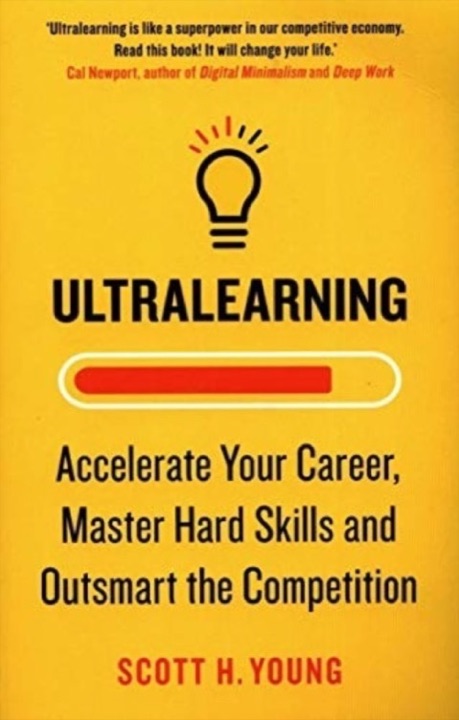
Ultralearning: Master Hard Skills, Outsmart the Competition, and Accelerate Your Career
Applying the lessons from "Ultralearning" by Scott H. Young to your life can be a transformative experience, especially given your diverse interests and experiences. Here’s how you might integrate the principles of ultralearning into your personal and professional life:
-
Metalearning: - Given your interest in lifelong learning, start by mapping out areas you want to explore further, such as skydiving or playing the guitar. Identify the best resources, whether they are books, online courses, or mentors, to guide your learning journey.
-
Focus: - With your busy schedule, carve out dedicated time blocks for learning without distractions. This could be early in the morning or during a quiet evening, aligning with your routine of waking up early and valuing a good night's sleep.
-
Directness: - Apply new skills in real-world contexts. For instance, if you decide to learn guitar, play for your family or friends. This aligns with your value of being present and engaging with loved ones.
-
Drill: - Break down complex skills into manageable parts. For example, if you pursue skydiving, focus on mastering each step of the process, from understanding safety protocols to perfecting your landing technique.
-
Retrieval: - Regularly test yourself on what you’ve learned. This could be through self-quizzing or teaching others, which aligns with your direct communication style and humor.
-
Feedback: - Seek constructive feedback from experts or peers in your areas of interest. This can help refine your skills and ensure continuous improvement, much like your approach to evaluating daily wins and losses.
-
Retention: - Use techniques like spaced repetition to retain new information. This could be useful in areas like learning a new language or memorizing guitar chords.
-
Intuition: - Develop a deep understanding of subjects by immersing yourself in them. Your philosophical influences, such as Marcus Aurelius and Socrates, suggest a natural inclination towards deep thinking and reflection.
-
Experimentation: - Embrace new approaches and techniques in your learning endeavors. Your openness to technological advancements and forward-thinking mindset can drive innovation in how you learn and apply new skills.
Practical Application:
- Skydiving: Start by researching the best training programs and instructors. Use the principles of directness and drill to practice each component of the jump.
- Guitar Playing: Set a structured practice schedule, focusing on drills for finger placement and chord transitions. Use feedback from online tutorials or local instructors.
- Professional Growth: Apply ultralearning to stay updated with medical advancements or explore new areas of interest, such as CRISPR technology. This aligns with your aspiration to leverage technology for societal betterment.
Overcoming Challenges:
- Use your resilience and persistence to push through learning plateaus. Your ability to remain calm under stress will be beneficial in maintaining focus and motivation.
- Address impulsivity by setting clear learning goals and timelines, ensuring a balanced approach to your diverse interests.
By integrating the principles of ultralearning into your life, you can continue to grow personally and professionally, achieving mastery in new skills while staying true to your core values of kindness, empathy, and lifelong learning.
What the book covers
"Ultralearning: Master Hard Skills, Outsmart the Competition, and Accelerate Your Career" by Scott H. Young is a comprehensive guide on how to learn effectively and efficiently. The book is based on the concept of "ultralearning," which is a strategy for aggressive, self-directed learning. Young draws from his own experiences and those of others who have successfully mastered complex skills in short periods.
Summary:
-
Introduction to Ultralearning: - Ultralearning is a strategy for acquiring skills and knowledge quickly and effectively. - It is characterized by intense focus and a self-directed approach. - The book argues that in a rapidly changing world, the ability to learn new skills quickly is a significant competitive advantage.
-
Principles of Ultralearning: - Young outlines nine principles that underpin ultralearning:
- Metalearning: Understanding how to learn effectively by mapping out the subject and identifying the best resources and methods.
- Focus: Cultivating the ability to concentrate deeply on learning tasks without distractions.
- Directness: Learning by doing, applying skills in real-world contexts rather than through abstract exercises.
- Drill: Breaking down complex skills into smaller components and practicing them intensively.
- Retrieval: Actively recalling information to strengthen memory and understanding.
- Feedback: Seeking and using feedback to improve performance and understanding.
- Retention: Employing strategies to ensure that learned material is retained over the long term.
- Intuition: Developing a deep understanding of the subject to the point where intuition guides decision-making.
- Experimentation: Trying new approaches and techniques to enhance learning.
-
Case Studies and Examples: - Young provides numerous examples of individuals who have successfully used ultralearning strategies to master complex skills, such as learning new languages, programming, or artistic abilities. - These case studies illustrate how the principles can be applied in various contexts and highlight the diversity of ultralearning projects.
-
Practical Application: - The book offers practical advice on how to design and execute an ultralearning project. - Young emphasizes the importance of setting clear goals, creating a structured plan, and maintaining motivation throughout the learning process.
-
Overcoming Challenges: - Young addresses common challenges faced during ultralearning, such as procrastination, lack of motivation, and dealing with setbacks. - He provides strategies for overcoming these obstacles, including techniques for maintaining focus and managing time effectively.
Key Takeaways and Lessons:
- Self-Directed Learning: Ultralearning emphasizes taking control of your own learning process, which requires discipline and motivation.
- Efficiency and Effectiveness: By focusing on the most effective learning strategies, you can achieve more in less time.
- Adaptability: The ability to learn quickly and adapt to new challenges is crucial in a rapidly changing world.
- Persistence and Resilience: Ultralearning requires perseverance and the ability to push through difficulties and setbacks.
- Continuous Improvement: Regular feedback and experimentation are essential for refining skills and improving performance.
Overall, "Ultralearning" provides a blueprint for anyone looking to enhance their learning capabilities and achieve mastery in their chosen fields. The book encourages readers to challenge themselves, embrace discomfort, and pursue lifelong learning as a means to personal and professional growth.