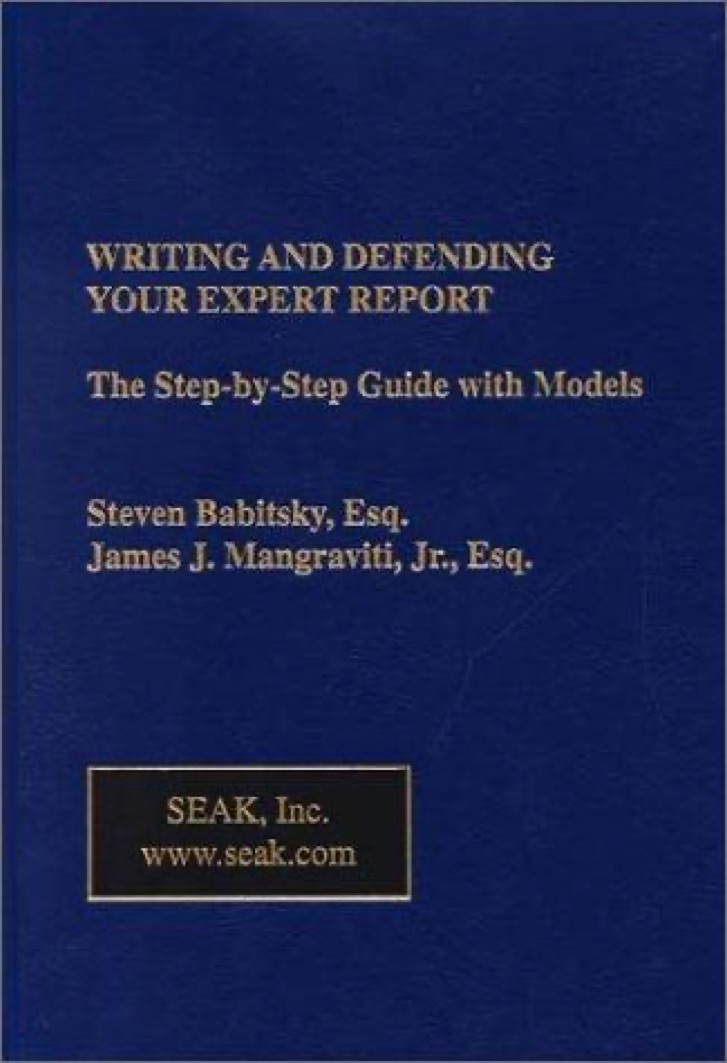
Writing and Defending Your Expert Report: The Step-by-Step Guide with Models
Applying the lessons from "Writing and Defending Your Expert Report: The Step-by-Step Guide with Models" by Steven Babitsky and James J. Mangraviti Jr. to your life can be a transformative exercise in precision, professional integrity, and strategic communication. Here are some ways you might integrate these lessons:
-
Master Precision in Professional Documentation: - Whether you are documenting a complex medical case or drafting a due diligence report for a venture capital deal, you must treat every written word as if it will be scrutinized by an adversary. You should adopt a habit of rigorous self-editing, ensuring that your conclusions are always backed by documented data and that your logic is transparent and reproducible.
-
Cultivate Objective Authority: - In leadership and consulting, you should strive to present yourself as an objective truth-teller rather than a biased advocate. By removing emotional or hyperbolic language from your professional communications, you build a brand of reliability and trust that makes your opinions more persuasive to stakeholders, partners, and competitors alike.
-
Practice Pre-emptive Risk Management: - You can improve your strategic planning by adopting the "defensive drafting" mindset, where you actively seek out the weaknesses in your own arguments or business plans before they are exposed by others. By identifying and addressing potential vulnerabilities in your strategy during the development phase, you create a more resilient foundation for your ventures.
-
Standardize Complex Workflows: - Just as the authors use models to simplify the reporting process, you should implement templates and checklists in your medical practice, aviation routines, or business operations. This structural discipline ensures that critical details are never overlooked and that your output remains consistent even under high-pressure conditions.
-
Bridge the Gap Between Theory and Application: - You must focus on the "how" and "why" of your conclusions, not just the "what." In your role as a mentor or entrepreneur, ensure that you can clearly explain the methodology behind your decisions, making your specialized knowledge accessible and defensible to those who do not share your technical background.
-
Uphold Unimpeachable Ethical Standards: - You should recognize that your professional reputation is your most valuable asset. By maintaining strict adherence to ethical guidelines and refusing to compromise your objectivity for the sake of a favorable outcome, you ensure long-term success and respect in the highly interconnected worlds of medicine, law, and finance.
By integrating these lessons, you will develop a superior ability to communicate complex ideas with clarity and confidence, ensuring that your expertise is not only heard but is also respected and durable in any high-stakes environment.
What the book covers
"Writing and Defending Your Expert Report: The Step-by-Step Guide with Models" by Steven Babitsky and James J. Mangraviti Jr. is a comprehensive technical manual designed to elevate the standard of forensic reporting for professionals across various disciplines. As a staple resource for expert witnesses, the book provides a systematic approach to drafting reports that comply with federal and state legal requirements while remaining resilient under the scrutiny of cross-examination. By combining legal theory with practical, model-based examples, the authors demystify the transition from technical expertise to judicial persuasiveness, ensuring that experts can effectively communicate complex findings to a legal audience.
Summary:
-
The Legal Framework and Rule 26 Compliance: - The authors begin by grounding the reader in the essential legal requirements for expert reports, specifically focusing on Rule 26 of the Federal Rules of Civil Procedure. They detail the mandatory disclosures required in federal court, such as a complete statement of all opinions, the data considered, the expert’s qualifications, and a list of previous testimonies, emphasizing that any omission can lead to the exclusion of the expert's testimony.
-
The Foundations of a Bulletproof Report: - This section explores the structural elements that make a report defensible, including the necessity of a clear table of contents, a concise summary of opinions, and a logical flow from facts to conclusions. The authors argue that the report is often the most important document in a case, as it sets the boundaries for the expert's deposition and trial testimony, requiring a level of precision that leaves no room for misinterpretation by opposing counsel.
-
Clarity, Tone, and Professional Language: - Babitsky and Mangraviti highlight the importance of using objective, non-adversarial language to maintain the expert's credibility as an independent professional rather than a "hired gun." They provide specific guidance on avoiding hedging language, jargon, and definitive statements that cannot be supported by the evidence, while also discussing the tactical use of active voice to convey confidence and authority.
-
Utilizing Models and Critiquing Examples: - A significant portion of the book is dedicated to analyzing actual expert reports, providing both "model" examples and "cautionary tales" to illustrate common errors. By deconstructing these reports, the authors show how subtle formatting choices, the inclusion of helpful visuals, and the organization of supporting data can either strengthen the expert’s position or provide ammunition for a devastating cross-examination.
-
Drafting for the Defense: - This section teaches experts how to "stress test" their own work by anticipating the specific lines of attack that an opposing attorney might use. The authors provide a checklist of vulnerabilities, such as inconsistent methodologies, reliance on hearsay, or failure to consider alternative hypotheses, and explain how to address these potential weaknesses directly within the written report to preemptively neutralize them.
-
The Transition from Report to Testimony: - The final sections focus on the defensive aspect of the report during depositions and trial, explaining how the written word becomes the basis for oral examination. The authors provide strategies for experts to stick to the four corners of their report and handle aggressive questioning that attempts to move them away from their prepared conclusions, reinforcing that a well-written report is the best shield against professional embarrassment in the courtroom.
This book is an essential guide for any professional looking to master the intersection of their specific expertise and the legal system. Its significance lies in its ability to transform high-level technical knowledge into a structured, legally sound document that protects the expert's reputation and assists the trier of fact in reaching a just conclusion.