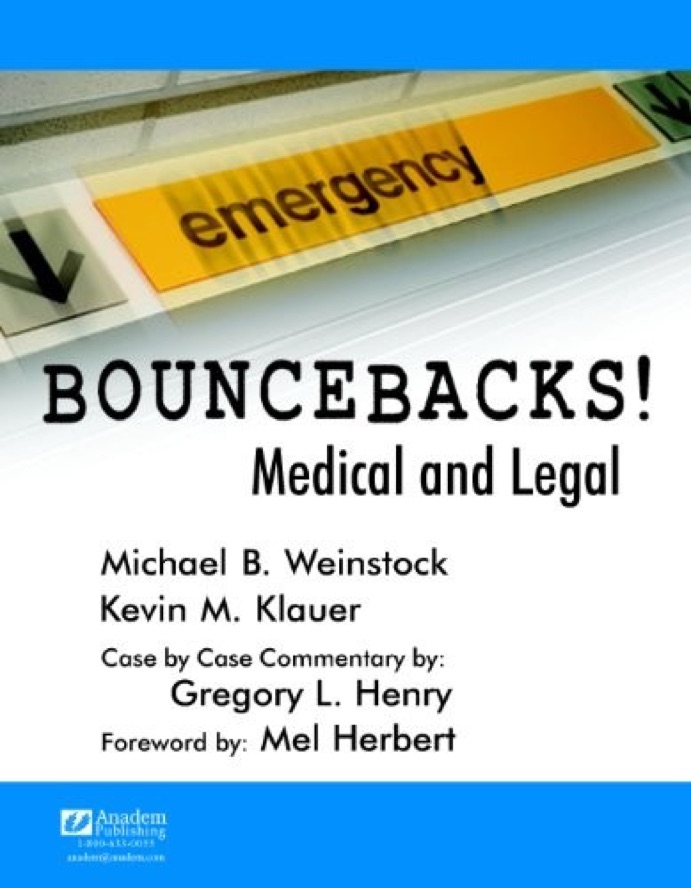
Bouncebacks! Medical and Legal
Applying the lessons from "Bouncebacks! Medical and Legal" by Michael B. Weinstock, Kevin M. Klauer, and Gregory L. Henry to your life can be a powerful catalyst for developing a more rigorous, risk-aware, and communicative professional practice. Here are some ways you might integrate these lessons:
-
Adopt a "Worst-First" Framework: - In any high-stakes environment—whether in the ER, the cockpit, or the boardroom—you must train yourself to identify the most catastrophic potential outcome first. By systematically ruling out the "killers" before moving to more likely but less dangerous explanations, you create a robust safety margin for your decision-making process.
-
Communicate the Rationale, Not Just the Result: - Whether you are speaking to a patient or a business partner, you should explain your thought process and the uncertainty involved in a situation. Effective communication involves setting clear expectations for what should happen next and what "red flags" should trigger a re-evaluation, ensuring all parties are aligned on the plan of action.
-
View Documentation as a Narrative of Excellence: - You should treat your records—legal, medical, or corporate—as a narrative that justifies your choices to a future audience. High-quality documentation should reflect your reasoning, demonstrating that you were thorough, thoughtful, and diligent, even if the eventual outcome was not what you intended.
-
Cultivate Extreme Vigilance During Transitions: - Recognize that the highest risk of error occurs during transitions of care or shifts in strategy. You should pay extra attention when "handing off" a project or a patient, ensuring that critical information is not lost in translation and that the recipient has a full understanding of the potential risks.
-
Actively Manage Your Cognitive Biases: - You must remain humble enough to realize that your brain is naturally wired to seek patterns and take shortcuts. By actively seeking out information that contradicts your initial hypothesis, you can prevent anchoring bias and premature closure, leading to more accurate results in your leadership and clinical practice.
-
Build a "Culture of Return": - You should foster an environment where a "bounceback" or a flagged error is seen as an opportunity for system improvement rather than an occasion for blame. By welcoming feedback and re-evaluating decisions when new data emerges, you create a resilient culture that prioritizes safety and continuous learning over ego.
By integrating these lessons, you can transform your approach to risk from one of fear-based avoidance to one of strategic mastery, ensuring that your clinical, legal, and entrepreneurial endeavors are built on a foundation of thoroughness and intellectual honesty.
What the book covers
"Bouncebacks! Medical and Legal" by Michael B. Weinstock, Kevin M. Klauer, and Gregory L. Henry is a seminal text in emergency medicine that bridges the gap between clinical decision-making and medical malpractice risk management. By analyzing real-world cases where patients returned to the emergency department with critical conditions after an initial discharge, the authors provide a framework for improving diagnostic accuracy and documentation. This work serves as both a teaching tool for clinicians and a cautionary guide for avoiding legal pitfalls in high-stakes medical environments.
Summary:
-
The Anatomy of a Bounceback: - The book defines a "bounceback" as the return of a patient to the emergency department after a recent discharge, often indicating a failure in the initial assessment or an evolution of disease. These cases represent the greatest clinical and legal vulnerability for physicians, as they often involve high-stakes conditions like pulmonary embolisms or evolving myocardial infarctions that were missed or underestimated during the first visit. - By studying these failures, the authors argue that clinicians can move from defensive medicine toward a proactive model of "safe" medicine. Each case study identifies the specific point where the diagnostic process went off track, highlighting the difference between a bad outcome and a preventable error.
-
Cognitive Biases and Diagnostic Errors: - A significant portion of the text is dedicated to the psychological hurdles that prevent accurate diagnosis, such as premature closure and anchoring bias. The authors demonstrate how clinicians often fixate on a benign diagnosis early in the encounter, leading them to ignore or minimize "red flag" symptoms that suggest a more serious underlying condition. - The book advocates for a systematic approach to patient evaluation, encouraging doctors to intentionally consider the most dangerous possible diagnosis for every presenting symptom. This "worst-first" mindset is presented as a necessary countermeasure to the fast-paced, high-volume nature of emergency medicine.
-
The Critical Role of Documentation: - The authors provide an in-depth analysis of how medical charts are viewed through a legal lens during a malpractice trial. They argue that documentation is not just a record of care but a primary defense tool, noting that if an assessment or physical exam finding is not written down, it effectively never happened in the eyes of a jury. - Specific attention is paid to the "negative finding," which involves explicitly documenting the absence of certain symptoms to prove that a serious diagnosis was considered and ruled out. This helps clinicians understand how to write notes that justify their clinical decisions even when the eventual outcome is poor.
-
Navigating High-Risk Medical Encounters: - Through detailed case reviews, the book examines conditions frequently missed in the ED, including aortic dissections and pediatric sepsis. The clinical analysis provides evidence-based updates on diagnostic testing and the limitations of certain labs, such as the danger of relying on a "normal" white blood cell count to rule out serious infection. - These chapters emphasize the importance of discharge instructions and "return precautions," which act as a safety net for both the patient and the physician. Clear, specific instructions can significantly mitigate legal risk by shifting responsibility back to the patient to report changes in their condition.
-
Legal Theory and the Malpractice Environment: - The text explains the four elements of negligence—duty, breach of duty, causation, and damages—through the eyes of both the doctor and the attorney. Gregory Henry provides insights into how plaintiff attorneys select cases and how they use expert witnesses to exploit gaps in clinical reasoning or incomplete medical records. - This section demystifies the legal process for physicians, explaining the nuances of deposition and trial testimony. By understanding the "standard of care" from a legal perspective, practitioners are better equipped to navigate the complexities of modern healthcare without living in constant fear of litigation.
The significance of "Bouncebacks! Medical and Legal" lies in its ability to turn failure into a pedagogical tool, humanizing the errors that often remain whispered about in hospital corridors. It moves beyond theoretical medicine to the reality of the bedside, teaching clinicians how to think critically under pressure. For the emergency physician, it is a guide to survival, ensuring they can provide the best possible care while maintaining the integrity of their practice in an increasingly litigious landscape.