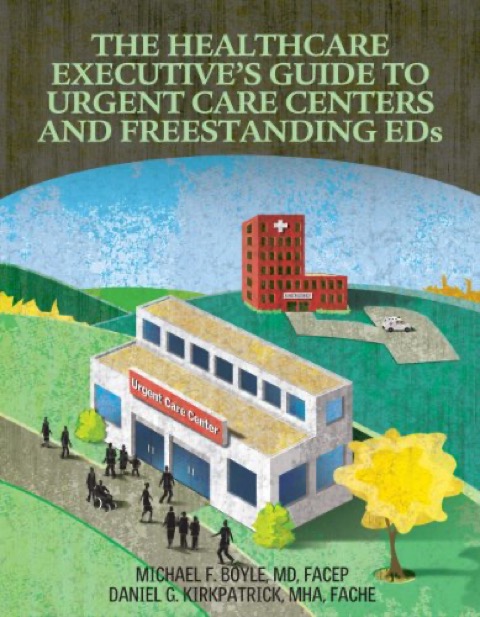
The Healthcare Executive's Guide to Urgent Care Centers and Freestanding EDs
Applying the lessons from "The Healthcare Executive's Guide to Urgent Care Centers and Freestanding EDs" by Michael F. Boyle and Daniel G. Kirkpatrick to your life can be a catalyst for rethinking how you deliver value in a high-stakes, consumer-driven environment. Here are some ways you might integrate these lessons:
-
Adopt a Retail Mindset for Professional Services: - In your ventures, you should view the "patient" or "client" as a consumer who values convenience and speed as much as quality. Evaluate your current business models—whether in medicine, law, or aviation—to identify where friction can be removed to provide a more seamless, "on-demand" experience that prioritizes the user's time and location.
-
Master the Regulatory Chessboard: - You must recognize that success in highly regulated industries is often determined by your ability to navigate legal nuances before they become obstacles. Like the distinction between urgent care and FED regulations, you should proactively analyze the legislative landscape of your next investment to ensure that your operational model is both compliant and strategically shielded from shifting state or federal policies.
-
Optimize the "Front Door" Strategy: - Whether building a telehealth platform or a VC firm, you should focus on the initial touchpoint where you first capture a lead or patient. Ensure this entry point is highly accessible and provides immediate value, as this serves as the primary engine for downstream opportunities and long-term loyalty within your broader ecosystem.
-
Balance Clinical Quality with Lean Operations: - You should apply "lean" principles to your leadership by constantly auditing processes for waste. In any high-cost environment, from an ER to a startup, the key to scaling is finding the optimal staffing mix and workflow that maintains high standards while minimizing overhead, ensuring that you remain "hungry" for efficiency and "humble" enough to fix broken systems.
-
Leverage Data-Driven Real Estate and Positioning: - When expanding your footprint, you must move beyond intuition and rely on granular data regarding demographics and competition. Just as site selection is critical for a physical clinic, you should apply the same rigor to "digital real estate" and market positioning, ensuring your brand is exactly where your target audience spends their time and resources.
-
Ensure Seamless Systems Integration: - You must avoid creating "silos" within your various professional roles. Just as a freestanding ED must integrate with the main hospital's EHR, you should ensure that your legal, medical, and entrepreneurial insights inform one another, creating a unified personal and professional brand that is more than the sum of its parts.
By integrating these lessons, you can build healthcare and business organizations that are not only financially resilient but also deeply attuned to the modern requirements of speed, accessibility, and high-quality outcomes.
What the book covers
"The Healthcare Executive's Guide to Urgent Care Centers and Freestanding EDs" by Michael F. Boyle and Daniel G. Kirkpatrick is a comprehensive strategic manual designed to help hospital and health system administrators navigate the expanding landscape of ambulatory care. The book provides a practical framework for evaluating the feasibility, design, and operational implementation of both urgent care centers and freestanding emergency departments (FEDs). It serves as a roadmap for healthcare leaders looking to expand their market footprint, capture downstream referrals, and improve patient access through decentralized delivery models. By blending financial analysis with operational best practices, the authors offer a blueprint for integrating these high-growth facilities into broader health system goals.
Summary:
-
The Strategic Imperative for Decentralization: - The authors argue that the traditional hospital-centric model is no longer sufficient to meet modern patient demands for convenience and lower costs. They emphasize that urgent care centers and FEDs act as critical "front doors" to a health system, capturing patients who might otherwise seek care from competitors or in expensive, over-burdened hospital emergency rooms. - By establishing a distributed network of care points, executives can better manage population health and build brand loyalty. The book outlines how these facilities serve as high-visibility marketing tools that signal a system's commitment to community-based, accessible medicine.
-
Market Assessment and Site Selection: - Boyle and Kirkpatrick detail the necessity of rigorous data-driven market analysis before breaking ground. This involves evaluating demographic trends, local competition, payer mix, and drive-time patterns to ensure the facility is positioned for maximum utilization. - The section highlights that site selection for these centers follows retail logic rather than clinical logic. High visibility, easy ingress and egress, and proximity to high-traffic retail anchors are often more important than being near a main hospital campus.
-
Regulatory and Legal Considerations: - A significant portion of the text is dedicated to the complex regulatory environment, particularly the differences between urgent care centers and FEDs regarding EMTALA compliance and state licensing. The authors warn that FEDs face higher scrutiny and stricter requirements for 24/7 operation and emergency physician coverage. - They provide guidance on navigating Certificate of Need (CON) laws and the legal implications of various joint venture models. Understanding these legal boundaries is presented as essential for mitigating risk and ensuring long-term institutional stability.
-
Operational Excellence and Patient Throughput: - The book focuses on the "retail healthcare" mindset, where patient experience and throughput are the primary drivers of success. The authors advocate for lean operational processes that minimize wait times and maximize provider efficiency without compromising clinical quality. - It covers the practicalities of staffing, suggesting that the mix of physicians, physician assistants, and nurse practitioners must be carefully balanced to manage labor costs while meeting the acuity levels typical of the specific facility type.
-
Financial Modeling and Revenue Cycles: - Detailed advice is provided on creating realistic pro formas that account for the unique billing and reimbursement structures of ambulatory care. This includes the higher facility fees associated with FEDs versus the lower, more competitive pricing of urgent care centers. - The authors emphasize the importance of specialized coding and billing teams who understand the nuances of outpatient versus emergency department claims. They argue that financial failure in these ventures often stems from a failure to account for the "leakage" of patients back to the main hospital system.
-
Facility Design and Clinical Integration: - The guide explores how the physical layout of a center influences both staff efficiency and patient satisfaction. Design should prioritize clear wayfinding, private exam spaces, and integrated diagnostic services like X-ray and lab capabilities. - Finally, the authors stress that these facilities must not exist as islands. They provide strategies for ensuring seamless electronic health record (EHR) integration and clinical hand-offs, so that a patient seen in an urgent care center can easily transition to a specialist or hospital within the same system.
This work is a foundational text for healthcare leaders who must balance clinical excellence with the fiscal realities of a competitive, retail-driven medical market. It remains highly relevant for those tasked with scaling medical services beyond the four walls of a traditional hospital.