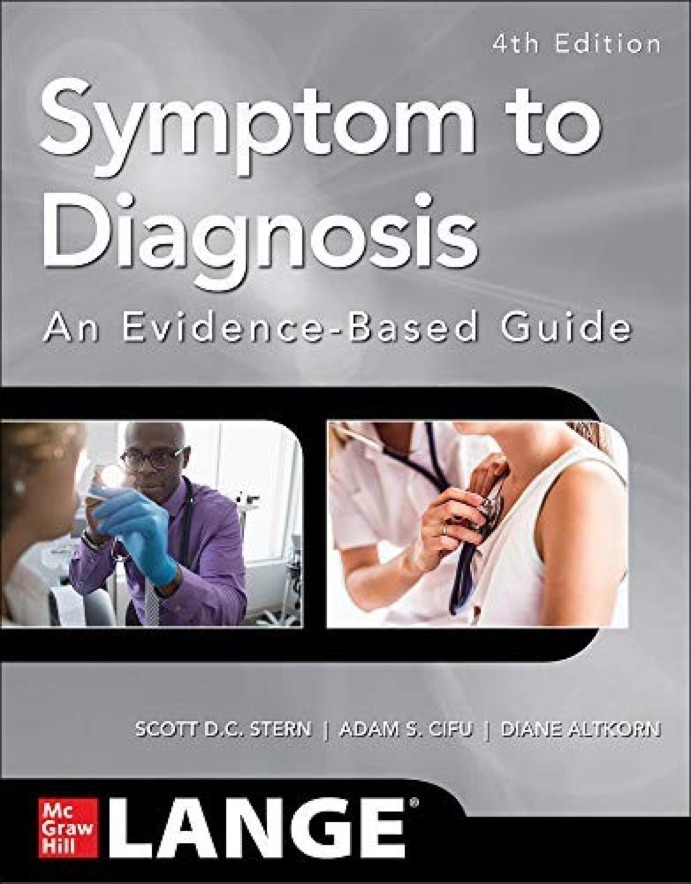
Symptom to Diagnosis: An Evidence-Based Guide
Applying the lessons from "Symptom to Diagnosis: An Evidence-Based Guide" by Scott D. C. Stern, Adam S. Cifu, and Diane Altkorn to your life can be a transformative exercise in sharpening your analytical faculties across medicine, business, and leadership. Here are some ways you might integrate these lessons:
-
Adopt a Bayesian Mindset in Decision-Making: - In your roles as a venture capitalist and attorney, you can use the book’s focus on pre-test probability and likelihood ratios to evaluate new opportunities or legal cases. Instead of viewing information in a vacuum, always ask how a new piece of data shifts the probability of success or failure based on your existing knowledge base.
-
Utilize Structured Differential Diagnosis in Business: - When a company in your portfolio underperforms, treat the "symptom" (e.g., declining revenue) like a medical case. Develop a broad differential of possible causes—market shifts, internal management issues, or product-market fit—and systematically use evidence to rule them out rather than jumping to a premature conclusion.
-
Implement Checklists and Decision Rules for High-Stakes Tasks: - Drawing from your aviation background, you can appreciate the book's reliance on clinical decision rules. In your leadership and clinical practice, formalize "go/no-go" criteria for complex procedures or business acquisitions to mitigate the effects of fatigue and cognitive bias.
-
Focus on the "Must-Not-Miss" Scenarios: - Just as the book emphasizes identifying life-threatening diagnoses early, you should apply this to risk management in entrepreneurship and law. Identify the "black swan" events that could bankrupt a project or lose a case, and ensure your primary strategy includes specific safeguards against these outcomes.
-
Prioritize High-Utility Information Over Noise: - In an age of data overload, the book teaches you to value tests with high likelihood ratios. Apply this by identifying the key performance indicators (KPIs) in your businesses that actually correlate with growth, rather than getting distracted by vanity metrics that don't truly inform the "diagnosis" of your company’s health.
-
Commit to Rigorous Root Cause Analysis: - Use the book’s symptom-to-source methodology to ensure you are never just treating symptoms in your organizations. Whether it’s a culture issue or an operational bottleneck, trace the problem back to its underlying "pathophysiology" to ensure the solution is permanent and effective.
By integrating these lessons, you will enhance your ability to navigate uncertainty with a disciplined, evidence-based approach that balances the hunger for discovery with the humility to follow where the data leads.
What the book covers
"Symptom to Diagnosis: An Evidence-Based Guide" by Scott D. C. Stern, Adam S. Cifu, and Diane Altkorn is a foundational medical text designed to bridge the gap between clinical symptoms and definitive diagnoses. Unlike traditional textbooks that organize content by disease, this guide utilizes a symptom-based approach to mirror the actual experience of a clinician in the exam room. By integrating pathophysiology with rigorous clinical reasoning and evidence-based medicine, the authors equip practitioners with the analytical tools needed to evaluate complex presentations and minimize diagnostic error. It serves as both a comprehensive curriculum for medical students and a sophisticated reference for seasoned physicians seeking to refine their diagnostic accuracy.
Summary:
-
The Architecture of Clinical Reasoning: - The book establishes a structured framework for the diagnostic process, emphasizing the transition from a patient’s subjective complaint to a refined list of possibilities. It teaches clinicians how to organize their thoughts using the "differential diagnosis" model, ensuring that high-probability conditions and "must-not-miss" diagnoses are prioritized. - By focusing on the logic of the clinical encounter, the authors demonstrate how to parse history and physical exam findings to adjust the pre-test probability of various diseases, a core tenet of Bayesian reasoning in medicine.
-
The Three-Part Chapter Structure: - Each chapter is meticulously organized into three distinct sections: The Patient Presentation, The Diagnostic Process, and The Evidence-Based Guide. This consistency allows readers to follow a single symptom—such as chest pain or fever—from its initial presentation through the investigative journey to the final diagnosis. - The "Patient Presentation" provides a realistic clinical vignette, while the "Diagnostic Process" outlines the cognitive steps taken to narrow down the differential, and the "Evidence-Based Guide" provides the data-driven justification for tests and treatments.
-
Evidence-Based Medicine and Likelihood Ratios: - A hallmark of the text is its heavy reliance on likelihood ratios (LRs) to determine the utility of specific physical exam findings and diagnostic tests. It moves away from binary "positive or negative" thinking toward a more nuanced understanding of how much a specific finding shifts the probability of a disease. - This data-driven approach encourages clinicians to abandon outdated or low-utility tests in favor of those with high sensitivity and specificity, ultimately leading to more efficient and cost-effective patient care.
-
Navigating Common and Complex Symptoms: - The book covers a vast array of clinical presentations, ranging from ubiquitous symptoms like cough and abdominal pain to complex systemic issues like weight loss and syncope. For each symptom, the authors provide detailed tables comparing the clinical features of various etiologies. - These comparisons help the reader recognize patterns and "red flags" that distinguish benign conditions from life-threatening emergencies, which is particularly vital in high-stakes environments like the emergency department.
-
The Role of Clinical Decision Rules: - The authors integrate validated clinical decision rules (such as the Wells Criteria for pulmonary embolism) directly into the diagnostic flow. This provides a standardized way to categorize patient risk and decide on the necessity of invasive or expensive imaging. - By incorporating these rules, the text helps standardize care and reduce the cognitive load on the physician, allowing for more objective decision-making in the heat of clinical practice.
-
Pathophysiological Correlation: - While the focus is on diagnosis, the book never loses sight of the underlying biological mechanisms. It connects the clinical signs observed at the bedside to the underlying pathophysiology of the disease, reinforcing why certain symptoms occur. - This deep integration of basic science with clinical practice ensures that the reader is not just memorizing algorithms but is developing a profound understanding of disease processes.
This text is significant because it transforms the diagnostic process from an intuitive "art" into a measurable, evidence-based science. By teaching clinicians how to think rather than just what to know, Stern, Cifu, and Altkorn provide a roadmap for reducing medical errors and improving the quality of patient care in an increasingly complex healthcare landscape.