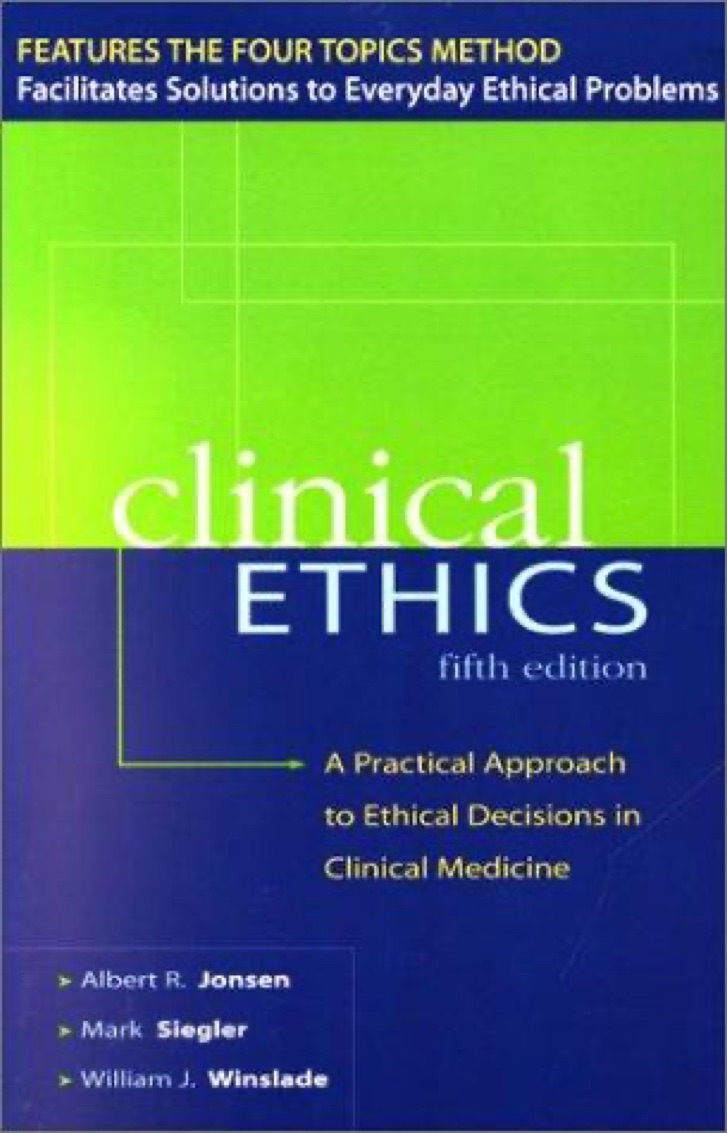
Clinical Ethics: A Practical Approach to Ethical Decisions in Clinical Medicine
Applying the lessons from "Clinical Ethics: A Practical Approach to Ethical Decisions in Clinical Medicine" by Albert R. Jonsen, Mark Siegler, and William J. Winslade to your life can be a transformative exercise in enhancing your professional integrity and decision-making clarity. Here are some ways you might integrate these lessons:
-
Implement Multi-Factorial Frameworks: - Just as the Four Topics method organizes clinical chaos, you can apply similar quadrants to your ventures in venture capital or entrepreneurship. By systematically evaluating technical feasibility, stakeholder preferences, long-term impact, and regulatory context, you ensure that your business decisions are balanced and defensible rather than reactive or one-dimensional.
-
Prioritize Stakeholder Autonomy: - In leadership, you should treat the "preferences" of your team and partners with the same respect a physician gives to a patient's wishes. Practice active listening and ensure true informed consent in your business dealings, recognizing that long-term success in complex healthcare systems depends on the voluntary and understood buy-in of all participants.
-
Navigate Legal and Moral Intersections: - Drawing on your background in law and medicine, use the "Contextual Features" lesson to better identify when a decision is legally permissible but morally questionable. Developing the habit of identifying external pressures—like reimbursement models or liability fears—allows you to separate these from the core mission of doing what is right for the end-user or patient.
-
Assess Quality vs. Quantity of Effort: - Use the book’s focus on "Quality of Life" to evaluate your own professional projects and personal time. Ask yourself whether a specific pursuit contributes to the "quality" of your mission or if it is merely a high-effort activity with diminishing returns, much like a medical intervention that prolongs life without restoring function.
-
Calibrate Decision-Making Under Pressure: - In aviation and emergency medicine, seconds count, but ethics still apply. By internalizing the structured approach of this book, you can develop the "muscle memory" to make ethically sound decisions even in high-stress environments, ensuring that your hunger for progress never outstrips your humble commitment to doing no harm.
By integrating these lessons, you will cultivate a leadership style that is both analytically rigorous and deeply human, allowing you to navigate the most complex healthcare and business landscapes with a clear moral compass and an unwavering focus on the people you serve.
What the book covers
"Clinical Ethics: A Practical Approach to Ethical Decisions in Clinical Medicine" by Albert R. Jonsen, Mark Siegler, and William J. Winslade is a foundational text that provides a structured, pragmatic framework for resolving the complex moral dilemmas encountered in the practice of medicine. Known widely as the "Four Topics" approach, the book offers clinicians a systematic way to organize their thoughts and data when navigating the intersection of medical facts, patient values, and legal or social obligations. It serves as an essential manual for healthcare providers to ensure that ethical decision-making is as rigorous and evidence-based as clinical diagnosis and treatment.
Summary:
-
The Four Topics Method: - The authors introduce a quadrant-based system designed to help clinicians categorize and analyze the ethical dimensions of any clinical case. This framework divides ethical considerations into Medical Indications, Patient Preferences, Quality of Life, and Contextual Features, ensuring no critical perspective is overlooked during the decision-making process.
-
Medical Indications: - This section focuses on the principles of beneficence and non-maleficence, requiring a clear assessment of the patient’s clinical problem, history, and prognosis. Clinicians are taught to evaluate the goals of treatment, the probability of success for various interventions, and the circumstances under which treatment may be deemed non-beneficial or physiologically futile.
-
Patient Preferences: - Emphasizing the principle of autonomy, the authors explore the legal and moral requirements for informed consent and the right to refuse treatment. The text provides guidance on assessing decisional capacity, managing the care of incapacitated patients through surrogate decision-makers or advance directives, and the nuances of truth-telling in the doctor-patient relationship.
-
Quality of Life: - This topic addresses the prospective evaluation of the patient’s life after treatment, examining what constitutes a "good life" from the patient's perspective versus a purely clinical one. It tackles difficult subjects such as palliative care, the use of pain medication that may hasten death, and the ethical distinctions between killing and letting die in various clinical scenarios.
-
Contextual Features: - The authors acknowledge that clinical decisions do not happen in a vacuum, requiring clinicians to consider external factors such as professional standards, institutional policies, and financial constraints. This section covers the impact of family interests, the role of hospital ethics committees, legal requirements for reporting, and the influence of the healthcare system’s economics on bedside care.
-
End-of-Life and Critical Care Dilemmas: - A significant portion of the book is dedicated to high-stakes decisions in the ICU and emergency settings, including Do-Not-Resuscitate (DNR) orders and the withdrawal of life-sustaining treatment. It provides a clear logic for navigating the emotional and professional stress associated with terminal illness and permanent unconsciousness.
This classic text remains significant because it successfully demystifies ethics for the working physician, moving the field away from abstract philosophy and toward a practical bedside tool. By providing a repeatable methodology, Jonsen, Siegler, and Winslade have standardized the way clinicians across the globe approach the moral weight of their professional responsibilities.