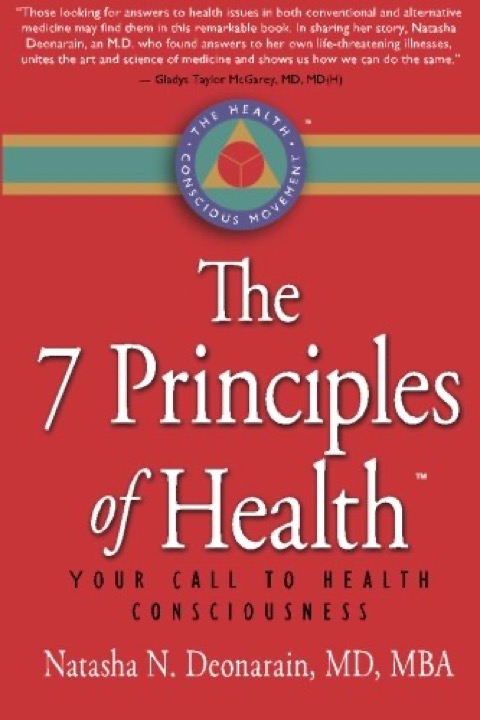
The 7 Principles of Health: Your Call to Health Consciousness
Applying the lessons from "The 7 Principles of Health: Your Call to Health Consciousness" by Natasha N. Deonarain to your life can be the catalyst for a total optimization of your physical and mental performance. Here are some ways you might integrate these lessons:
-
Adopt a Founder’s Mindset Toward Your Biology: - You should view your body not as a machine that occasionally breaks down, but as a high-stakes startup where you are the CEO and majority stakeholder. In the same way you conduct due diligence on a venture capital deal, perform daily "due diligence" on your health by tracking data, monitoring inputs, and adjusting strategy based on your unique physiological feedback.
-
Incorporate Strategic Stillness into Your Leadership: - In fast-paced environments like the ER, the cockpit, or the boardroom, the ability to find a "center" is a competitive advantage. Integrate short, non-negotiable blocks of stillness into your schedule to clear cognitive clutter, which enhances decision-making and prevents the burnout common in high-performance careers.
-
Cultivate Somatic Awareness for Better Diagnostics: - Use the principle of awareness to become more attuned to your body’s subtle cues. Just as a pilot monitors a cockpit’s gauges for early signs of engine fatigue, you must learn to recognize the early physical manifestations of stress or inflammation before they escalate into medical crises that sideline your productivity.
-
Optimize Your Environment for Peak Performance: - Audit your physical and social surroundings to ensure they are conducive to your long-term goals. This means ruthlessly eliminating "environmental noise"—whether that is processed toxins in your pantry or toxic dynamics in your professional circles—to create a workspace and home life that act as a tailwind for your health.
-
Leverage Bio-Individuality in Nutrition and Movement: - Reject the "standard operating procedures" of generic health trends and instead treat your diet and exercise as an iterative experiment. As a lifelong learner, you should use trial and error to identify which specific protocols maximize your personal energy levels and mental acuity, ignoring the noise of mass-market fitness fads.
-
Build a Legacy of Health Consciousness: - Extend your leadership by fostering a culture of health within your organizations and family. By modeling health consciousness rather than just "managing" symptoms, you inspire those around you to take agency over their own lives, creating a ripple effect of vitality that strengthens your entire community.
By integrating these lessons, you move beyond the limitations of the traditional medical model and enter a state of high-performance health consciousness. This holistic approach ensures that you stay hungry for new challenges and humble enough to listen to your body’s wisdom, ultimately sustaining your ability to lead, innovate, and serve at the highest level for decades to come.
What the book covers
"The 7 Principles of Health: Your Call to Health Consciousness" by Natasha N. Deonarain is a provocative and transformative guide that challenges the status quo of the modern medical-industrial complex. Deonarain, a physician herself, argues that true health is not merely the absence of disease but a state of heightened consciousness and active participation in one's own biological and spiritual well-being. The book provides a structured framework designed to help individuals transition from being passive recipients of healthcare to becoming the primary architects of their own vitality.
Summary:
-
The Paradigm of Health Consciousness: - Deonarain begins by distinguishing between "healthcare," which she defines as a reactive system focused on symptom suppression, and "health consciousness," a proactive state of self-awareness. She argues that the current system is designed to manage chronic illness rather than foster true wellness, requiring a fundamental shift in how patients perceive their bodies. - This section emphasizes that health is a personal responsibility and a continuous journey rather than a destination. By understanding the interconnectedness of mind, body, and spirit, individuals can break free from the cycle of dependency on pharmaceutical interventions and embrace a more holistic approach to longevity.
-
The Principle of Consciousness and Intent: - The author posits that every health outcome begins with an internal state of being and intentionality. She explores how our thoughts and beliefs directly influence our physiological states, suggesting that a mindset of healing is a prerequisite for any physical recovery. - This principle encourages readers to examine their underlying motivations for seeking health, moving away from fear-based reactions toward a purpose-driven desire to live a full and vibrant life.
-
The Power of Stillness and Internal Silence: - Deonarain highlights the critical role of stillness in a hyper-connected, high-stress world, presenting it as a vital biological necessity for cellular repair and mental clarity. She provides techniques for integrating meditation and quiet reflection into daily life to recalibrate the nervous system. - By cultivating stillness, individuals can better hear the subtle signals their bodies send, allowing for earlier intervention and a more intuitive understanding of their own health needs.
-
Awareness as a Diagnostic Tool: - This section focuses on developing a deep, somatic awareness of one's physical sensations and emotional triggers. Deonarain argues that most people are dissociated from their bodies, leading them to ignore early warning signs of systemic imbalance. - The book teaches readers how to perform internal "scans" and use mindfulness to identify the root causes of discomfort, effectively becoming their own primary observers before seeking external medical consultation.
-
Movement, Nutrition, and the Physical Foundation: - While covering traditional topics like diet and exercise, the author frames them through the lens of bio-individuality. She rejects one-size-fits-all protocols, urging readers to experiment and find the specific fuels and movements that resonate with their unique genetic and lifestyle requirements. - The emphasis is on functional movement and nutrient density, treating food as information that tells the body how to function at an epigenetic level.
-
Environmental Influence and External Toxicity: - Deonarain examines the impact of the external environment, including toxins in the air, water, and food supply, as well as the "emotional toxicity" of stressful relationships and media consumption. She provides strategies for creating a "healing sanctuary" within one's home and workplace. - This principle underscores the importance of setting boundaries and consciously choosing environments that support, rather than deplete, one's energetic and physical resources.
-
The Necessity of Connection: - The final principle addresses the social and spiritual dimensions of health, arguing that isolation is a significant risk factor for mortality. Deonarain explores how deep, authentic connections with others and a sense of belonging to a community act as biological buffers against disease. - She encourages the cultivation of a supportive "health tribe" and emphasizes that our individual well-being is inextricably linked to the health of our communities and the planet.
By synthesizing clinical expertise with ancient wisdom, Natasha N. Deonarain offers a blueprint for a new era of personalized wellness. The book's significance lies in its ability to empower the reader with the tools needed to navigate the complexities of modern life while maintaining a core of resilient, conscious health.