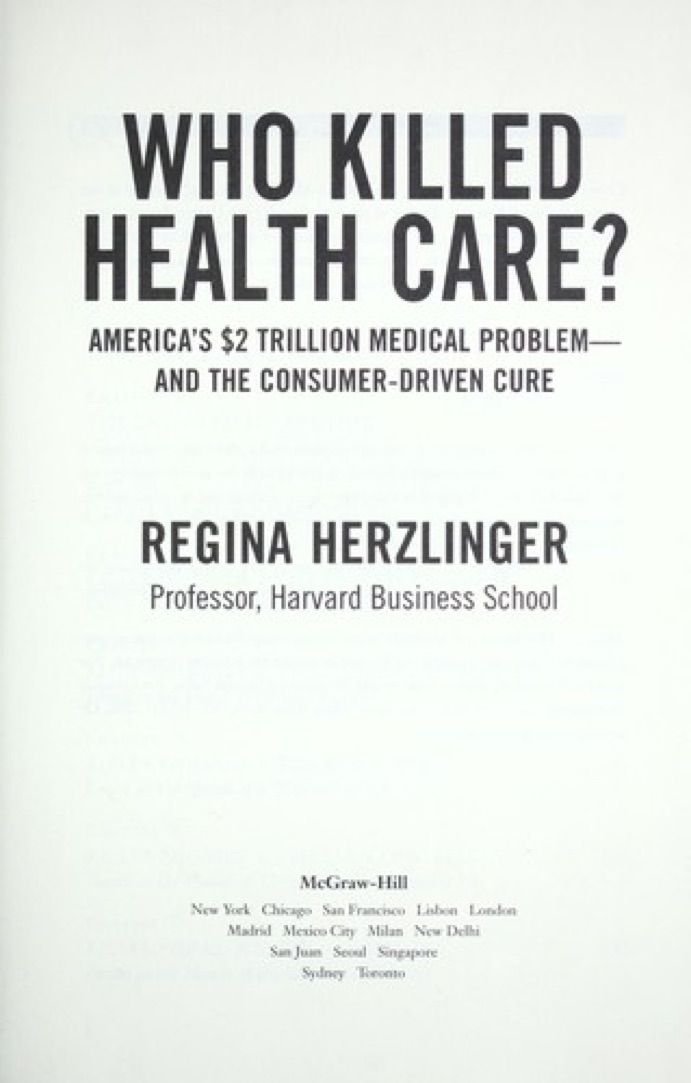
Who Killed Health Care? America's $2 Trillion Medical Problem - and the Consumer-Driven Cure
Applying the lessons from "Who Killed Health Care?" by Regina E. Herzlinger to your life can be a powerful catalyst for rethinking how you deliver care, invest in innovation, and navigate the complex intersection of medicine and business. Here are some ways you might integrate these lessons:
-
Empower the Patient as a True Consumer: - In your ventures like NextCare and MeMD, you have already moved toward increasing access; the next step is ensuring your services treat patients as active consumers rather than passive recipients. You should continue to build platforms that offer clear, upfront pricing and outcome data, allowing patients to feel the direct value of the service they are purchasing.
-
Champion Specialized Delivery Models: - As a leader in healthcare entrepreneurship and venture capital, you can look to fund and develop "focused factories"—clinics or digital health platforms that specialize deeply in one area. By focusing on excellence in a narrow scope, you can drive down costs and improve outcomes more effectively than generalist models, creating a competitive moat based on efficiency and expertise.
-
Leverage Transparency as a Competitive Edge: - Whether in the ER or the boardroom, you should advocate for radical transparency in medical billing and performance. By being the first to offer clear metrics to your patients and investors, you build a level of trust that traditional "middleman-heavy" organizations cannot match, positioning your firms as the ethical and practical choice in a murky market.
-
Advocate for Regulatory and Tax Reform: - Use your legal and MBA background to support policies that decouple health insurance from employment. By advocating for tax-advantaged individual accounts and the removal of barriers for new entrants, you can help create a macroeconomic environment where your entrepreneurial ventures can thrive without being stifled by protective regulations for incumbents.
-
Prioritize Patient-Controlled Data: - In the development of new health tech, you should prioritize interoperability and patient ownership of records. By ensuring that the people you serve can take their data with them, you reinforce the "Stay Humble" mantra—serving the patient’s long-term health journey rather than trying to lock them into a single proprietary ecosystem for short-term gain.
By integrating these lessons, you can continue to lead the charge in transforming healthcare from a bureaucratic maze into a responsive, consumer-driven industry. Embracing the role of the disruptive innovator allows you to align your medical ethics with your business acumen, ultimately creating a legacy of care that is as efficient as it is compassionate.
What the book covers
"Who Killed Health Care? America's $2 Trillion Medical Problem - and the Consumer-Driven Cure" by Regina E. Herzlinger is a seminal critique of the American medical system that identifies the systemic forces and "middlemen" responsible for rising costs and declining quality. Herzlinger, a Harvard Business School professor known as the "godmother of consumer-driven healthcare," argues that the system is broken because the actual consumer—the patient—has been stripped of control by powerful intermediaries. The book serves as both a diagnostic tool for the industry's failures and a strategic blueprint for a market-based revolution that empowers individuals to direct their own care.
Summary:
-
The Four Killers of Modern Medicine: - Herzlinger identifies four major players that have effectively "killed" the healthcare system: the government, private insurers, large employers, and the healthcare industry itself (hospitals and physician groups). She argues that these entities act as intermediaries that prioritize their own administrative and financial interests over the direct needs and preferences of the patients they are meant to serve. - These "killers" have created a top-down, one-size-fits-all system that removes the patient from the decision-making process. By controlling the money and the choices, these entities have stifled the natural market forces of competition and innovation that thrive in almost every other sector of the American economy.
-
The Failure of Managed Care and PPOs: - The book dissects the failure of managed care organizations and Preferred Provider Organizations (PPOs) to contain costs effectively. Herzlinger explains that while these models were designed to improve efficiency, they instead introduced layers of bureaucracy and restricted patient choice, leading to public backlash and a lack of transparency regarding the value of care being delivered. - Because patients do not directly pay for their care or choose their specific providers based on performance metrics, there is no incentive for providers to lower prices or for insurers to offer truly tailored products. This disconnect results in a system where costs continue to spiral upward without a corresponding increase in health outcomes.
-
The Vision of Consumer-Driven Health Care (CDHC): - The core of Herzlinger’s argument is the transition to a consumer-driven model, where individuals control their own healthcare dollars through tax-advantaged health savings accounts. She advocates for a system where consumers purchase their own insurance and medical services directly, much like they buy cars or electronics, forcing providers to compete on price, quality, and service. - This model shifts the power from the employer-sponsored system to a portable, individual-based system. By making patients the primary payers, the industry would be forced to cater to their needs, leading to higher satisfaction and more efficient allocation of medical resources.
-
The Rise of "Focused Factories": - One of the book's most compelling arguments is for the development of "focused factories"—specialized medical facilities that focus on specific diseases or procedures, such as heart surgery or orthopedic care. Herzlinger highlights examples like the Shouldice Hospital to show how specialization leads to higher volume, lower costs, and significantly better patient outcomes. - These specialized centers contrast with the traditional, sprawling general hospitals that try to be everything to everyone. Herzlinger posits that by allowing focused factories to proliferate, the system would benefit from the same economies of scale and expertise that revolutionized the manufacturing and retail industries.
-
Transparency and Information Technology: - Herzlinger emphasizes that for a consumer-driven market to work, there must be radical transparency regarding medical prices and clinical outcomes. She criticizes the current lack of data available to patients, which makes it impossible for them to make informed decisions about their own health. - The book calls for a robust national infrastructure for electronic medical records that are owned and controlled by the patient, rather than the hospital or insurer. This portability would ensure continuity of care and empower patients to shop for the best value without being tethered to a specific network or provider.
-
Overcoming Regulatory and Tax Barriers: - The final sections of the book address the legal and regulatory hurdles that protect incumbents and prevent disruptive innovation. Herzlinger argues for reforming the tax code to provide individual tax credits for healthcare, ending the unfair advantage currently given to employer-provided plans. - She also calls for the removal of state-level mandates and "certificate of need" laws that prevent new, innovative healthcare businesses from entering the market. By leveling the playing field, she believes the United States can foster an entrepreneurial environment that will finally solve the healthcare crisis.
Ultimately, Regina Herzlinger presents a compelling case that the only way to save the American healthcare system is to return it to the people. By dismantling the influence of intermediaries and fostering a transparent, competitive market, she believes the U.S. can achieve a system that is both economically sustainable and deeply responsive to the human needs of its citizens.