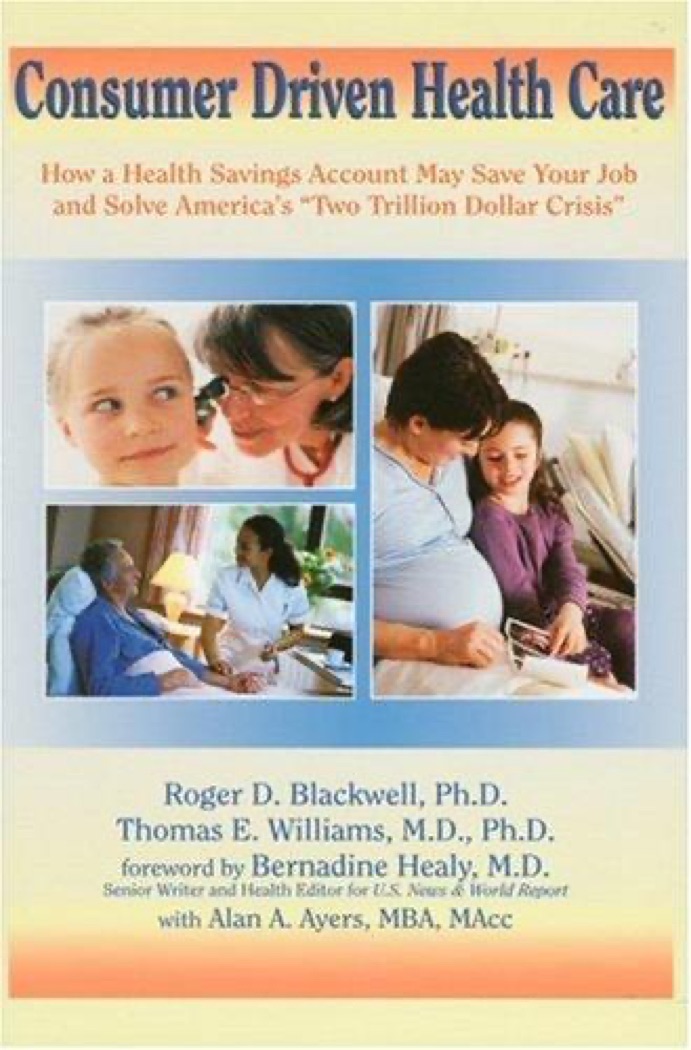
Consumer Driven Health Care: How a Health Savings Account May Save Your Job and Solve America's Two Trillion Dollar Crisis
Applying the lessons from "Consumer Driven Health Care: How a Health Savings Account May Save Your Job and Solve America's Two Trillion Dollar Crisis" by Roger D. Blackwell, Thomas Edwards Williams, and Alan A. Ayers to your life can be a transformative step toward both financial independence and better health outcomes. Here are some ways you might integrate these lessons:
-
Adopt a Stewardship Mindset Toward Health Wealth: - You should view your healthcare spending not as an unavoidable tax, but as a manageable investment. By maximizing your contributions to a Health Savings Account, you are creating a portable, tax-advantaged asset that grows over time, providing you with a financial safety net that remains under your control regardless of your employment status.
-
Demand Transparency in Clinical and Business Transactions: - As a leader in medicine and entrepreneurship, you should push for "sticker price" clarity in every venture you oversee. By being the provider who offers transparent, upfront pricing—as seen in successful urgent care and telehealth models—you can win the loyalty of the growing number of patients who are spending their own HSA dollars and looking for the best value.
-
Incentivize Personal Accountability and Prevention: - You can integrate the book’s lessons by focusing on preventative wellness as a financial strategy. Recognizing that every dollar saved on unnecessary procedures or avoidable chronic conditions is a dollar that stays in your pocket, you can model and advocate for lifestyle choices that reduce the long-term cost of care for yourself and your organization.
-
Leverage Defined Contribution Models for Organizational Growth: - When designing benefits for your healthcare startups or VC portfolio companies, you should prioritize consumer-driven plans that empower employees. This not only caps the organization's rising health costs but also educates your workforce on the true cost of care, fostering a culture of fiscal responsibility and personal empowerment.
-
Identify Market Disruption Opportunities in Information Asymmetry: - Given your background in law and an MBA, you are uniquely positioned to identify where the current system fails to provide data to the consumer. You can look for investment opportunities in technologies or services that bridge the gap between complex medical pricing and the consumer’s need for simple, actionable information.
By integrating these lessons, you can navigate the complex intersection of medicine, law, and business with a focus on empowering the individual. Embracing the consumer-driven model allows you to lead the transition away from inefficient legacy systems toward a more transparent, accountable, and sustainable healthcare future for both patients and providers.
What the book covers
"Consumer Driven Health Care: How a Health Savings Account May Save Your Job and Solve America's Two Trillion Dollar Crisis" by Roger D. Blackwell, Thomas Edwards Williams, and Alan A. Ayers is a comprehensive examination of the systemic inefficiencies within the American medical system and a roadmap for market-based reform. The book argues that the rising costs of healthcare are a direct result of a third-party payer system that obscures price signals and removes consumer accountability. By advocating for the widespread adoption of Health Savings Accounts (HSAs) and high-deductible health plans, the authors propose a shift toward a model where patients act as informed shoppers, ultimately driving down costs and improving quality through competition.
Summary:
-
The Economic Crisis of Third-Party Payment: - The authors identify the "Two Trillion Dollar Crisis" as the unsustainable trajectory of healthcare spending in the United States, which at the time of writing was threatening corporate competitiveness and national economic stability. They argue that because insurance companies and the government—not patients—pay the bills, there is no natural market pressure to keep prices low or quality high.
-
The Shift from Defined Benefit to Defined Contribution: - A central argument of the book is the necessary transition in employer-sponsored healthcare from a "defined benefit" model to a "defined contribution" model. This mirrors the evolution of retirement savings from traditional pensions to 401(k) plans, effectively transferring the control of healthcare funds from human resource departments to the individual employees who use the services.
-
Mechanics and Advantages of the Health Savings Account (HSA): - The text provides a detailed breakdown of the HSA as a financial vehicle, emphasizing its triple-tax advantage: tax-free contributions, tax-free growth through investment, and tax-free withdrawals for qualified medical expenses. The authors explain how this structure encourages long-term saving and discourages the over-utilization of unnecessary medical services by making patients the stewards of their own health dollars.
-
The Necessity of Price and Quality Transparency: - Blackwell and his co-authors emphasize that a consumer-driven system cannot function without transparent pricing. They call for providers to publish "retail" prices and outcomes data, allowing consumers to compare value just as they would when purchasing a car or electronics, thereby forcing healthcare providers to compete on efficiency and customer service for the first time.
-
Impact on the Physician-Patient Relationship: - The book explores how Consumer Driven Health Care (CDHC) reframes the patient as a customer rather than a passive recipient of care. This shift requires physicians to become more accountable for their service delivery, while patients are incentivized to become more engaged in preventative care and lifestyle management to preserve the funds in their accounts.
-
Strategies for Corporate Implementation: - For business leaders, the authors provide a strategic guide on how to implement CDHC plans to save jobs and reduce overhead. They outline how organizations can reinvest the savings from lower insurance premiums back into the business or into higher employee wages, arguing that consumerism is the only viable alternative to government-mandated healthcare rationing.
This book remains a seminal text for understanding the move toward healthcare consumerism, providing a visionary look at how economic incentives can be realigned to serve both the patient and the provider. Its focus on individual empowerment and market transparency continues to influence modern debates on healthcare reform and the role of private innovation in public health.