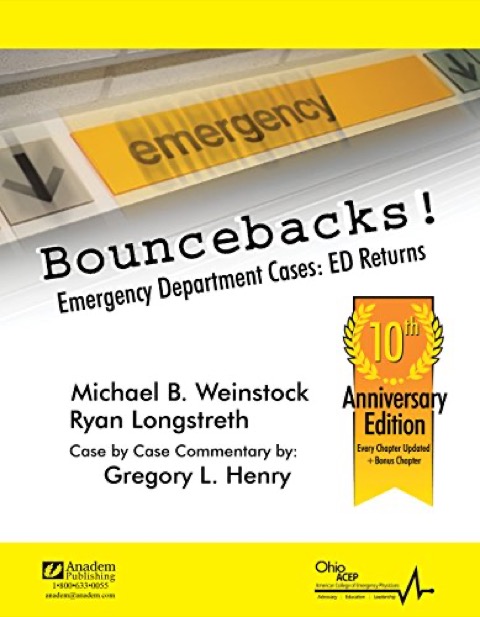
Bouncebacks! Emergency Department Cases: ED Returns
Applying the lessons from "Bouncebacks! Emergency Department Cases: ED Returns" by Michael B. Weinstock, Ryan Longstreth, and Gregory L. Henry to your life can be a powerful exercise in enhancing your decision-making frameworks across medicine, business, and high-stakes leadership. Here are some ways you might integrate these lessons:
-
Embrace a 'Pre-Mortem' Mindset: - Just as the authors analyze clinical returns, you should apply a pre-mortem analysis to your business ventures or legal strategies. Ask yourself, "If this project fails six months from now, what will be the most likely cause?" Identifying those 'red flags' early allows you to build in safeguards before the 'bounceback' occurs in your professional life.
-
Avoid the Trap of Anchoring Bias: - In both VC investing and medical diagnosis, first impressions are powerful but dangerous. You must consciously challenge your initial 'hunch' about a founder or a patient by seeking out data that contradicts your theory. By actively trying to disprove your own assumptions, you reduce the risk of falling victim to cognitive shortcuts that lead to expensive or fatal mistakes.
-
Maintain 'Cockpit Discipline' in All Disciplines: - As a pilot, you know the value of checklists; this book reinforces that same discipline in the ED. You should treat every complex decision—whether it’s a clinical discharge or a multi-million dollar investment—with the same rigors as a pre-flight check. Ensure that the 'vitals' of the situation are not just recorded, but truly understood and reconciled.
-
Refine Your Documentation as a Narrative of Logic: - Your background in law and medicine uniquely positions you to appreciate that documentation is more than a record; it is a defense of your reasoning. Whether you are drafting a term sheet or a patient note, your documentation should clearly articulate the 'why' behind your decision, demonstrating that you considered high-risk alternatives and made a reasoned choice based on the available data.
-
Listen for the 'Signal' Amidst the 'Noise': - In a crowded ED or a busy portfolio, it is easy to miss the one subtle sign of trouble. You must train yourself to focus on the small anomalies—the 'tachycardia' in a business plan or the slight 'fever' in a legal contract—that others might dismiss as outliers. These are often the leading indicators of systemic failure.
-
Practice Radical Transparency and Humility: - The core of the 'Stay Hungry, Stay Humble' mantra is found in this book’s willingness to look at failures. By reviewing your own 'returns'—the investments that went south or the cases that didn't go as planned—without ego, you turn every setback into a masterclass in professional development.
By integrating these lessons, you will develop a more resilient and reflective approach to leadership that prioritizes safety, strategic foresight, and intellectual honesty. This book reminds us that the pursuit of excellence is not about achieving perfection, but about the relentless, humble pursuit of identifying and correcting our own blind spots before they lead to crisis.
What the book covers
"Bouncebacks! Emergency Department Cases: ED Returns" by Michael B. Weinstock, Ryan Longstreth, and Gregory L. Henry is a sophisticated medical text that serves as both a clinical guide and a cautionary tale for practitioners of emergency medicine. The book utilizes a case-study format to examine real-life scenarios where patients were evaluated and discharged from the emergency department (ED), only to return later with significant morbidity or mortality. Through a meticulous analysis of the initial documentation, diagnostic reasoning, and subsequent outcomes, the authors provide a framework for identifying high-risk presentations and mitigating diagnostic errors in high-pressure environments.
Summary:
-
The Architecture of the 'Bounceback': - Each chapter begins with the actual medical record from the initial visit, allowing you to walk through the physician's thought process in real-time. This includes the chief complaint, physical examination findings, nursing notes, and the eventual discharge instructions, creating a transparent view of the clinical encounter. - The book then reveals the 'return' visit, detailing the patient's deterioration and the final diagnosis that was missed during the initial evaluation. This structure emphasizes that medical errors are rarely the result of a single catastrophic failure but are usually a sequence of missed opportunities and subtle cues.
-
Cognitive Bias and Diagnostic Anchoring: - A central theme is the exploration of why experienced clinicians miss life-threatening conditions. The authors dissect the 'anchoring bias,' where a physician settles on a diagnosis early in the encounter and ignores subsequent information that contradicts it. - By analyzing these errors, the book encourages a culture of 'metacognition'—thinking about how we think. It urges you to remain open to alternative possibilities and to consciously look for the 'can't-miss' diagnoses that might be mimicking benign conditions.
-
The Critical Importance of Vital Signs: - The authors stress that 'normal' vital signs are not always a guarantee of stability. They highlight numerous cases where subtle tachycardia or a slight tachypnea was overlooked or attributed to anxiety or pain, rather than viewed as a signal of early sepsis or pulmonary embolism. - This section reinforces the necessity of explaining every abnormality. You are taught that an abnormal vital sign must be reconciled before discharge, rather than simply documented and ignored in the rush of a crowded department.
-
High-Risk Clinical Presentations: - The book categorizes cases into high-stakes areas such as chest pain, abdominal pain, and headache. It provides specific clinical pearls for identifying subtle presentations of aortic dissection, mesenteric ischemia, and subarachnoid hemorrhage. - These sections serve as a refresher on 'red flag' symptoms that should trigger a broader workup. The authors emphasize that the goal is not to order every test for every patient, but to apply rigorous clinical logic to identify the few who truly need them.
-
Risk Management and Documentation Excellence: - Beyond clinical skills, the book provides a deep dive into the legal and professional implications of medical practice. It illustrates how poor documentation can make a defensible case indefensible in a court of law. - The authors provide specific strategies for 'risk-informed' charting, such as documenting the absence of red flags and providing clear, specific discharge instructions that empower the patient to return if their condition changes.
-
The Role of Physician-Patient Communication: - A significant portion of the analysis focuses on the interaction between the provider and the patient. Misunderstandings and failures to address the patient's primary concern are shown to be major contributors to adverse outcomes. - The text argues for a collaborative approach to discharge, ensuring the patient understands the 'why' behind the diagnosis and knows exactly what symptoms should prompt an immediate return to the hospital.
This book is a vital resource for any clinician who seeks to bridge the gap between academic medical knowledge and the messy, unpredictable reality of the emergency department. It fosters a spirit of professional humility, reminding even the most seasoned experts that every patient encounter carries the potential for both life-saving intervention and devastating error.