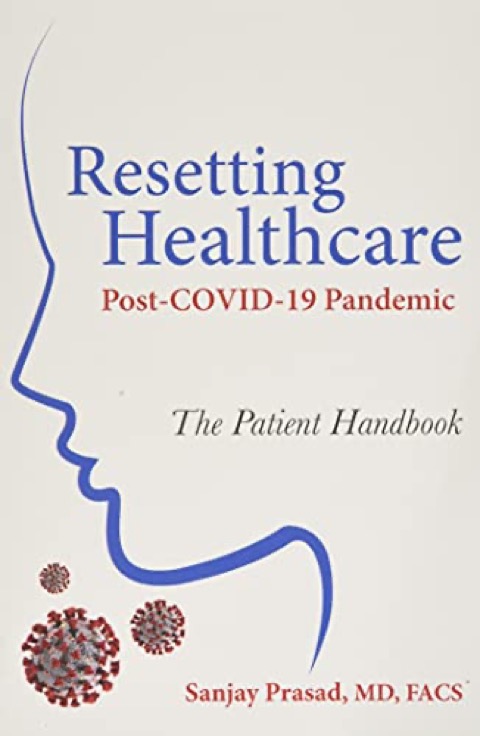
Resetting Healthcare Post-COVID-19 Pandemic: The Patient Handbook
Applying the lessons from "Resetting Healthcare Post-COVID-19 Pandemic" by Sanjay Prasad to your life can be a powerful catalyst for improving your efficacy as a leader, a clinician, and an informed citizen of the medical community. Here are some ways you might integrate these lessons:
-
Champion Data Transparency: - In your roles as a physician and a venture capitalist, you should demand objective data over subjective reputation. Whether you are evaluating a startup’s potential or a clinical protocol, look for the underlying metrics of success and insist on seeing the "complication rates" of any new venture or treatment plan.
-
Shift Toward Value-Based Leadership: - You can apply the move from "volume to value" in your entrepreneurial pursuits by ensuring your companies solve core problems rather than just increasing the quantity of services. Focus your healthcare investments and leadership on outcomes that genuinely improve patient lives, which ultimately creates more long-term business value than high-volume, low-impact models.
-
Leverage Technology for Scalable Quality: - Use your background in telehealth to continue pushing the boundaries of how digital platforms can democratize access to excellence. Just as Prasad suggests using technology to find the best surgeons, you can continue to build or fund platforms that remove the "geographic lottery" from healthcare, ensuring top-tier medical advice is available to anyone with a connection.
-
Practice Aggressive Patient Advocacy: - Use your legal and medical expertise to empower those around you to ask the hard questions. You can teach your peers and students that being a "humble" learner also means being a "hungry" seeker of truth—never accepting a medical recommendation without understanding the data and the costs behind it.
-
Identify Systemic Fractures Early: - As a pilot, you understand the importance of a pre-flight check; apply this to your businesses by looking for the same types of "fragilities" Prasad identified during the pandemic. Build your companies with the resilience to withstand systemic shocks, ensuring that your operations are not just profitable in the best of times but functional in the worst of times.
-
Promote the 'Consumerization' of Medicine: - Integrate the mindset that the patient is a customer who deserves a high-quality experience and price certainty. By treating the patient as an empowered consumer, you can lead the charge in changing the culture of healthcare from one of paternalism to one of partnership and mutual respect.
By integrating these lessons, you can further your mission of optimizing the healthcare landscape, ensuring that your ventures not only succeed financially but also contribute to a more equitable and efficient system for everyone involved.
What the book covers
"Resetting Healthcare Post-COVID-19 Pandemic" by Sanjay Prasad is a critical analysis of the structural failures within the United States healthcare system that were brought to light by the global health crisis. Prasad, a surgeon and entrepreneur, argues that the pandemic provided a unique, albeit painful, opportunity to overhaul a system plagued by opacity and misaligned incentives. The book serves as a strategic manual for patients, providers, and policymakers to transition toward a more transparent, data-driven, and value-based model of care.
Summary:
-
The Pandemic as a Catalyst for Change: - Prasad begins by illustrating how the COVID-19 pandemic acted as a "stress test" that exposed the extreme fragility of American medical infrastructure. He argues that the sudden shift in demand highlighted the dangers of a system optimized for high-margin elective procedures rather than public health resilience and basic patient access.
-
The Transparency Deficit in Surgery: - A central theme of the work is the lack of transparency regarding both the price and the quality of surgical outcomes. Prasad discusses how the current system effectively hides performance data, leaving patients unable to distinguish between a high-performing surgeon and one with significant complication rates, leading to unnecessary suffering and inflated costs.
-
The SurgiQuality Framework: - The author introduces the concept of using data-driven platforms to match patients with the best-performing surgeons for their specific needs. By focusing on "SurgiQuality," Prasad demonstrates how leveraging independent data can lower costs for employers and insurers while simultaneously improving the clinical results for the individual patient.
-
Moving Beyond Fee-for-Service: - Prasad provides a detailed critique of the traditional fee-for-service payment model, which he argues incentivizes volume over value. He advocates for a "reset" that prioritizes value-based care, where providers are reimbursed based on the success of the outcome and the efficiency of the delivery rather than the number of tests or procedures performed.
-
Empowering the Healthcare Consumer: - The book emphasizes the necessity of shifting the patient's role from a passive recipient of care to an active, informed consumer. Prasad provides practical advice on how individuals can demand cost estimates and quality metrics before agreeing to treatment, effectively forcing the market to become more competitive and accountable.
-
The Role of Digital Health Innovation: - Prasad explores how the rapid adoption of telehealth and digital health platforms during the pandemic should not be rolled back but rather integrated into the core of the healthcare experience. He argues that these technologies are essential for bridging the gap between underserved populations and top-tier medical expertise.
-
Restructuring the Provider-Patient Relationship: - The final sections of the book focus on restoring the trust between the doctor and the patient, which has been eroded by administrative burdens and corporate interests. Prasad suggests that by removing the middle-man inefficiencies, physicians can return to a more patient-centric style of practice that values the human element of medicine.
"Resetting Healthcare Post-COVID-19 Pandemic" is a significant contribution to the conversation on health reform because it moves beyond theoretical complaints to offer actionable, market-based solutions. It challenges the status quo of the healthcare industry, urging a move toward a system where quality is measurable, prices are known, and the patient is truly the priority.