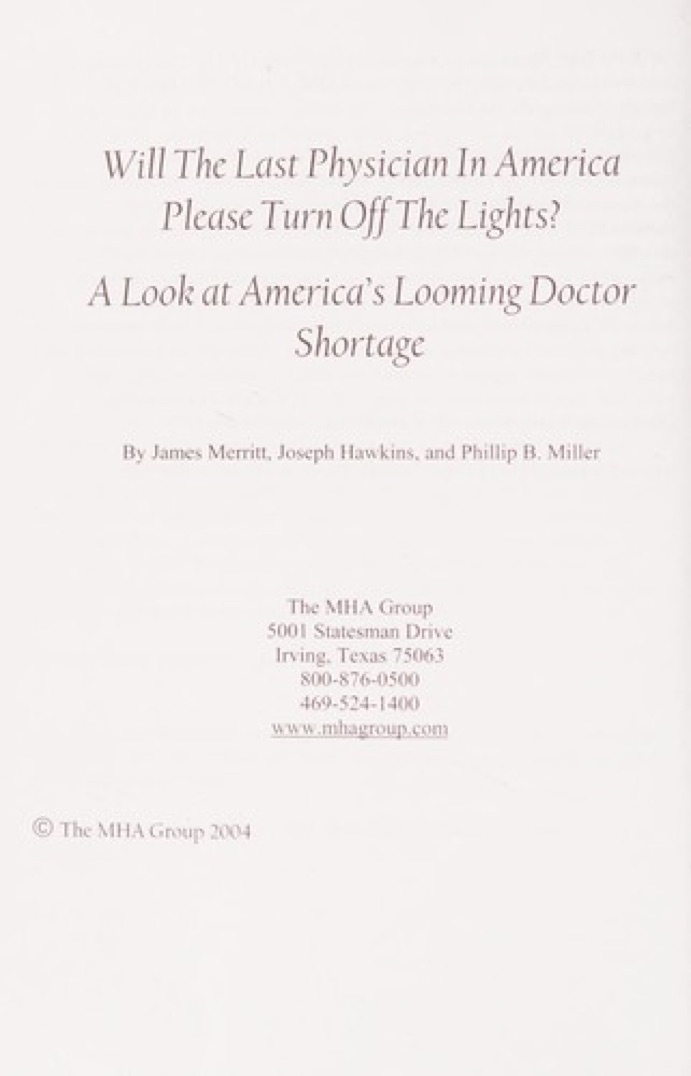
Will the Last Physician in America Please Turn Off the Lights?: A Look at America's Looming Doctor Shortage
Applying the lessons from "Will the Last Physician in America Please Turn Off the Lights?: A Look at America’s Looming Doctor Shortage" by James Merritt, Joseph Hawkins, and Phillip B. Miller to your life can be a transformative exercise in strategic foresight and professional resilience. Here are some ways you might integrate these lessons:
- Anticipate Human Capital Scarcity: - As a venture capitalist and entrepreneur, you must recognize that human capital is the most constrained resource in healthcare. When evaluating new business models, you should prioritize those that maximize "top of license" practice and utilize technology to augment the productivity of a dwindling physician pool, ensuring that your investments are not built on an unsustainable labor model.
- Champion Innovative Care Delivery: - Your background in urgent care and telehealth aligns perfectly with the book’s call for alternative delivery systems. You can continue to lead the industry by developing platforms that alleviate the burden on traditional emergency rooms, ensuring that the existing physician workforce is utilized where their specialized skills are most critically needed.
- Leverage Legal Expertise for Reform: - With your background in law, you are uniquely positioned to advocate for the removal of residency funding caps and the streamlining of interstate licensing. You can influence the "rules of the game" to allow for more flexible and mobile medical staffing, helping to dissolve the barriers that prevent doctors from reaching the patients who need them most.
- Prioritize Operational Efficiency to Combat Burnout: - In any organization you lead, you should make it a priority to reduce administrative friction for clinicians. By investing in tools that minimize EMR bloat and restore clinical autonomy, you not only improve physician retention but also enhance the quality of patient outcomes, creating a more resilient and sustainable business culture.
- Strategic Integration of Mid-Level Providers: - You should view the integration of NPs and PAs not merely as a cost-saving measure, but as a strategic necessity. Design your healthcare ventures so that physicians handle the most complex clinical puzzles while advanced practice providers manage routine care, optimizing the efficiency of the entire medical unit and preventing specialist fatigue.
- Solve the Geographic Access Gap: - Given the maldistribution of doctors, there is a massive opportunity to use your aviation and telehealth experience to bridge the geographic gap. You can build or fund solutions that provide high-quality care to rural "medical deserts," turning a systemic failure of distribution into a profitable and socially impactful business model.
By integrating these lessons, you can turn the looming physician shortage from a systemic threat into a powerful catalyst for innovation. Your unique combination of skills across medicine, law, and business allows you to build the infrastructure necessary to ensure the lights stay on for the next generation of American patients.
What the book covers
"Will the Last Physician in America Please Turn Off the Lights?: A Look at America’s Looming Doctor Shortage" by James Merritt, Joseph Hawkins, and Phillip B. Miller is a data-driven examination of the systemic and demographic crises threatening the stability of the United States healthcare workforce. Drawing on their deep expertise in physician recruitment, the authors analyze how a surge in demand from an aging population is colliding with a stagnant supply of medical professionals. The book serves as both a warning for the general public and a strategic guide for healthcare leaders who must navigate an environment where doctors are becoming the country's most scarce resource.
Summary:
- The Demographic Tsunami: - The authors detail the dual-edged sword of aging in America: as the Baby Boomer generation enters their senior years, their medical needs increase exponentially, requiring more frequent and complex care. Simultaneously, a large percentage of the physician workforce is reaching retirement age, creating a supply-demand gap that leads to longer wait times and decreased access to care across all specialties.
- The Residency Funding Bottleneck: - A primary focus of the text is the 1997 Balanced Budget Act, which placed a hard cap on federal funding for Graduate Medical Education (GME). The authors argue that while medical schools have successfully increased student enrollment, the number of residency slots has not kept pace, creating a structural bottleneck that prevents thousands of qualified medical graduates from entering the workforce each year.
- The Primary Care Crisis and Economic Pressures: - The book explores the financial and professional pressures driving new doctors away from primary care and into lucrative specialties. They note that the disparity in reimbursement rates, coupled with the crushing burden of six-figure student loan debt, makes it nearly impossible for many young physicians to choose family medicine or internal medicine, leaving the "front door" of the healthcare system dangerously unguarded.
- The Impact of Physician Burnout: - Merritt, Hawkins, and Miller address the "silent exodus" of doctors who are leaving the profession early due to administrative burdens, electronic health record (EHR) fatigue, and the loss of clinical autonomy. They argue that the corporatization of medicine has turned physicians into data-entry clerks, leading to high rates of burnout and a significant reduction in the number of hours doctors are willing to spend in direct patient care.
- The Rise of Advanced Practice Providers: - As a response to the physician shortage, the book discusses the increasing reliance on Nurse Practitioners (NPs) and Physician Assistants (PAs). While the authors acknowledge their essential role in the modern care team, they emphasize the need for clear regulatory frameworks that optimize the use of these professionals without compromising the standards of physician-led clinical care.
- Geographic Maldistribution and Medical Deserts: - The text highlights the extreme difficulty of recruiting physicians to rural and underserved urban areas, explaining that most doctors prefer to practice in urban centers near major medical hubs. This trend has created vast "medical deserts" where patients have zero access to local specialists, forcing them to travel hundreds of miles for basic emergency or preventative services.
- The Regulatory and Legal Framework: - The authors analyze how antiquated state licensing laws and medical malpractice concerns create additional barriers for physicians wishing to practice across state lines. They suggest that legal reform, including national licensure and tort reform, is a necessary component of any solution to the national workforce crisis.
This book serves as a vital blueprint for understanding why the traditional American medical model is fraying at the seams and provides a sobering look at the consequences of inaction. It emphasizes that without significant intervention at the legislative, educational, and institutional levels, the quality of healthcare will inevitably decline as the remaining workforce becomes dangerously overstretched.