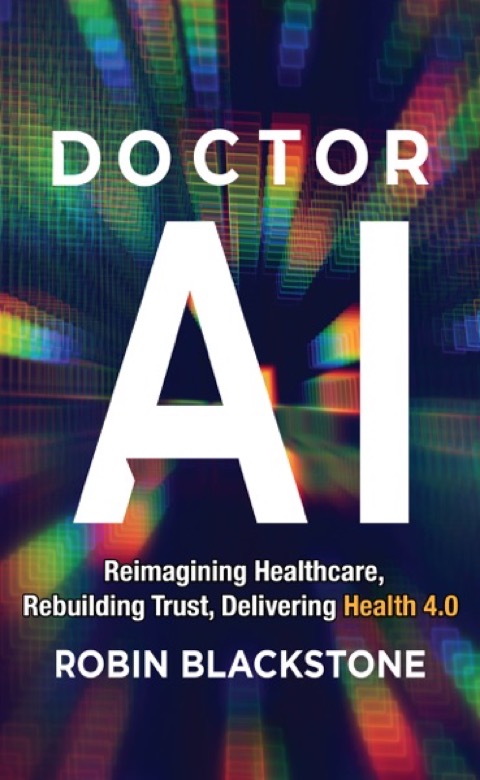
Doctor AI: Reimagining Healthcare, Rebuilding Trust, Delivering Health 4.0
Applying the lessons from "Doctor AI: Reimagining Healthcare, Rebuilding Trust, Delivering Health 4.0" by Robin Blackstone to your life can be a transformative exercise in balancing high-tech innovation with high-touch human connection. Here are some ways you might integrate these lessons:
- Leverage AI for Cognitive Offloading: - Look for ways to automate the clerical work in your own professional and personal life. Whether through generative AI for drafting communications or specialized software for project management, your goal should be to clear mental clutter so you can focus on high-stakes decision-making and creative problem-solving. - In your leadership roles or venture capital work, identify where human bandwidth is being wasted on repetitive data tasks. By implementing intelligent systems, you free yourself and your team to focus on the art of your craft, whether that is patient care or strategic investment.
- Prioritize Transparency and Trust in Technology: - When evaluating new health-tech ventures or implementing tools in your practice, use Blackstone’s emphasis on trust as your primary filter. Ask not only what the technology can do, but how it arrives at its conclusions and protects the integrity of the user relationship. - Building trust requires you to be an advocate for ethical AI. In your role as an investor, champion transparency by requiring that the AI tools you support are explainable, ensuring that the technology serves as a bridge rather than a barrier between you and those you serve.
- Adopt a "Health 4.0" Mindset Toward Personal Growth: - Move beyond simply collecting data—like tracking steps—and move toward an augmented approach where you use data to drive meaningful behavior change. View your personal health and performance metrics through a lens of predictive analytics to anticipate problems before they arise. - This proactive stance ensures that you are not just reacting to the stressors of your various careers but are strategically managing your physical and mental energy. Treat your personal data as a diagnostic tool that helps you maintain peak performance.
- Champion Human-Centric Innovation: - In your business ventures, remember that the most successful technologies enhance human interaction rather than replace it. Focus on Health 4.0 solutions that empower clinicians and patients, looking for unmet needs where technology can restore the empathy eroded by bureaucratic systems. - This involves looking at innovation through the eyes of the end-user. Whether you are advising a startup or leading a firm, prioritize solutions that solve the moral injury of the professional, making the work of caregiving more sustainable for the next generation.
- Cultivate Data Fluency and Lifelong Learning: - As a lifelong learner, you must embrace the necessity of becoming literate in the language of AI. You do not need to be a coder, but you must understand the strengths and limitations of these models to lead effectively in a tech-driven world. - Stay updated on the evolving landscape of medical AI. By maintaining your curiosity and staying hungry for knowledge in this field, you ensure that you remain an insightful leader who can navigate the complexities of a rapidly changing professional environment with confidence.
By integrating these lessons, you will be able to navigate the intersection of medicine, law, and technology with a perspective that honors the human element of your work. Embracing AI as a partner rather than a competitor allows you to enhance your effectiveness across all your disciplines, ultimately leading to a more impactful and fulfilling career that embodies the true spirit of a modern polymath.
What the book covers
"Doctor AI: Reimagining Healthcare, Rebuilding Trust, Delivering Health 4.0" by Robin Blackstone is a comprehensive analysis of how artificial intelligence is poised to revolutionize the medical field while addressing the systemic failures of the current digital era. The book serves as a strategic guide for clinicians and leaders, advocating for a transition from the administrative burdens of "Health 3.0" to an era of augmented intelligence that prioritizes patient outcomes and professional satisfaction. Blackstone argues that the successful integration of AI is not merely a technical challenge but a human-centric necessity to restore trust in the healthcare ecosystem.
Summary:
- The Transition to Health 4.0: - Blackstone defines the current state of healthcare as "Health 3.0," a period characterized by the digitization of records that often created more work for providers than it solved. She proposes a shift to "Health 4.0," where AI acts as a seamless layer that interprets data in real-time, allowing physicians to move away from being data entry clerks and back toward being healers. - This transition involves moving beyond basic electronic health records toward ambient technology that works in the background. By utilizing natural language processing and machine learning, Health 4.0 systems can capture patient interactions and synthesize them into actionable insights, reducing the friction that currently exists between doctors and their technology.
- Mitigating Physician Burnout: - A central theme of the book is the use of AI as a tool to combat the epidemic of burnout among healthcare workers. Blackstone examines how administrative tasks—the clerical work spent on charts and coding—can be automated through AI scribes and intelligent triage systems. - By offloading repetitive and cognitive-heavy administrative tasks to AI, physicians can reclaim time for direct patient care. This isn't just about efficiency; it is about restoring the joy of medicine and preventing the moral injury that occurs when doctors feel they are prioritizing computers over people.
- The Importance of Trust and Ethics: - The author emphasizes that the "Doctor AI" concept cannot succeed without a robust framework of trust. She explores the ethical dilemmas of algorithmic bias, data privacy, and the "black box" nature of some AI models, insisting that transparency must be a core design principle. - To build trust, healthcare systems must ensure that AI tools are validated through rigorous clinical standards. Blackstone calls for a collaborative approach where clinicians are involved in the development of these tools, ensuring that the technology reflects the nuances of medical ethics and the specific needs of diverse patient populations.
- Generative AI and Clinical Decision Support: - Blackstone delves into the practical applications of Large Language Models (LLMs) and generative AI in clinical settings. She explains how these tools can summarize vast amounts of patient history, suggest differential diagnoses, and provide personalized treatment recommendations based on the latest medical literature. - Rather than replacing the doctor, these tools act as a super-powered assistant that provides a cognitive safety net. The book highlights how these systems can alert physicians to rare diseases or drug interactions that might otherwise be missed in a high-pressure, fast-paced environment.
- Empowering the Patient as a Partner: - The book explores how AI shifts the patient's role from a passive recipient of care to an active participant. AI-driven applications and wearable devices allow for continuous monitoring, moving healthcare from episodic visits to a constant stream of health management. - This democratization of data empowers patients to understand their health better and engage in shared decision-making. Blackstone notes that when patients have access to AI-enabled tools that explain their conditions and treatments, the overall health literacy of the population improves, leading to better compliance and outcomes.
- Institutional Change and Leadership: - Blackstone outlines the leadership strategies required to implement AI successfully across large healthcare organizations. She argues that leaders must foster a culture of innovation while managing the change-resistance common in traditional medical settings. - This includes investing in the necessary infrastructure and reimagining medical education. Future doctors must be trained not just in biology but in data fluency, learning how to critique and utilize AI outputs effectively in their daily practice.
The significance of "Doctor AI" lies in its balanced view of technology as a restorative force. It moves the conversation beyond the fear of automation toward a vision of augmented humanity, where AI provides the efficiency and precision necessary to save the healthcare system from collapse while allowing the human element of medicine to flourish once again.