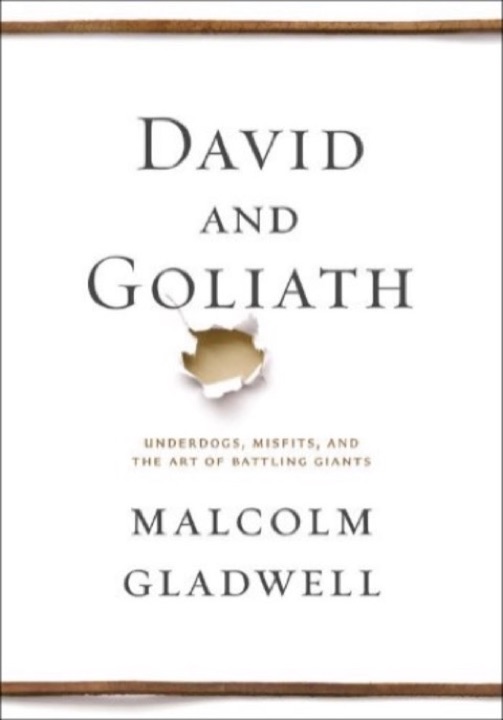
David and Goliath
Applying the lessons from Malcolm Gladwell's "David and Goliath" to your life can provide valuable insights and strategies for navigating challenges and leveraging your unique strengths. Here are some ways you might integrate these lessons:
-
Embrace Your Unique Strengths: Just as David used his agility and skill with a sling to defeat Goliath, you can leverage your unique strengths, such as resilience, humor, kindness, and empathy, to overcome challenges. Recognize that these qualities can be powerful tools in both personal and professional settings.
-
Rethink Perceived Weaknesses: Consider how your perceived weaknesses, like impulsivity or lack of balance, might be reframed as strengths in certain contexts. For example, your impulsivity might lead to quick decision-making in high-pressure situations, which can be advantageous.
-
Adopt Unconventional Strategies: When faced with obstacles, don't be afraid to think outside the box and adopt unconventional strategies. Your experience in emergency situations and your ability to remain calm under pressure are examples of how you can approach problems with innovative solutions.
-
Persevere Through Challenges: Your life experiences, including surviving plane crashes and overcoming personal setbacks, demonstrate the power of perseverance. Continue to embrace challenges as opportunities for growth and learning, knowing that resilience can lead to unexpected success.
-
Question Authority and Tradition: Your skepticism of organized religion and your independent political views reflect a willingness to question established norms. Continue to challenge authority and tradition when necessary, using your insights to advocate for social issues you are passionate about, such as equality and civil rights.
-
Leverage Desirable Difficulties: Reflect on how past difficulties have contributed to your personal growth. For instance, your experience of being rejected by your birth mother may have strengthened your empathy and understanding of others. Use these experiences to fuel your passion for activism and advocacy work.
-
Live in the Moment: One of your aspirations is to live in the moment. Apply the lesson of embracing challenges and uncertainties to cultivate mindfulness and presence in your daily life. This can enhance your appreciation for life's experiences and deepen your connections with others.
-
Focus on Personal Growth: Your commitment to being a lifelong learner aligns with the book's emphasis on innovation and growth. Continue to seek opportunities for personal development, whether through new experiences like skydiving or by expanding your knowledge and skills.
By integrating these lessons into your life, you can continue to navigate challenges with resilience and creativity, leveraging your unique strengths to achieve your goals and make a positive impact on the world around you.
What the book covers
"David and Goliath: Underdogs, Misfits, and the Art of Battling Giants" by Malcolm Gladwell explores the dynamics of competition between underdogs and giants, challenging conventional perceptions of strength and advantage. Gladwell uses historical events, psychological research, and compelling anecdotes to illustrate how perceived weaknesses can be strengths and how advantages can sometimes lead to failure.
Summary:
-
The David and Goliath Story: - Gladwell begins with the biblical story of David and Goliath, reinterpreting it to show that David's victory was not a miracle but a result of his unconventional approach and Goliath's vulnerabilities. David's agility and use of a sling gave him an unexpected advantage over the heavily armored Goliath.
-
The Advantages of Disadvantages: - The book argues that what we perceive as disadvantages can often be advantages. For instance, smaller class sizes in schools are generally seen as beneficial, but Gladwell presents evidence that very small classes can hinder learning due to lack of diversity in discussion and interaction.
-
The Disadvantages of Advantages: - Conversely, Gladwell discusses how advantages can become disadvantages. He uses the example of wealthy parents who struggle to instill discipline and motivation in their children, as their wealth removes the necessity for hard work.
-
The Theory of Desirable Difficulty: - Gladwell introduces the concept of "desirable difficulty," suggesting that certain challenges can lead to greater success. He cites examples of successful individuals with dyslexia who developed unique skills and strategies to compensate for their reading difficulties.
-
The Limits of Power: - The book explores how power and authority can backfire. Gladwell discusses the civil rights movement, showing how the oppressive tactics of authorities often galvanized support for the movement rather than suppressing it.
-
The Importance of Perseverance and Innovation: - Through various stories, Gladwell emphasizes the importance of perseverance and innovation. He highlights how underdogs often succeed by adopting unconventional strategies and refusing to play by the established rules.
Key Takeaways and Lessons:
-
Rethink Strength and Weakness: Strengths and weaknesses are often context-dependent. What appears to be a disadvantage can be leveraged into a strength with the right approach.
-
Embrace Challenges: Difficulties and challenges can foster resilience, creativity, and innovation. Embracing these challenges can lead to unexpected success.
-
Question Authority and Tradition: Established norms and authority can be challenged effectively with unconventional strategies. Innovation often comes from questioning the status quo.
-
Understand the Power of Perseverance: Success often requires persistence and the willingness to continue despite setbacks. Perseverance can be more important than raw talent or resources.
-
Leverage Unique Strengths: Identifying and leveraging unique strengths, even if they are unconventional, can provide a significant advantage in overcoming larger, more powerful opponents.
Gladwell's "David and Goliath" encourages readers to reconsider how they perceive obstacles and advantages, advocating for a more nuanced understanding of what it means to be powerful or weak.