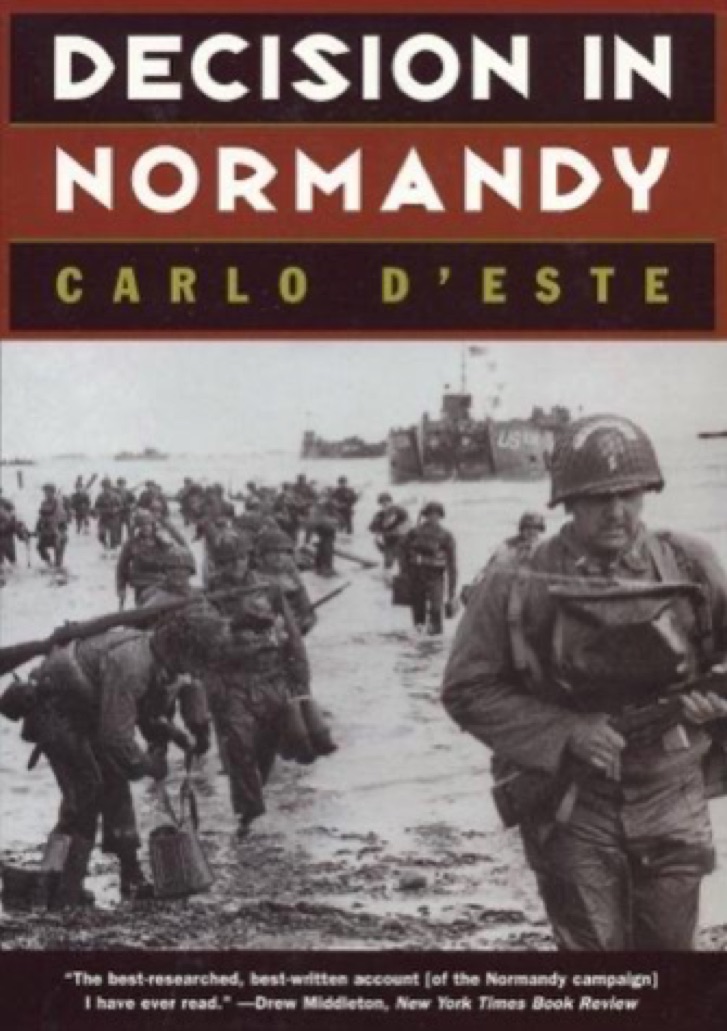
Decision in Normandy: The Unwritten Story of Montgomery and the Allied Campaign
Applying the lessons from "Decision in Normandy" by Carlo D’Este to your life can be a transformative exercise in understanding the disparity between strategic intent and operational reality. Here are some ways you might integrate these lessons:
- Maintain Strategic Flexibility: - You must recognize that no plan survives first contact with reality, whether in a complex surgery, a legal trial, or a business launch. Avoid the "Montgomery Trap" of insisting that every setback was part of the plan; instead, cultivate the intellectual honesty to admit when a pivot is necessary to achieve your ultimate objective.
- Manage the Friction of Success: - In leadership, understand that as your organization grows, internal friction and clashing egos become your greatest threats. Like Eisenhower, you must act as a bridge-builder, ensuring that the personal ambitions of your high-performing team members do not compromise the overarching mission of the enterprise.
- Prepare for the "Bocage" of Your Industry: - Identify the unforeseen obstacles in your field—the regulatory hurdles, market shifts, or technical failures—that your initial training did not cover. You should empower your team to innovate from the bottom up, encouraging the "Rhino tank" solutions that solve ground-level problems through practical ingenuity rather than top-down mandates.
- Audit Your Own Narrative: - Be wary of the human tendency to rewrite your personal or professional history to make past failures look like intentional choices. To truly grow as a lifelong learner, you must conduct honest after-action reviews that acknowledge mistakes, allowing you to extract real lessons rather than reinforcing a false sense of infallibility.
- Capitalize on Breakthrough Moments: - When you find a strategy that works, such as the American breakthrough in Operation Cobra, you must be prepared to commit your resources fully to exploit that opening. Success often requires shifting your focus from underperforming sectors to areas where you have genuine momentum, even if it disrupts your original resource allocation.
- Commit to Radical Accountability: - Avoid the hesitation seen at the Falaise Gap by ensuring clear lines of communication and decisive action during critical moments. Whether in the ER or the boardroom, the window of opportunity is often small; you must possess the courage to close the gap and finish the task rather than settling for a partial victory.
By integrating these lessons, you move beyond the surface-level stories of success to master the deeper mechanics of leadership and strategy. Embracing the humility to recognize your errors and the hunger to adapt in real-time will ensure that your decisions lead to lasting impact rather than historical footnotes.
What the book covers
"Decision in Normandy" by Carlo D’Este is a provocative and meticulously researched re-examination of the Allied campaign in France following the D-Day landings. Rather than reciting the familiar narrative of inevitable victory, D’Este delves into the strategic friction, personal rivalries, and tactical failures that nearly derailed the operation. The book serves as a critical analysis of General Bernard Montgomery’s leadership, challenging his post-war assertions and highlighting the disconnect between the original "Master Plan" and the chaotic reality on the ground.
Summary:
- The Myth of the Master Plan: - D’Este argues that Montgomery’s claim that the campaign proceeded exactly according to plan is historically inaccurate. He demonstrates how the initial failure to capture the city of Caen on D-Day forced a series of desperate improvisations that were later reframed as intentional strategic maneuvers. - This section explores the rigidity of the British command structure and the initial overestimation of how quickly Allied forces could break through German defenses and move into the open terrain of France.
- The Strategic Stalemate at Caen: - The book details the repeated, bloody attempts by British and Canadian forces to seize Caen, which became a symbolic and tactical bottleneck. D’Este examines how Montgomery’s cautious approach and reliance on set-piece battles led to significant attrition without achieving the desired breakout. - It highlights the growing frustration within the Allied High Command, specifically from Eisenhower and Tedder, who began to doubt Montgomery’s ability to deliver the promised results as the campaign stalled for weeks.
- Friction in the Bocage: - D’Este provides a vivid account of the tactical nightmare faced by American troops in the Norman hedgerows, or bocage. He explains that the Allies were woefully unprepared for this terrain, having failed to train for the specific defensive advantages it offered the German defenders. - The narrative emphasizes the ingenuity of front-line soldiers who eventually developed the "Rhino" tanks to breach the hedges, illustrating the gap between high-level planning and the realities of small-unit combat.
- The Politics of Command: - A central theme is the interpersonal conflict between the top Allied commanders, including the tensions between the British and American contingents. D’Este explores how national pride, clashing egos, and different military philosophies influenced strategic decisions at the highest levels. - The book sheds light on the diplomatic tightrope walked by Dwight D. Eisenhower as he attempted to manage the volatile personalities of Montgomery, Patton, and Bradley while keeping the coalition intact.
- Operation Goodwood and Operation Cobra: - The author contrasts the failure of the British Operation Goodwood, a massive armored thrust that ended in a costly stalemate, with the success of the American Operation Cobra. He credits Omar Bradley’s willingness to adapt and use carpet bombing to create the opening necessary for a decisive breakthrough. - This shift marked the moment when the strategic center of gravity moved from the British sector to the Americans, fundamentally changing the trajectory of the campaign and the post-war power balance.
- The Failure at the Falaise Gap: - One of the book's most critical sections focuses on the missed opportunity to trap and destroy the German Seventh Army at Falaise. D’Este analyzes the cautiousness and lack of coordination that allowed thousands of German troops to escape to the east. - He suggests that if the Allied leadership had been more aggressive and better synchronized, the war in Europe might have ended months earlier, potentially saving countless lives.
- The Revisionist Legacy: - In the concluding chapters, D’Este examines how the history of Normandy was written after the fact, often to protect reputations. He challenges the "official" versions of events and calls for a more honest appraisal of the campaign’s difficulties. - By dissecting Montgomery’s memoirs and the British official history, the author reveals how the narrative was massaged to hide the cracks in the Allied strategy and the near-failure of the invasion’s early stages.
By peeling back the layers of wartime propaganda, D’Este provides a definitive account that honors the bravery of the soldiers while holding the commanders accountable for their errors. The book remains a seminal work for understanding the complexities of large-scale military operations and the fallibility of those who lead them.