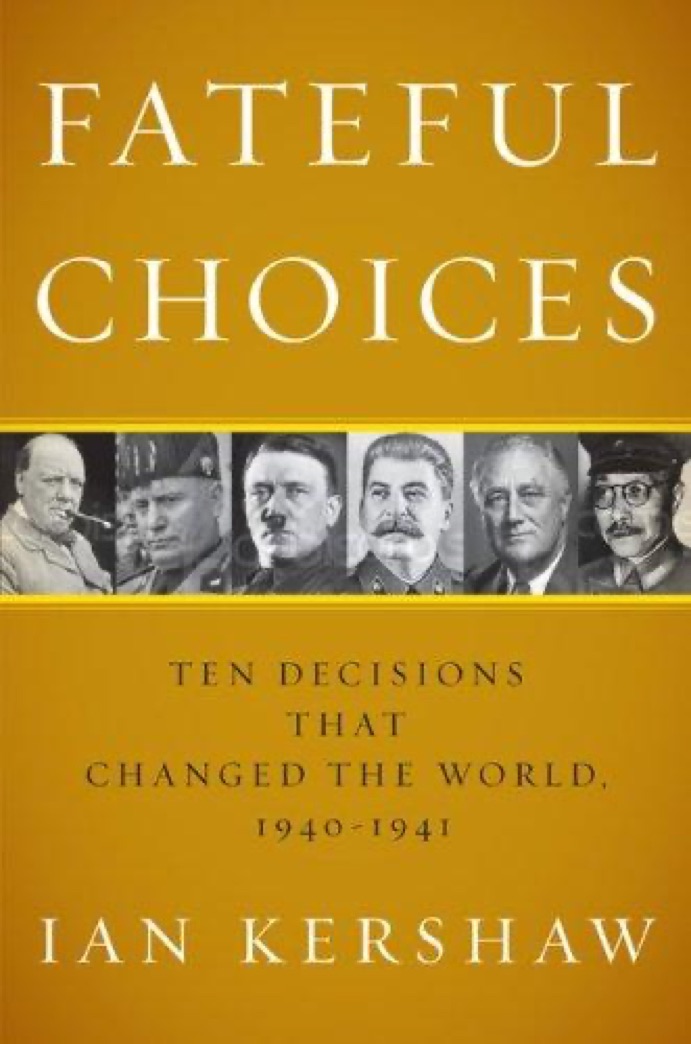
Fateful Choices: Ten Decisions That Changed the World, 1940-1941
Applying the lessons from "Fateful Choices: Ten Decisions That Changed the World, 1940-1941" by Ian Kershaw to your life can be a transformative exercise in understanding the mechanics of high-stakes leadership and the long-term impact of strategic pivots. Here are some ways you might integrate these lessons:
-
Analyze the Cost of Inaction: - Just as Churchill recognized that beginning peace talks would erode Britain’s psychological capacity to fight, you must recognize when "keeping your options open" is actually a form of surrender. In business and medicine, some paths are irreversible; understand that the mere act of exploring an exit strategy can sometimes undermine the primary mission.
-
Guard Against Ideological Blindness: - Hitler and Stalin both ignored intelligence that contradicted their worldviews, leading to catastrophic surprises. You should actively cultivate a "red team" mindset in your VC firm and clinical practice, seeking out data that challenges your existing hypotheses to ensure your strategy is based on reality rather than a desired narrative.
-
Assess the Realities of Resource Constraints: - Mussolini’s failure was a failure to align ambition with capability. Whether you are scaling a new healthcare venture or planning a complex flight, you must conduct a rigorous audit of your "industrial base"—your capital, your team's stamina, and your technical limits—before committing to a new theater of operations.
-
Recognize the Momentum of Incremental Decisions: - The path to the Holocaust was paved by smaller, incremental choices that normalized the unthinkable. You should remain vigilant about the ethical trajectory of your organizations, understanding that small compromises in values can create a momentum that eventually leads to systemic failure or moral bankruptcy.
-
Balance Tactical Needs with Strategic Endpoints: - Japan’s tactical brilliance at Pearl Harbor was a strategic disaster because it lacked a realistic plan for ending the war. In your entrepreneurial ventures, ensure that your short-term wins are actually building toward a sustainable long-term goal rather than simply provoking a superior competitor you cannot outlast.
-
Leverage the Power of Personal Agency: - Despite the massive forces of history, Kershaw shows that individual leaders changed the world. You should embrace the weight of your own agency in the ER, the boardroom, and the cockpit, knowing that your specific decisions in moments of crisis can alter the trajectory of lives and organizations for years to come.
By integrating these lessons, you will develop a more nuanced approach to decision-making that respects the complexity of the global environment while maintaining the decisive edge necessary for high-performance leadership across multiple disciplines.
What the book covers
"Fateful Choices: Ten Decisions That Changed the World, 1940-1941" by Ian Kershaw is a masterful examination of the critical geopolitical turning points that occurred during the nineteen months between the fall of France and the Japanese attack on Pearl Harbor. Kershaw, a preeminent historian of the Third Reich, analyzes how specific choices made by leaders in London, Berlin, Tokyo, Rome, Moscow, and Washington transformed a regional European conflict into a truly global conflagration. By reconstructing the pressurized environments and limited intelligence available to these decision-makers, the book illustrates that the outcome of World War II was not an inevitability, but a consequence of human agency and strategic calculation.
Summary:
-
The British Resolve to Fight On: - In May 1940, with the fall of France imminent, the British War Cabinet faced a defining moment: negotiate through Mussolini or continue a seemingly hopeless resistance. Kershaw highlights the tension between Lord Halifax, who sought a mediated peace, and Winston Churchill, who successfully argued that once negotiations began, Britain's will to resist would crumble, potentially leading to vassalage under Hitler.
-
Hitler’s Fatal Gamble in the East: - The decision to invade the Soviet Union (Operation Barbarossa) is analyzed not just as military folly, but as the fulfillment of Hitler's ideological obsession. Kershaw explains that Hitler believed a quick victory over the USSR would force Britain to terms and prevent the United States from entering the war, demonstrating how ideological bias can warp strategic reality and lead to overextension.
-
Mussolini’s Quest for Glory: - Mussolini’s decision to enter the war in June 1940 and his subsequent disastrous invasion of Greece are presented as examples of vanity-driven leadership. Seeking a "parallel war" to match Hitler's triumphs, Il Duce ignored the advice of his military commanders and the reality of Italy's industrial weakness, ultimately tying Italy’s fate to a German machine that viewed its ally with growing contempt.
-
Japan’s Path to Pearl Harbor: - Facing an American oil embargo and the stalemate of their war in China, Japanese leaders debated between withdrawal and expansion. Kershaw details the internal struggle within the Japanese high command, which eventually chose the "Strike South" and the preemptive blow at Pearl Harbor, driven by a cultural refusal to lose face and a desperate hope that a short, sharp war would force the US into a negotiated settlement.
-
Roosevelt’s Undeclared War: - FDR navigated a difficult path between his desire to aid Britain and the strong isolationist sentiment of the American public. The book explores the strategic brilliance of the Lend-Lease Act and the Atlantic Charter, showing how Roosevelt gradually committed the United States to a path of belligerence, effectively entering an undeclared naval war in the Atlantic long before the formal declaration.
-
The Decision for Genocide: - Kershaw traces the evolution of the "Final Solution" from a series of fragmented initiatives to a coordinated continental program of mass murder. He argues that the decision for the Holocaust was not a single moment of clarity, but an incremental process catalyzed by the euphoria of early victories in Russia and the logistical "problems" created by the rapid expansion of German-controlled territory.
This work serves as a profound reminder of the weight of leadership. By focusing on these nineteen months, Kershaw demonstrates how a handful of individuals, operating under immense stress and often with flawed information, made choices that determined the survival of civilizations and the death of millions.