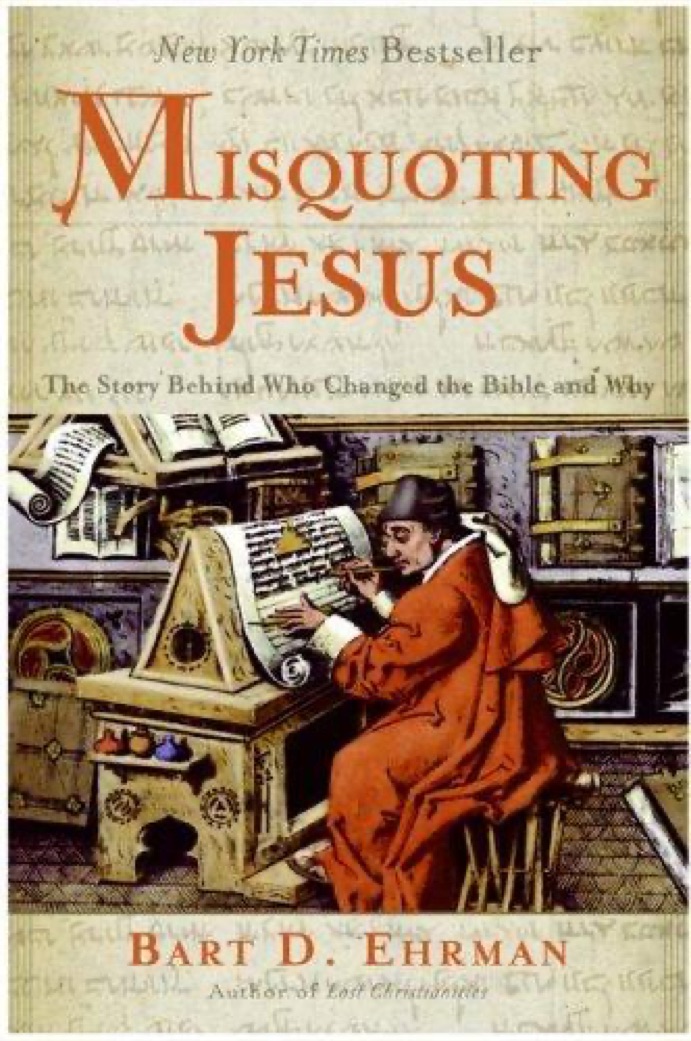
Misquoting Jesus: The Story Behind Who Changed the Bible and Why
Applying the lessons from "Misquoting Jesus: The Story Behind Who Changed the Bible and Why" by Bart D. Ehrman to your life can be a masterclass in the necessity of intellectual rigor and the critical evaluation of information. Here are some ways you might integrate these lessons:
-
Exercise Due Diligence with Primary Sources: - Just as textual critics must trace manuscripts back to their earliest forms, you should always seek the most direct source of information in medicine, law, or business. Relying on filtered or "copied" data can lead to compounding errors that cloud your decision-making and strategy.
-
Acknowledge the Persistence of Human Error: - Recognize that every system involving human intervention is susceptible to mistakes, whether it is a medical record, a legal contract, or a business plan. By adopting a mindset of "Stay Humble," you remain vigilant and open to the possibility that your foundational data may contain unintentional flaws.
-
Identify Implicit Bias in Record-Keeping: - Understand that information is often subtly altered to fit a specific narrative or desired outcome. In leadership and venture capital, you must look beyond the presented story to identify if data has been "smoothed" or adjusted to align with a preferred theological or corporate orthodoxy.
-
Embrace Nuance and Ambiguity: - The realization that even sacred texts are subject to change teaches you to become comfortable with ambiguity. In high-stakes environments like the ER or a cockpit, being able to operate effectively while acknowledging that your information may be incomplete or evolving is a hallmark of professional maturity.
-
Value the Role of the Specialist: - The complex work of textual criticism highlights why experts are essential for decoding intricate systems. Whether you are navigating a new healthcare regulation or a complex acquisition, ensure you have specialists who can perform the deep "philological" work necessary to understand the nuances of the situation.
-
Maintain Intellectual Humility through Learning: - If the most studied book in history can contain significant variants, then your own assumptions are likely subject to error. Staying hungry for knowledge means constantly questioning your "canonical" beliefs and being willing to update them in the face of new evidence.
By integrating these lessons, you will develop a more sophisticated approach to information management and leadership, ensuring that your ventures and your life are built on a foundation of verified truth rather than unexamined tradition.
What the book covers
"Misquoting Jesus: The Story Behind Who Changed the Bible and Why" by Bart D. Ehrman is a compelling exploration into the history of the New Testament manuscripts and the discipline of textual criticism. The book details how the early Christian scriptures were transcribed by hand for over a millennium, leading to thousands of variations across different manuscripts. Ehrman explains the methods scholars use to reconstruct the original text while examining the theological and cultural motives that influenced these changes.
Summary:
-
The Absence of Original Manuscripts: - Ehrman clarifies that we do not possess the original autographs of any book in the New Testament; instead, we rely on copies made decades or centuries later. These copies were produced by scribes who, especially in the first few centuries, were often amateur practitioners prone to making mistakes.
-
The Mechanics of Scribal Error: - The book categorizes changes into accidental and intentional errors. Accidental errors include simple slips of the pen, such as skipping lines (parablepsis) or repeating words (dittography), which were common in an era before standardized spelling and punctuation.
-
Theological and Polemical Alterations: - Beyond accidents, some scribes intentionally altered the text to reflect contemporary theological debates or to clarify perceived ambiguities. These changes were often made to combat heresies or to align the text more closely with the developing orthodoxy of the church, such as clarifying the nature of the Trinity.
-
Famous Textual Discrepancies: - Ehrman highlights significant passages familiar to modern readers that were likely not in the original texts, such as the story of the woman caught in adultery (John 7:53–8:11) and the final twelve verses of the Gospel of Mark. These sections appear to be later additions that became canonical through centuries of tradition.
-
The Rise of Textual Criticism: - The narrative follows the development of scholarly techniques to identify these errors, beginning with Renaissance figures like Lorenzo Valla and Desiderius Erasmus. These pioneers began to compare different Greek manuscripts, discovering that the "standard" texts of their time were based on relatively late and inferior versions.
-
The Johannine Comma and the Textus Receptus: - A key case study involves the Johannine Comma, a phrase supporting the Trinity that was absent from early Greek manuscripts. Ehrman describes the pressure placed on Erasmus to include it in his printed Greek New Testament, which eventually formed the basis for the King James Version.
-
Modern Reconstructions and Methodologies: - The book concludes by discussing how modern scholars use rules of thumb—such as preferring the shorter reading or the more difficult reading—to get closer to what the original authors likely wrote. It emphasizes that while many changes are minor, some significantly impact our understanding of the New Testament’s message.
"Misquoting Jesus" serves as a vital bridge between complex biblical scholarship and the general public, demystifying the origins of the world's most famous book. It underscores the human element involved in the preservation of sacred texts and challenges readers to consider the historical processes that shape their beliefs.