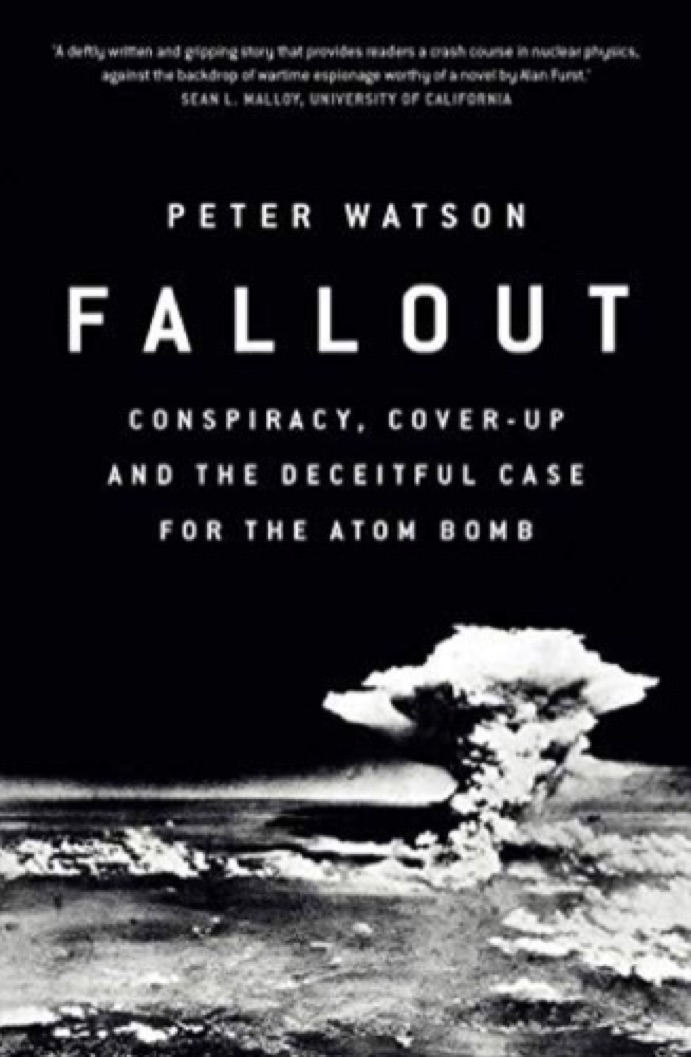
Fallout: Conspiracy, Cover-Up and the Deceitful Case for the Atom Bomb
Applying the lessons from "Fallout" by Peter Watson to your life can be a sobering exercise in understanding how institutional momentum and the suppression of dissenting information can lead to ethically compromised outcomes. Here are some ways you might integrate these lessons:
-
Challenge the Sunk Cost Fallacy in Leadership: - In both healthcare entrepreneurship and venture capital, you must remain vigilant against continuing a project solely because of the resources already invested. Just as General Groves pushed the Manhattan Project to completion to justify its cost, you must have the humility to pivot or halt an initiative if the original data or market justification changes, regardless of the "billion-dollar" stakes.
-
Cultivate Radical Transparency to Prevent Ethical Drift: - As a leader in complex environments like emergency medicine or law, you must ensure that information is not siloed. Watson shows how compartmentalization allowed scientists to work toward a goal they might have morally opposed had they known the full truth; you should foster a culture where your team has the contextual clarity needed to make informed, ethical decisions.
-
Audit the "Necessary Evil" Narratives: - Whenever you are told a course of action is a "necessary evil" or the only way forward, apply the critical lens of a historian. In business negotiations or legal disputes, verify the underlying assumptions of the "threat" yourself rather than accepting the prevailing narrative at face value.
-
Balance Ambition with Objective Reality: - Watson’s depiction of Groves is a cautionary tale for any serial entrepreneur. While drive is essential for success, you must ensure your ambition doesn't lead to "deceitful cases" for your own projects. Maintaining your "Stay Humble" mantra means subordinating your desire for a legacy to the objective truth of the situation.
-
The Responsibility of Expert Knowledge: - As a pilot or physician, your specialized knowledge carries a heavy social burden. This book reminds you that your expertise should never be a tool for political or bureaucratic utility; you must maintain intellectual independence to ensure your work serves its intended humanitarian or professional purpose without being co-opted.
-
Recognize the Long-Term Cost of Secrecy: - In building companies or legal frameworks, realize that short-term deceptions to maintain control or momentum often result in a long-term erosion of trust. Prioritize integrity in your communications to ensure that the organizations you build have a sustainable foundation rather than one built on a "fallout" of misinformation.
By integrating these lessons, you can better navigate the pressures of high-stakes leadership while remaining anchored to the truth. Watson’s history serves as a blueprint for identifying when organizational goals have decoupled from their moral justifications, allowing you to lead with both the hunger to succeed and the humility to be corrected by the facts.
What the book covers
"Fallout: Conspiracy, Cover-Up and the Deceitful Case for the Atom Bomb" by Peter Watson is a provocative re-examination of the dawn of the nuclear age and the true motivations behind the Manhattan Project. Watson meticulously deconstructs the prevailing historical narrative that the development and deployment of the atomic bomb were a necessary race against a looming Nazi nuclear threat. Through rigorous archival research and analysis of declassified documents, the book reveals a pattern of intelligence manipulation, institutional momentum, and deliberate secrecy that prioritized the completion of the weapon long after its original justification had vanished.
Summary:
-
The Scientific Genesis and the Hahn-Meitner Discovery: - Watson begins by tracing the 1938 discovery of nuclear fission by Otto Hahn and Fritz Strassmann, with the essential theoretical interpretation provided by Lise Meitner. This breakthrough sparked an immediate global realization among physicists that a weapon of unprecedented power was theoretically possible, prompting the initial letters to Roosevelt.
-
The Myth of the Nazi Nuclear Threat: - A central argument of the book is that the Allied "race" against a German bomb was largely a fabrication maintained to ensure funding and scientific focus. Watson provides evidence that British and American intelligence had strong indications early on that the German program was disorganized and underfunded, lacking the industrial capacity to produce a weapon.
-
General Leslie Groves and the Machinery of Power: - The author focuses heavily on the role of General Leslie Groves, the military head of the Manhattan Project, depicting him as a man driven by ego and the need to justify a massive two-billion-dollar expenditure. Groves is shown as a primary architect of the culture of secrecy, ensuring that the project became an unstoppable bureaucratic machine that no longer required its original raison d'être.
-
The Alsos Mission and the Truth Revealed: - Watson details the Alsos Mission, a specialized intelligence unit that followed Allied front lines into Europe to investigate German scientific progress. By late 1944, the mission, led by Boris Pash and Samuel Goudsmit, confirmed that the Nazi nuclear program had stalled at a primitive, non-military level, yet this information was suppressed from the scientists working at Los Alamos.
-
The Deception of the Scientific Community: - The book examines the ethical breach committed by military and political leaders who withheld intelligence from the scientists. Many researchers, including Joseph Rotblat, believed they were working on a deterrent; Watson argues that had they known the German threat was non-existent, the moral consensus within the project might have collapsed before the Trinity test.
-
Shifting Targets and Atomic Diplomacy: - As the German threat evaporated, Watson describes the pivot toward Japan and the nascent Cold War strategy against the Soviet Union. He suggests that the decision to drop the bomb was influenced less by the need to save lives during an invasion and more by the desire to demonstrate American hegemony and justify the project's costs to Congress.
-
The Legacy of the National Security State: - The final chapters explore how the deceptions and extreme secrecy of the Manhattan Project set a dangerous precedent for modern governance. Watson posits that the "original sin" of the atomic age was the normalization of government misinformation, which fundamentally altered the relationship between the state, the scientific community, and the public.
Ultimately, Watson’s work serves as a chilling reminder of how institutional momentum can override ethical considerations. By exposing the gap between the official history and the documented reality, the book challenges readers to rethink the moral foundations of the nuclear era and the accountability of those in power during times of crisis.