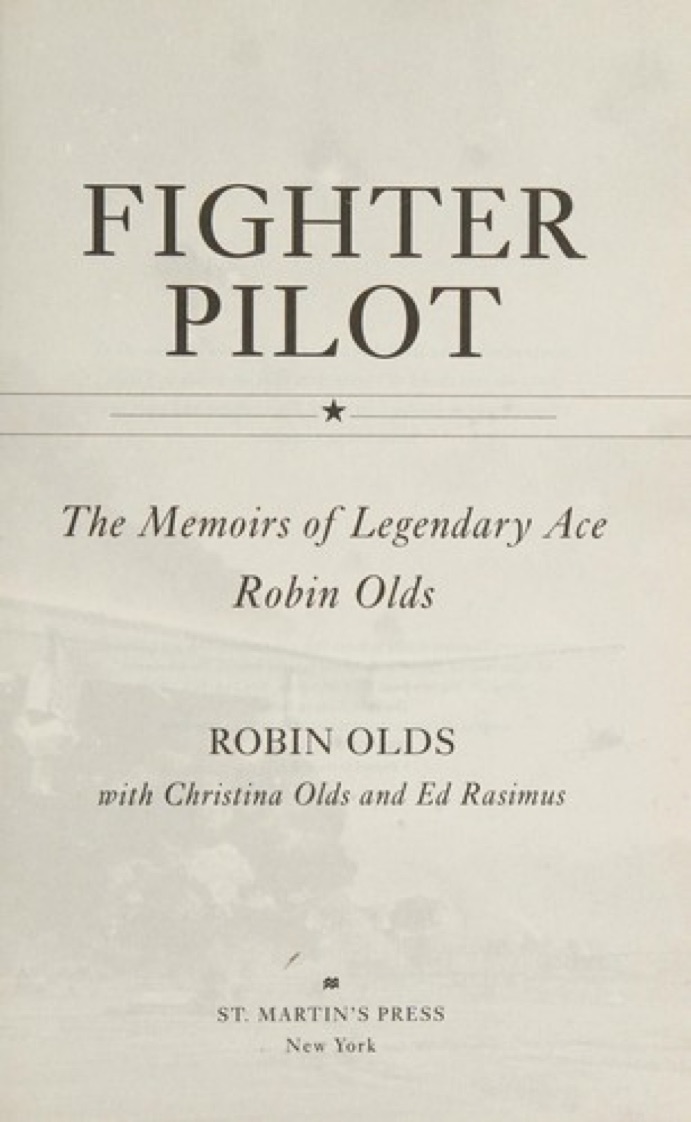
Fighter Pilot: The Memoirs of Legendary Ace Robin Olds
Applying the lessons from "Fighter Pilot: The Memoirs of Legendary Ace Robin Olds" by Robin Olds, Christina Olds, and Ed Rasimus to your life can be a transformative exercise in leadership, audacity, and personal accountability. Here are some ways you might integrate these lessons:
-
Command Through Presence: - Whether you are in the cockpit, the emergency room, or the boardroom, you must be willing to do exactly what you ask of your team. By flying the first mission of every new rotation, Olds earned the right to lead; you should similarly demonstrate your clinical or operational proficiency to build trust and credibility with your staff.
-
Foster a Culture of Aggressive Problem-Solving: - Encourage your team to identify and exploit "blind spots" in your industry, just as Olds used Operation Bolo to exploit the predictability of enemy tactics. You should create an environment where junior members feel empowered to suggest unconventional solutions to long-standing systemic inefficiencies.
-
Prioritize People Over Hierarchy: - Olds focused on the welfare and performance of his "Wolfpack" over his own standing with the Pentagon. In your entrepreneurial ventures or legal practice, you must be the umbrella that protects your team from bureaucratic "noise," allowing them to focus entirely on the mission and their professional growth.
-
Uncompromising Mastery of the Fundamentals: - Never let technology make you complacent. Just as Olds insisted his pilots master visual dogfighting despite having advanced missiles, you must ensure that you and your team maintain foundational skills—like basic physical exams in medicine or first-principles thinking in business—that remain effective when the "radar" fails.
-
The Value of Constructive Rebellion: - Do not fear the "outlaw" label if the rules are preventing you from achieving the primary objective or endangering your team. You should have the courage to challenge outdated regulations or suboptimal industry standards, provided your dissent is rooted in a desire for excellence and better outcomes.
-
Stay Hungry for Innovation: - Olds never stopped looking for a better way to fly and fight. You must maintain a lifelong learner’s mindset, constantly seeking new mental models and technologies that can give you a tactical advantage in the rapidly evolving healthcare and venture capital landscapes.
By integrating these lessons, you will develop the grit and vision necessary to lead high-performing teams through turbulent environments. You will learn to balance the "Stay Hungry" drive for victory with the "Stay Humble" realization that your greatest successes are achieved through the collective effort and morale of those you lead.
What the book covers
"Fighter Pilot: The Memoirs of Legendary Ace Robin Olds" by Robin Olds, Christina Olds, and Ed Rasimus is an immersive first-person account of one of the most charismatic and effective combat aviators in American history. The book traces Olds’s journey from a young West Point athlete to a triple-ace fighter pilot across two major conflicts: World War II and the Vietnam War. It captures his relentless pursuit of excellence, his fierce loyalty to his men, and his career-long battle against a stifling military bureaucracy that often valued conformity over combat effectiveness.
Summary:
-
A Warrior’s Foundation: - Robin Olds was born into a military tradition as the son of a World War I pursuit pilot, fostering an early obsession with flight and a deep respect for the warrior ethos. His time at West Point during the early 1940s was defined by his prowess on the football field and his growing impatience with rigid, non-tactical discipline, a trait that would define his entire career.
-
The European Theater and Double-Ace Status: - During World War II, Olds flew P-38 Lightnings and P-51 Mustangs, quickly establishing himself as a natural hunter in the sky. He gained "ace" status by mastering the aggressive tactics of the era, emphasizing that a pilot’s success depends more on situational awareness and guts than on the technical specifications of the aircraft alone.
-
Post-War Friction and the Jet Age: - Following WWII, Olds struggled with the Air Force's transition into a peacetime bureaucracy that he felt was losing its edge. He became a vocal critic of the shift away from dogfighting training, arguing that the reliance on missiles and radar would fail pilots in real-world visual combat—a prophecy that would tragically come true during the early years of the Vietnam War.
-
Commanding the Wolfpack: - In 1966, Olds was given command of the 8th Tactical Fighter Wing in Thailand, known as the "Wolfpack." He instantly transformed the unit’s morale by flying the most dangerous missions himself, listening to his junior officers, and demanding a level of tactical proficiency and aggressiveness that had been previously suppressed by risk-averse leadership.
-
Operation Bolo and Tactical Innovation: - The book details the planning and execution of Operation Bolo, perhaps the most successful aerial trap in history. Olds and his team disguised their F-4 Phantoms as vulnerable F-105 bombers to lure North Vietnamese MiGs into a fight, resulting in the destruction of a significant portion of the enemy’s interceptor force without a single American loss.
-
The Battle Against the Pentagon: - Throughout his Vietnam tour, Olds fought a secondary war against the restrictive Rules of Engagement (ROE) imposed by Washington. He highlights the frustration of losing pilots to targets they were forbidden to hit and his own subversion of orders to ensure his men had the best chance of survival and mission success.
-
Legacy and the Spirit of Flight: - The memoir concludes with Olds’s return to the United States and his eventual role as Commandant of Cadets at the Air Force Academy. He reflects on the evolution of air power and the eternal necessity of the "fighter pilot spirit," which combines technical mastery with an indomitable will to win.
This memoir serves as a definitive study of leadership and tactical brilliance. It stands as a testament to the importance of the human element in high-stakes environments, proving that even in an age of advancing technology, the character and courage of the individual remain the most decisive factors in success.