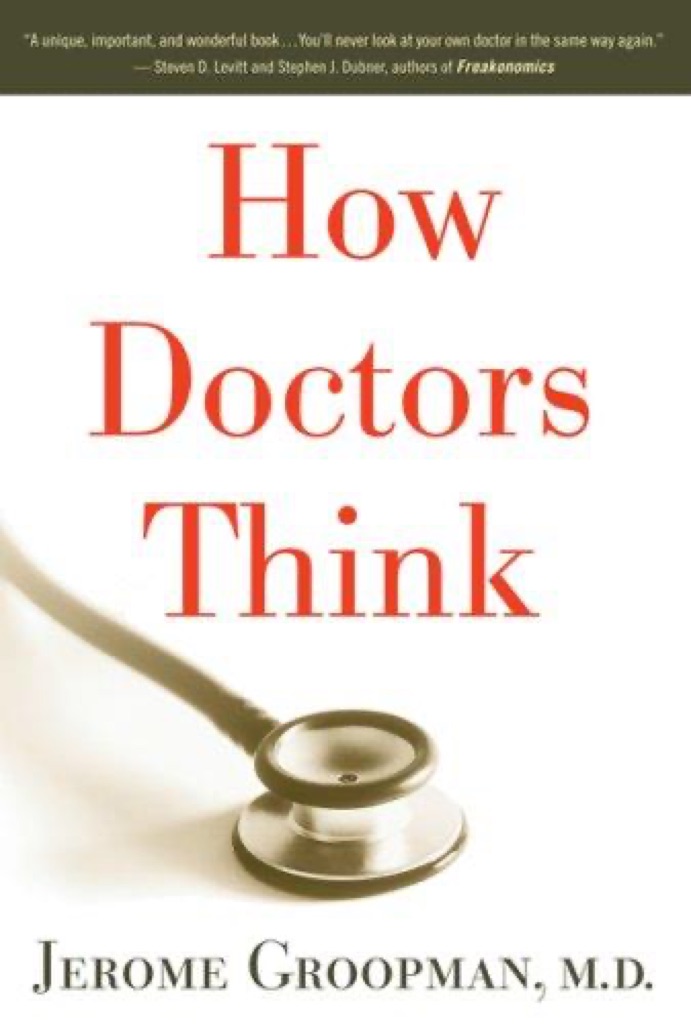
How Doctors Think
Applying the lessons from "How Doctors Think" by Jerome Groopman to your life can be a transformative exercise in enhancing your decision-making, whether you are in the exam room, the cockpit, or the boardroom. Here are some ways you might integrate these lessons:
-
Challenge Your Initial Anchors: - In medicine and entrepreneurship, the first piece of information you receive often exerts a disproportionate influence on your final decision. You must consciously ask, "What else could this be?" to prevent yourself from fixating on a premature conclusion, especially when the stakes are high.
-
Master the Art of the Pause: - Just as a doctor often interrupts within eighteen seconds, leaders often interrupt employees before the full scope of a problem is articulated. Practice "intentional silence" to ensure you have gathered all the relevant data before you begin your analysis; this is as vital for legal discovery as it is for clinical diagnosis.
-
Audit Your Emotional Biases: - Be mindful of how your personal feelings toward a colleague, a client, or a patient influence your judgment. If you find yourself rushing a meeting or dismissing an idea, pause to consider if your reaction is based on the data or on a subconscious "countertransference" that is clouding your objectivity.
-
Apply First-Principles Thinking Over Algorithms: - While checklists are essential in aviation and surgery for safety, they can lead to intellectual laziness if used as a crutch. You should use protocols as a baseline but maintain the "hunger" to look for the outlier data that doesn't fit the standard template, allowing for more creative and accurate problem-solving.
-
Foster a Culture of Curiosity: - In any leadership role, encourage your team to play devil's advocate. By asking, "Is there anything that contradicts our current theory?" you create a safe environment for people to point out flaws in the "groupthink," which is the most effective way to avoid catastrophic errors in both law and business.
-
Stay Humble in the Face of Uncertainty: - Acknowledging what you do not know is not a sign of weakness but a hallmark of true expertise. Embracing the "Stay Humble" mantra allows you to seek out diverse perspectives and prevents the ego-driven blind spots that lead to diagnostic and strategic failures.
-
Systems Thinking and Redundancy: - Much like an aviator uses cross-checks, you should build redundant loops into your thinking processes. Before finalizing a major decision, go back to the "gatekeeper" phase and ensure no vital information was missed during the transition from the big picture to the specialized details.
By integrating these lessons, you will develop a more robust and flexible mindset that thrives on the boundary between art and science. Whether you are leading a VC firm or treating a patient in the ER, the ability to recognize your own cognitive patterns is the ultimate tool for achieving excellence. Embracing uncertainty and prioritizing the human narrative will not only make you a better professional but will ensure that you continue to evolve as a lifelong learner.
What the book covers
"How Doctors Think" by Jerome Groopman is a profound exploration into the cognitive and emotional processes that govern medical decision-making. As an oncologist and professor at Harvard Medical School, Groopman pulls back the curtain on the clinical encounter to reveal why physicians succeed, why they err, and how patients can actively participate in their own care. The book argues that medicine is an uncertain science where technical knowledge must be balanced with human intuition to avoid the pitfalls of modern diagnostic practice.
Summary:
-
The Mechanics of Clinical Judgment: - Groopman introduces the concept that most medical errors are not caused by technical ignorance, but by flaws in the thinking process. He uses the harrowing case of Anne Dodge, who was misdiagnosed with psychiatric eating disorders for fifteen years before a physician looked past her history to discover she actually suffered from celiac disease. - This section emphasizes that doctors often make a diagnosis within the first twenty seconds of meeting a patient, often before the patient has finished describing their symptoms. These snap judgments are necessary for efficiency but create a high risk of "anchoring," where a doctor fixates on a single diagnosis and ignores contradictory evidence.
-
Cognitive Biases and Heuristics: - The author details several cognitive traps, such as the availability heuristic, where a doctor diagnoses what is most easily remembered or recently seen. For instance, during flu season, a physician might overlook a more serious underlying condition because the "available" data points toward a common virus. - Other biases discussed include "satisfaction of search," the tendency to stop looking for further problems once one abnormality is found, and "confirmation bias," where a doctor only seeks information that supports their initial theory while dismissing anomalies.
-
The 18-Second Interruption: - Research cited by Groopman shows that, on average, a doctor interrupts a patient's story after only eighteen seconds. This rush to speak prevents the physician from hearing critical nuances that might lead to a correct diagnosis, transforming the dialogue into a narrow interrogation rather than an open exchange. - He argues that the "art of listening" is a foundational clinical tool. When doctors stop listening, they lose the ability to perceive the patient's unique narrative, which is often where the most vital diagnostic clues are hidden.
-
Emotional Countertransference: - Doctors are human and are subject to emotional reactions—both positive and negative—toward their patients. Groopman explores how a doctor's personal dislike of a patient, perhaps due to non-compliance or lifestyle choices, can lead to sub-par care and diagnostic negligence. - Conversely, when a doctor likes a patient too much, they may avoid ordering painful tests or delivering bad news, subconsciously wanting to protect the patient from the reality of a terminal illness, which ultimately delays necessary intervention.
-
The Specialized Lens: - Specialists often suffer from "tunnel vision," viewing every symptom through the narrow prism of their own expertise. A surgeon may see a problem as something to be cut, while an internist sees it as something to be medicated. - Groopman interviews several prominent specialists to show how the most effective experts are those who remain aware of their own professional biases and are willing to consider possibilities outside their immediate field.
-
The Influence of External Pressures: - The book examines how pharmaceutical marketing and insurance reimbursement structures subtly influence medical thinking. Financial incentives and time constraints often push doctors toward standardized algorithms and "evidence-based" templates that can stifle independent clinical reasoning. - While checklists and algorithms have their place, Groopman warns that over-reliance on them can turn doctors into passive data-entry clerks who fail to recognize the outlier cases that fall outside the statistical norm.
-
Empowering the Patient as a Partner: - One of the most practical sections provides specific questions patients can ask to redirect a doctor's thinking, such as "What else could this be?" and "Is there anything that doesn't fit?" - By asking these questions, the patient helps the doctor break free from cognitive ruts and forces a recalibration of the diagnostic process, moving the relationship toward a collaborative partnership.
Ultimately, Groopman concludes that the best medicine occurs when doctors stay humble enough to admit uncertainty and hungry enough to keep searching for the truth. By acknowledging the human element in the clinic, both doctors and patients can work together to navigate the complexities of the medical mind and achieve better outcomes.