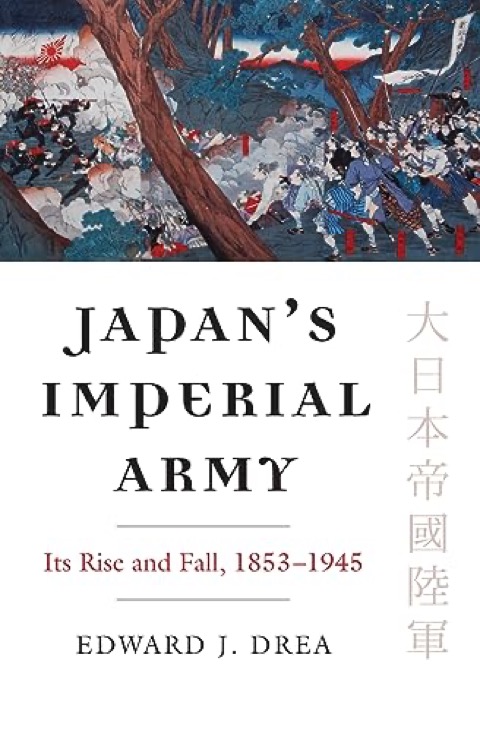
Japan's Imperial Army: Its Rise and Fall, 1853-1945
Applying the lessons from "Japan's Imperial Army: Its Rise and Fall, 1853-1945" by Edward J. Drea to your life can be a profound exercise in understanding the delicate balance between institutional culture and strategic reality. Here are some ways you might integrate these lessons:
-
Guard Against Institutional Insularity: - Just as the IJA became a "state within a state," you must ensure your organizations—whether a medical practice or a VC firm—remain open to external feedback and reality checks. Avoid creating silos where internal ideology or "the way we've always done it" blinds you to changing market conditions or technological shifts.
-
Balance Spirit with Logistics: - In entrepreneurship and medicine, passion and "grit" (seishin) are vital, but they cannot replace a sound supply chain or financial runway. You must ensure that your vision is always backed by the necessary material resources and logistical support; never allow your enthusiasm to mask a fundamental lack of operational viability.
-
Recognize the Danger of Strategic Drift: - The IJA suffered from a lack of clear objectives in China, leading to an endless drain on resources. In your professional life, you should constantly evaluate whether your current projects align with your ultimate goals, and have the courage to cut losses on "quagmire" initiatives that no longer serve your primary mission.
-
Maintain Unity of Command and Purpose: - The factionalism that crippled the Japanese high command serves as a warning for leadership. You should prioritize transparency and alignment among your partners and stakeholders, ensuring that internal rivalries do not undermine the collective health of the enterprise or the safety of the mission.
-
Respect Material Constraints in Decision Making: - As a pilot and attorney, you know that physical laws and legal frameworks provide hard boundaries. Drea’s history teaches you to always base your strategies on objective data and "ground truth" rather than optimistic assumptions or the belief that sheer will can overcome structural deficiencies.
-
Prioritize Sustainable Growth Over Rapid Expansion: - The IJA’s rise was spectacular but unsustainable because it lacked the foundational depth to support its breadth. In your role as a venture capitalist and entrepreneur, focus on building robust, scalable foundations that can withstand pressure, rather than chasing growth that outstrips your ability to manage it.
By integrating these lessons, you can build organizations that are not only high-performing and mission-driven but also resilient, grounded in reality, and capable of long-term survival in complex, competitive environments.
What the book covers
"Japan's Imperial Army: Its Rise and Fall, 1853-1945" by Edward J. Drea is a definitive scholarly examination of the institutional life cycle of Japan’s ground forces from the Meiji Restoration to the end of World War II. Drea explores how a feudal society rapidly synthesized Western military technology and doctrine to create a world-class fighting force that eventually succumbed to its own internal contradictions and strategic overreach. The book meticulously tracks the army's evolution from a defensive domestic force into an aggressive engine of empire, emphasizing the cultural and political shifts that shaped its identity.
Summary:
-
Origins and the Meiji Transition: - The book begins with the 1853 arrival of Commodore Perry, which shattered Japan's isolation and forced a total reorganization of its military structures. Drea details how the early Meiji reformers dismantled the samurai class to build a conscript army based on European models, initially favoring French and later Prussian systems to ensure national survival against Western encroachment.
-
The Prussian Model and Professionalization: - During the late 19th century, the Imperial Japanese Army (IJA) adopted the German General Staff system, creating a professionalized officer corps and a centralized command structure. This era was defined by a focus on offensive doctrine and the belief that superior training and discipline could overcome the inherent resource limitations of a small island nation.
-
Continental Ambitions and Early Victories: - Drea analyzes the army's performance in the First Sino-Japanese War and the Russo-Japanese War, which served as proof of concept for Japan’s modernization. These victories cemented the army's prestige domestically but also fostered a dangerous sense of invincibility and a reliance on the concept of "seishin" (spiritual power) to trump material disadvantages.
-
Internal Factionalism and Political Interference: - The narrative delves into the interwar years, highlighting the deep-seated rift between the Koda-ha (Imperial Way Faction) and the Tosei-ha (Control Faction). This internal struggle led to political assassinations and an autonomous military that effectively hijacked the civilian government, driving Japan toward an inevitable confrontation with China and the West.
-
The Quagmire in China and Strategic Drift: - By the 1930s, the IJA became bogged down in a massive, undeclared war in China that drained resources and lacked a clear exit strategy. Drea explains how tactical successes in the field failed to translate into strategic victory, leading the military leadership to take increasingly desperate risks to secure raw materials.
-
The Pacific War and Institutional Collapse: - The final chapters cover the catastrophic decline of the IJA as it faced the industrial might of the United States. Drea illustrates the breakdown of logistics, the failure of the "decisive battle" doctrine, and the horrific human cost of a military culture that prioritized suicide over surrender, leading to total destruction in 1945.
Drea’s work is significant for its objective analysis of the IJA not just as a combat force, but as a socio-political institution. It serves as a cautionary tale regarding the dangers of military autonomy and the fatal consequences of allowing ideological zeal to override objective material reality.