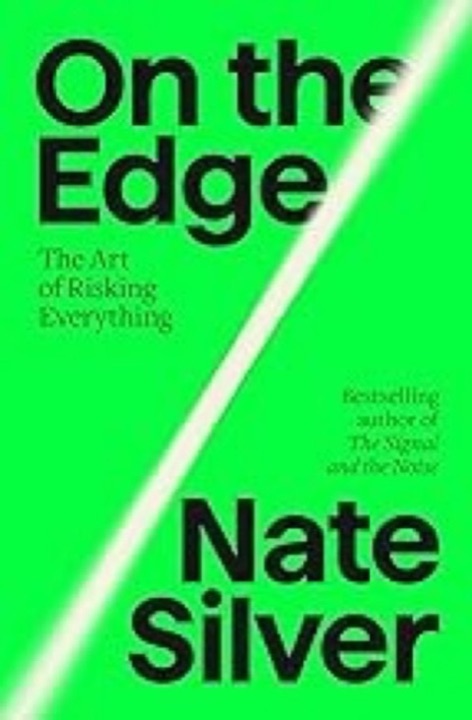
On the Edge
As of my last update, Nate Silver has not published a book titled "On the Edge." However, if we consider the themes and lessons from his well-known work, "The Signal and the Noise," we can draw some parallels and apply them to your life.
-
Embrace Uncertainty and Complexity: Nate Silver emphasizes the importance of understanding uncertainty and complexity in predictions. In your life, this could mean accepting that not everything can be controlled or predicted, especially given your experiences with near-death situations. Embrace the unknown and be open to the possibilities it brings.
-
Focus on Meaningful Signals: Silver discusses the challenge of distinguishing meaningful signals from noise. In your life, this could translate to focusing on what truly matters—your family, personal growth, and core values—while filtering out distractions and negativity.
-
Adapt and Learn Continuously: Silver highlights the need for adaptability and continuous learning. Your commitment to being a lifelong learner and your daily self-evaluation align well with this lesson. Keep seeking knowledge and adapting to new circumstances.
-
Use Data and Evidence: Silver's work emphasizes the importance of data-driven decision-making. In your life, this could mean relying on evidence and past experiences to guide your decisions, whether in your career, personal life, or activism.
-
Balance Optimism with Realism: While you are an eternal optimist, it's important to balance this with a realistic understanding of the challenges you face. Silver's work suggests that a balanced approach can lead to better outcomes.
-
Persistence and Resilience: Your superpower of persistence aligns with Silver's emphasis on resilience in the face of uncertainty. Continue to persevere through challenges, knowing that your resilience is a key strength.
By applying these lessons, you can continue to navigate life's uncertainties with confidence and purpose, staying true to your values and aspirations.
What the book covers
"On the Edge" by Nate Silver is a comprehensive exploration of a specific subculture of risk-takers who use a quantitative and probabilistic mindset to navigate the modern world. Silver identifies this group as inhabitants of "The River," a community encompassing professional gamblers, hedge fund managers, and tech innovators who prioritize expected value over conventional wisdom. Through a mix of reporting and personal analysis, the book examines how these individuals are reshaping global finance, politics, and technology by embracing uncertainty.
Summary:
-
The Concept of 'The River': Nate Silver introduces "The River" as a metaphorical ecosystem populated by individuals who share a specific cognitive style defined by analytical rigor and a high tolerance for risk. These "Riverians" include poker players, hedge fund managers, and venture capitalists who view life through the lens of game theory and calculated bets. - The book argues that this demographic has gained disproportionate influence in the 21st century by mastering the art of the gamble while traditional institutions, or "The Village," remain bogged down by bureaucracy and social signaling. Silver suggests that the River's ability to decouple emotion from decision-making allows its members to exploit market inefficiencies and drive technological progress.
-
Expected Value and Poker Logic: Silver draws heavily from his own background in professional poker to explain how the mechanics of gambling serve as a training ground for real-world decision-making. He emphasizes the concept of Expected Value (EV), a mathematical framework used to determine the average outcome of a given action over time. - By applying EV to non-gambling scenarios, Silver demonstrates how the River mindset prioritizes long-term success over short-term losses, a trait that distinguishes successful risk-takers from the general public. He posits that the ability to think probabilistically—accepting that a "correct" decision can still result in a bad outcome—is the foundational skill of the modern elite.
-
Venture Capital and High-Stakes Innovation: The narrative shifts to Silicon Valley, where Silver explores the similarities between the "all-in" mentality of poker and the high-risk, high-reward nature of venture capital. He interviews prominent figures like Peter Thiel and Marc Andreessen to understand how they evaluate founders and market trends. - This section highlights how the River's risk-seeking behavior has become the primary engine of modern economic growth. While the Village often views these tech moguls with skepticism, Silver argues that their willingness to bet on low-probability, high-impact ideas is essential for tackling grand challenges and avoiding stagnation.
-
The Rise and Fall of Effective Altruism: A significant portion of the book focuses on the intersection of the rationalist community and Effective Altruism (EA), particularly in the context of Sam Bankman-Fried and the FTX collapse. Silver examines how the EA movement's focus on maximizing impact led to a dangerous brand of utilitarianism. - The author explores how the River's obsession with optimization can go awry when moral guardrails are ignored in favor of pure mathematical utility. The fall of SBF serves as a cautionary tale within the book about the limits of quantitative reasoning and the perils of "risk-blindness" when the stakes involve billions of dollars and public trust.
-
Artificial Intelligence and Existential Risk: Silver tackles the internal debates within the River regarding the future of Artificial Intelligence, contrasting "doomers" who fear existential catastrophe with "accelerationists" who want to move faster. He looks at the rationalist roots of the AI safety movement and the high-stakes lobbying occurring in Washington. - This section illustrates the tension between different factions of the River, showing that while they share a common language of probability, they often arrive at wildly different conclusions about the future. Silver suggests that the battle over AI regulation is a proxy for a larger fight over who gets to define the trajectory of human civilization.
-
Conflict with 'The Village': The book concludes by analyzing the widening chasm between the River and "The Village," which represents traditional media, academia, and the government establishment. Silver argues that the Village often relies on social consensus and status-seeking, which puts it at odds with the River’s meritocratic and contrarian nature. - This divide has profound implications for politics and social stability, as the two groups increasingly live in different epistemic realities. Silver warns that if the River becomes too isolated or if the Village becomes too reactive, the resulting friction could lead to systemic instability and a breakdown of democratic norms.
"On the Edge" serves as both a field guide to the people shaping our future and a philosophical meditation on the nature of uncertainty. By bridging the gap between the gambling floor and the boardroom, Silver provides a vital framework for understanding how risk—when managed with rigor—becomes the ultimate tool for progress in an unpredictable world.