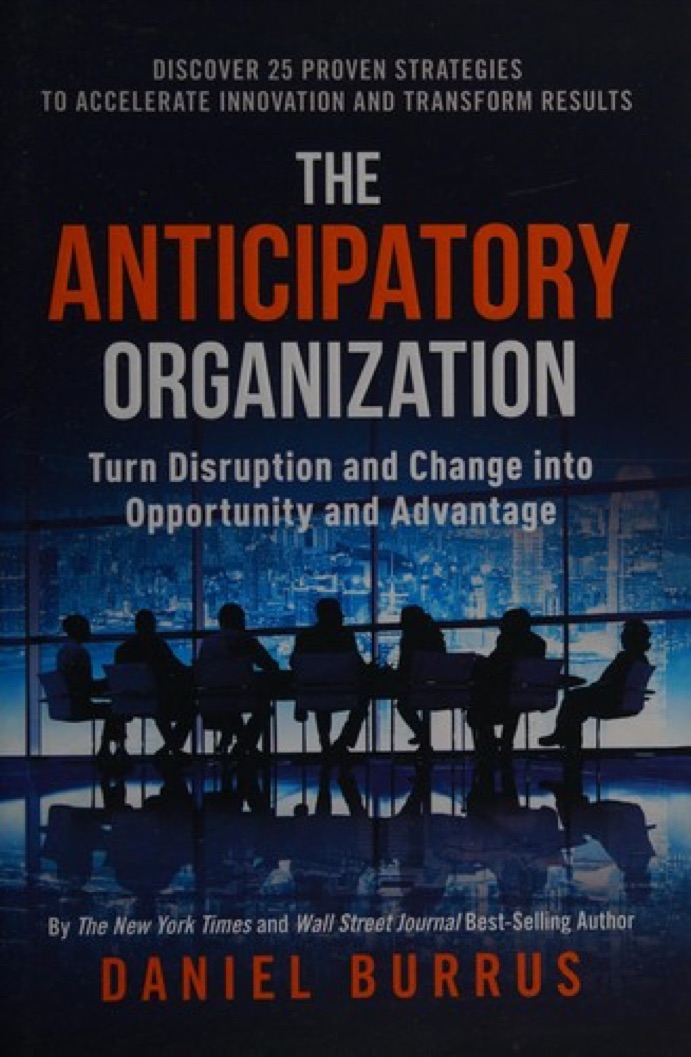
The Anticipatory Organization: Turn Disruption and Change into Opportunity and Advantage
Applying the lessons from "The Anticipatory Organization" by Daniel Burrus to your life can be a powerful way to enhance your decision-making across medicine, law, and venture capital by focusing on what is certain rather than what is merely possible. Here are some ways you might integrate these lessons:
- Identify Healthcare Hard Trends: - As an emergency physician and healthcare entrepreneur, you can distinguish between the inevitable rise of AI-driven diagnostics (a Hard Trend) and the fluctuating regulatory landscape of telehealth reimbursement (a Soft Trend). By building your next healthcare venture around Hard Trends, you ensure that the core value proposition is supported by the future rather than fighting against it.
- Optimize Your Futureview in Aviation: - In the cockpit, a pilot's Futureview is their mental projection of where the aircraft will be in the next several minutes based on current data. You can apply this same discipline to your business leadership; by constantly scanning the horizon for technological "weather patterns," you can make small corrections now that prevent a catastrophic crisis later.
- Leverage the Accelerators in VC Investing: - When evaluating startups for Xcellerant Ventures, look for founders who truly understand the trajectory of bandwidth and storage. Ask yourself if their business model relies on a Soft Trend that might change with the wind, or if they are riding the wave of a Hard Trend that makes their eventual success a mathematical probability over time.
- Practice Problem Skipping in Legal and Regulatory Hurdles: - When faced with complex legal or administrative bottlenecks in your various ventures, do not just try to solve the immediate symptom. Instead, find the underlying Hard Trend—such as the shift toward decentralized data or automated compliance—and skip the current problem by building a new system that bypasses the outdated regulatory friction entirely.
- Stay Hungry for Future Facts: - Maintain your mantra of "Stay Hungry" by dedicating time each week to specifically identifying new Hard Trends in your fields of interest. This prevents you from becoming complacent with your past successes and ensures that your thirst for knowledge is directed toward information that carries the highest strategic value for your future.
- Lead with Humility through Soft Trends: - Exercise the "Stay Humble" part of your mantra by recognizing which of your assumptions are actually Soft Trends. Be willing to change your mind when new data suggests that a previous assumption about the market or technology was wrong, allowing you to be flexible and adaptive where your competitors are rigid and fragile.
By integrating these lessons, you will transform your approach to leadership and innovation, ensuring that you are never caught off guard by disruption but are instead the one driving it. This anticipatory mindset will enable you to navigate the complexities of multiple professional worlds with the same precision and foresight that you bring to the operating room or the flight deck.
What the book covers
"The Anticipatory Organization: Turn Disruption and Change into Opportunity and Advantage" by Daniel Burrus is a strategic manifesto designed to help leaders shift from a reactive mindset to a proactive, forward-thinking approach. The book posits that while agility is important for reacting to change, anticipation is the true driver of long-term success because it allows individuals to see disruptions before they arrive. Burrus provides a practical framework for identifying future certainties, which he calls Hard Trends, to minimize risk and accelerate growth in an increasingly volatile global market.
Summary:
- The Difference Between Hard and Soft Trends: - Burrus introduces the foundational concept of Hard Trends—future facts that will happen, such as the aging of the global population or the continued exponential increase in computing power. By focusing on these certainties, leaders can plan with confidence rather than guessing or reacting to every minor market fluctuation. - Conversely, Soft Trends are things that might happen and are open to influence; for example, a specific piece of legislation might pass, or a consumer preference might shift. Distinguishing between the two allows an organization to identify where they can take a stand and where they must adapt to the inevitable.
- The Three Digital Accelerators: - The book identifies three core technologies that are driving the exponential pace of change: computing power, bandwidth, and storage. Burrus explains that these accelerators are the engines behind every major industry disruption, from the rise of telemedicine to the development of autonomous vehicles. - Understanding the trajectory of these accelerators helps organizations predict when a technology will become commercially viable, allowing them to time their entry into new markets with precision rather than being too early to scale or too late to compete.
- Futureview and Your Mental Map: - Burrus introduces the concept of "Futureview," which is the internal picture an individual or organization holds regarding their future. He argues that your Futureview determines your current actions; if you see a future defined by decline and obsolescence, you will act defensively and fearfully. - By consciously upgrading your Futureview and the Futureview of your team to align with Hard Trends, you can move toward opportunity. This shift in mindset transforms change from something that happens to you into something that happens for you.
- The Innovation Paradox and Problem Skipping: - Many organizations fail because they are busy solving the wrong problems or trying to fix legacy systems that are already obsolete. Burrus suggests "Problem Skipping," a technique where you identify the real obstacle behind the apparent one and leapfrog it entirely to reach a higher-level solution. - This prevents the common trap of getting bogged down in incremental improvements of outdated models, which often distracts from the disruptive, transformational innovation required to stay relevant in a rapidly evolving economy.
- The Eight Pathways to Increase Value: - The book outlines specific pathways for value creation, such as de-commoditization, virtualization, and personalization. By applying these lenses to existing products or services, a business can reinvent its value proposition before a competitor does. - These pathways encourage leaders to look for ways to turn a product into an ongoing service or use data to create a high-touch experience that competitors cannot easily replicate through traditional means.
- Creating a Culture of Anticipation: - Burrus emphasizes that anticipation must be a collective competency rather than the trait of a single visionary leader. He provides strategies for training employees at all levels to look for Hard Trends and share insights across different departments. - This democratization of foresight ensures that the entire organization remains nimble and can pivot collectively when new data suggests a major shift in the technological or economic landscape is imminent.
This work is a vital resource for any leader who feels overwhelmed by the speed of modern change, providing a structured methodology to replace anxiety with actionable certainty. By mastering the art of anticipation, Burrus demonstrates how to turn the very disruptions that destroy others into a unique and sustainable competitive advantage.