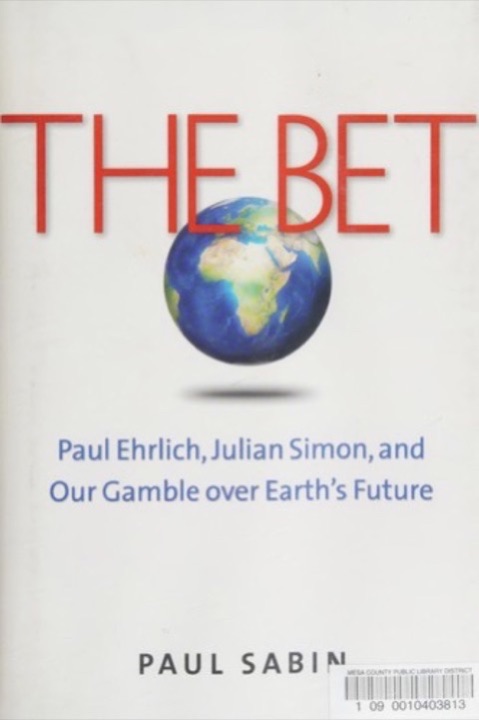
The Bet: Paul Ehrlich, Julian Simon, and our Gamble over Earth's Future
Applying the lessons from "The Bet: Paul Ehrlich, Julian Simon, and Our Gamble over Earth’s Future" by Paul Sabin to your life can be insightful, especially given your diverse experiences and values. Here are some ways you might integrate these lessons:
-
Embrace Complexity and Uncertainty: - Just as the book highlights the complexity of predicting environmental and economic outcomes, recognize that life is full of uncertainties. Your experiences, such as surviving plane crashes, already reflect an understanding of life's unpredictability. Continue to approach challenges with an open mind, acknowledging that simplistic solutions may not always suffice.
-
Value Innovation and Adaptability: - Julian Simon's belief in human ingenuity aligns with your forward-thinking approach to technology and societal progress. Leverage your optimism and adaptability to embrace new ideas and innovations, whether in your professional life, personal growth, or advocacy work.
-
Foster Constructive Dialogue: - The book underscores the importance of dialogue between differing perspectives. In your interactions, especially when dealing with controversial issues or political differences, strive for open and respectful communication. Your direct and humorous communication style can be a tool for bridging gaps and fostering understanding.
-
Balance Short-term and Long-term Thinking: - Consider both immediate and long-term impacts in your decision-making, whether in your career, personal life, or activism. Your desire to live in the moment while planning for a long life reflects this balance. Continue to evaluate how your actions today contribute to your long-term goals and values.
-
Promote Sustainability and Responsibility: - While Simon's victory in the bet highlights the potential of innovation, it doesn't negate the need for sustainable practices. In your advocacy and lifestyle, continue to champion responsible resource management and environmental stewardship, aligning with your passion for equality and social issues.
-
Cultivate Resilience and Optimism: - Your resilience and optimism are strengths that align with Simon's worldview. Use these qualities to navigate life's challenges, maintaining your belief in the potential for positive change and growth, both personally and societally.
-
Encourage Lifelong Learning: - The book's themes of innovation and adaptability resonate with your commitment to being a lifelong learner. Continue to seek knowledge and experiences that broaden your understanding and contribute to your personal and professional development.
By integrating these lessons, you can continue to navigate life's complexities with resilience, adaptability, and a commitment to positive change, both for yourself and the world around you.
What the book covers
"The Bet: Paul Ehrlich, Julian Simon, and Our Gamble over Earth’s Future" by Paul Sabin explores the famous wager between biologist Paul Ehrlich and economist Julian Simon, which encapsulates the broader debate over environmental sustainability and economic growth. The book delves into the contrasting worldviews of Ehrlich and Simon, their intellectual backgrounds, and the implications of their bet on public discourse about environmental and economic policies.
Summary:
-
Background and Context: - Paul Ehrlich: A biologist known for his book "The Population Bomb," Ehrlich warned of the dire consequences of overpopulation, predicting mass starvation and societal collapse due to resource depletion. - Julian Simon: An economist who believed in human ingenuity and market mechanisms to solve environmental and resource challenges. Simon argued that resources are effectively infinite because human innovation can overcome scarcity.
-
The Bet: - In 1980, Ehrlich and Simon made a public wager on the future prices of five metals (chromium, copper, nickel, tin, and tungsten) over a decade. Ehrlich bet that scarcity would drive prices up, while Simon bet they would decrease due to human innovation and substitution. - By 1990, the prices of all five metals had fallen, and Simon won the bet, reinforcing his belief in the power of market-driven solutions and technological progress.
-
Philosophical and Ideological Differences: - Ehrlich's perspective was rooted in ecological limits and the potential for catastrophic outcomes if humanity did not curb population growth and consumption. - Simon's optimism was based on the adaptability of human societies and the potential for technological advancements to address environmental challenges.
-
Impact on Public Discourse: - The bet highlighted the polarization in environmental debates, with Ehrlich's views often associated with environmental activism and Simon's with free-market economics. - It influenced policy discussions on sustainability, resource management, and economic development, often framing them as a binary choice between environmental protection and economic growth.
-
Lessons and Key Takeaways: - Complexity of Environmental Issues: The book underscores the complexity of predicting environmental and economic outcomes, emphasizing that simplistic models or predictions often fail to capture real-world dynamics. - Role of Innovation: Simon's victory in the bet illustrates the potential for technological and market innovations to address resource scarcity, though it does not negate the need for sustainable practices. - Importance of Dialogue: The polarized nature of the debate between Ehrlich and Simon highlights the need for constructive dialogue and collaboration between different ideological perspectives to address global challenges. - Long-term Thinking: Both short-term market trends and long-term environmental impacts must be considered in policy-making, recognizing that immediate solutions may not address underlying systemic issues.
In conclusion, "The Bet" provides a nuanced exploration of the ongoing debate between environmental limits and economic growth, urging readers to consider the interplay of innovation, policy, and sustainability in shaping Earth's future.