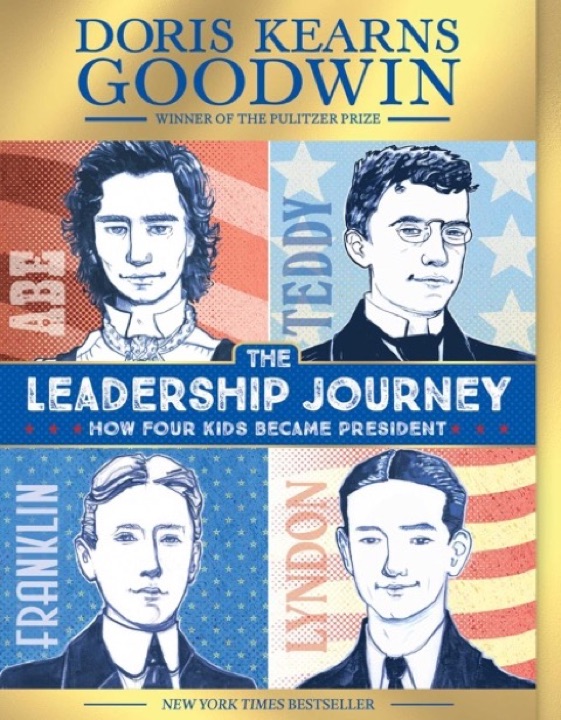
The Leadership Journey: How Four Kids Became President
Applying the lessons from "The Leadership Journey: How Four Kids Became President" by Doris Kearns Goodwin to your life can be a transformative exercise in recognizing that your current challenges—whether in the operating room, the boardroom, or the cockpit—are the training grounds for your future impact. Here are some ways you might integrate these lessons:
- Reframe Adversity as Character Training: When you encounter professional setbacks or personal trials, view them as the "wilderness years" described by Goodwin. Instead of seeing an obstacle as a dead end, treat it as a necessary diagnostic tool that identifies which virtues—such as patience, grit, or humility—you need to strengthen for the next stage of your career. - You should actively look for the lessons inherent in every failure, understanding that the resilience you build today is the very quality that will allow you to lead others through their own crises tomorrow.
- Commit to the "Strenuous Life" of Growth: Follow Theodore Roosevelt’s example by taking radical ownership of your physical and mental readiness. Recognize that your capacity to serve your patients and lead your ventures is directly tied to the discipline you apply to your own self-improvement and health. - You can integrate this by setting high standards for your personal routine, ensuring that you are always "making your mind and body" ready to meet the demands of a high-performance life.
- Cultivate Deep, Practical Empathy: Like LBJ in the schoolhouse or FDR in the recovery ward, you must seek out perspectives far removed from your own. Use your leadership positions to listen to those at the front lines of your organizations, ensuring your strategic decisions are grounded in the lived reality of your team and your customers. - By deliberately expanding your empathy, you transform your entrepreneurship from a pursuit of profit into a mission to solve the most pressing problems facing your community.
- Adopt a Scholar-Leader Mindset: Maintain a voracious appetite for knowledge outside your primary fields of medicine and law. Use history and biography as a laboratory where you can observe how great figures navigated complexity, allowing you to approach modern healthcare and venture capital with a sense of historical context. - You should aim to be a lifelong student of human nature, knowing that the more you understand the stories of those who came before, the better equipped you are to write your own.
- Audit Your Motivation for Service: Regularly evaluate whether your actions are driven by personal ambition or a genuine desire to serve a larger cause. Aim to align your entrepreneurial drive with a mission that improves the lives of others, shifting your focus from accumulating titles to building a lasting legacy. - By prioritizing the "we" over the "me," you ensure that your leadership is both sustainable and impactful, reflecting the true essence of what it means to be a statesman in your own field.
By integrating these lessons, you move beyond the mechanics of management and into the realm of true, character-based leadership. You begin to see your life as a continuous journey of formation, understanding that "staying hungry and staying humble" is the most effective way to navigate the turbulent times of any era while making a permanent difference in the lives of those you lead.
What the book covers
"The Leadership Journey: How Four Kids Became President" by Doris Kearns Goodwin is a compelling distillation of the author's decades of research into the lives of Abraham Lincoln, Theodore Roosevelt, Franklin D. Roosevelt, and Lyndon B. Johnson, specifically adapted to highlight their formative years. The book explores how the disparate childhoods of these four future presidents—ranging from extreme poverty to immense privilege—provided the raw materials for their eventual leadership. By focusing on their early struggles, the narrative serves as a roadmap for understanding how character is built through resilience, empathy, and persistent self-improvement. Goodwin demonstrates that great leaders are not born with a finished set of skills but are forged through a continuous process of learning and overcoming adversity.
Summary:
- The Crucible of Early Adversity: The book begins with Abraham Lincoln’s childhood, marked by backbreaking physical labor and the profound loss of his mother and sister. These early trials are presented not as mere obstacles, but as the foundation of his legendary resilience and his ability to find humor and hope in the darkest of times. - Lincoln’s "journey" illustrates that leadership is often rooted in the quiet strength developed during years of obscurity and manual toil, where he cultivated a deep sense of justice and a love for the written word.
- Conquering Physical Limitations: Theodore Roosevelt’s section focuses on his transformation from a sickly, asthmatic boy into a proponent of the "strenuous life." Inspired by his father’s admonition to "make your body," Roosevelt’s disciplined approach to physical fitness mirrors the mental discipline required for high-stakes governance. - This part of the narrative emphasizes that the first person a leader must learn to master is themselves, showing how TR’s proactive response to his own weaknesses became a hallmark of his energetic presidency.
- The Expansion of Empathy Through Experience: For Lyndon B. Johnson, the book highlights his time teaching at a segregated school for children of Mexican descent in Cotulla, Texas. This experience is portrayed as the catalyst for his lifelong commitment to civil rights and poverty relief, grounding his political ambition in a visceral understanding of inequality. - Goodwin argues that empathy is a foundational leadership trait, developed when individuals step outside their own social circles to understand the struggles and aspirations of those they serve.
- Intellectual Curiosity as a North Star: A shared trait among all four subjects was an insatiable appetite for learning, often through voracious reading. Franklin D. Roosevelt’s early education and travel provided him with a broad perspective and a sense of historical context that allowed him to remain creative and optimistic during the Great Depression. - The book details how a commitment to lifelong learning provides leaders with the imaginative capacity to solve complex problems and the historical perspective to avoid the mistakes of the past.
- Resilience in the Face of Failure: The narrative does not shy away from the leaders' failures, such as FDR’s struggle with polio. Rather than ending his career, his illness deepened his connection to the suffering of others and taught him the strategic patience required to lead a nation through crisis. - This section teaches that setbacks are often the necessary prelude to greatness, as they strip away vanity and leave behind a more authentic, grounded form of leadership.
- The Transition from Ambition to Service: While each of these men was driven by personal ambition, the book traces the pivotal moments when their focus shifted toward a larger purpose. Whether it was saving the Union or implementing the New Deal, their legacies were secured when their private goals aligned with the public good. - Goodwin concludes that the ultimate mark of a leader is the transition from seeking power for its own sake to wielding power as a tool for meaningful, lasting service to the community and the country.
"The Leadership Journey" serves as an essential primer for understanding that the qualities required to lead a nation are the same qualities that allow any individual to live a life of purpose. Goodwin’s work offers a hopeful reminder that while the path to leadership is rarely linear, it is accessible to anyone willing to cultivate character, embrace learning, and serve others with integrity.