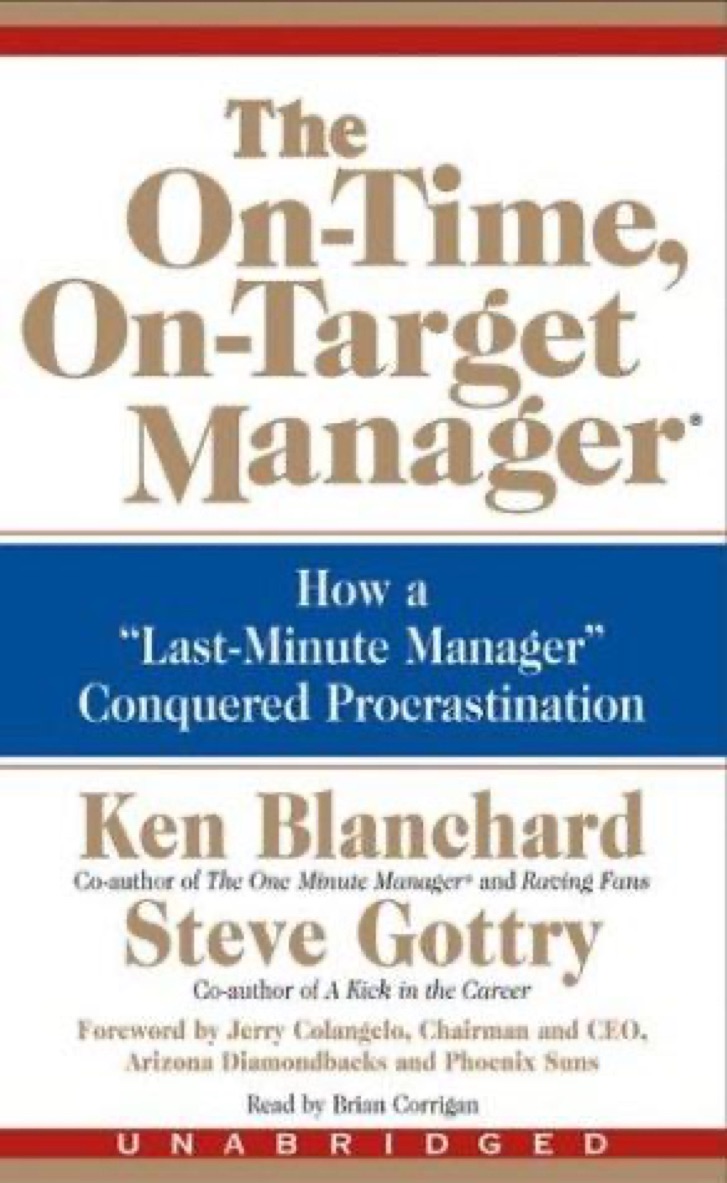
The On-Time, On-Target Manager: How to Manage Your Priorities and Get Results
Applying the lessons from "The On-Time, On-Target Manager" by Ken Blanchard and Steve Gottry to your life can be a transformative step toward achieving peak performance across your diverse professional interests. Here are some ways you might integrate these lessons:
-
Identify Your Procrastination Persona: - You must take an honest look at your habits to see if you fall into categories like the "Crisis-Maker" or the "Over-Committer." In high-stakes fields like emergency medicine or aviation, waiting until the last minute is not just a productivity drain but a safety risk; recognizing your specific triggers allows you to build better cognitive guardrails.
-
Master the Triage of the Three D’s: - Use the "Done, Delegated, or Deleted" framework to manage the complexity of your multiple roles as an attorney, physician, and entrepreneur. By making immediate decisions on incoming requests, you prevent the mental fatigue that comes from an ever-growing, unaddressed to-do list, keeping your "mental runway" clear for critical decision-making.
-
Uphold the Standard of Propriety: - You should ensure that your pursuit of efficiency never compromises the accuracy of your work. Whether you are reviewing a legal contract or a venture capital pitch, remind yourself that being "on-target" requires a commitment to excellence and ethics that transcends mere speed.
-
Align Your Schedule with High-Payoff Priorities: - As a serial entrepreneur and lifelong learner, your time is your most precious asset. You must ruthlessly prioritize activities that align with your core mission of healthcare innovation, ensuring that you are not just busy, but truly effective in moving the needle on major projects.
-
Leverage Passion as a Productivity Tool: - When you find yourself dragging your feet on administrative or mundane tasks, reconnect with the "why" behind your work. Use your passion for helping patients or mentoring the next generation of leaders to find the internal drive necessary to tackle the difficult tasks with the same energy as your favorite pursuits.
-
Model Punctuality as Leadership Integrity: - You can strengthen your organizational culture by being the primary example of "on-time" behavior. Demonstrating respect for others' time through your own punctuality builds a culture of trust and high expectations, which is essential for any high-growth venture or professional team.
By integrating these lessons, you can synchronize your various professional identities into a cohesive, high-output lifestyle. This balance of being both on-time and on-target ensures that your contributions across medicine, law, and business are sustainable, impactful, and reflective of your commitment to staying hungry and humble.
What the book covers
"The On-Time, On-Target Manager: How to Manage Your Priorities and Get Results" by Ken Blanchard and Steve Gottry is a practical business parable designed to help professionals overcome the destructive habit of procrastination. Through the story of Bob Shoveler, a manager whose career and personal life are faltering due to chronic lateness, the authors introduce a systematic approach to time management and prioritization. The book serves as both a diagnostic tool for identifying why people delay tasks and a strategic guide for achieving high-quality results consistently. By blending narrative storytelling with actionable management principles, Blanchard and Gottry provide a roadmap for transforming organizational culture and individual productivity.
Summary:
-
Identifying the Five Types of Procrastinators: - The authors outline five specific personas that characterize different procrastinators: the Dreamer, the Worrier, the Defier, the Crisis-Maker, and the Over-Committer. Each type has unique psychological triggers, such as a fear of failure or a need for an adrenaline rush, which cause them to delay essential work. - Bob Shoveler identifies himself as a "Crisis-Maker," someone who thrives on the stress of a looming deadline. He realizes that while he enjoys the high of a last-minute finish, he is actually delivering sub-par work and creating unnecessary chaos for his colleagues and family.
-
The Principle of Priorities: - This section emphasizes the importance of distinguishing between what is urgent and what is truly important. The authors argue that many managers spend their days reacting to minor interruptions and "firefighting" rather than focusing on high-payoff activities that drive long-term success. - To be on-target, a manager must align their daily schedule with their core values and organizational goals. The book teaches readers how to prune away low-value tasks to make room for the projects that actually matter.
-
The Principle of Propriety: - Propriety in this context refers to doing things the right way and maintaining high standards of quality. The authors posit that being on time is irrelevant if the final output is inaccurate or does not meet the necessary requirements. - By focusing on propriety, managers ensure that their work is not just finished, but is ethically sound and professional. This principle acts as a safeguard against the "sloppy speed" that often accompanies a rushed, last-minute effort.
-
The Principle of Passion: - Passion is presented as the essential fuel for productivity. When an individual lacks a clear "why" for their work, they are far more likely to succumb to distractions and delays. - The narrative shows how Bob rediscovers his enthusiasm for his role by connecting his tasks to a larger purpose. When workers are passionate about their contributions, they naturally prioritize their duties and strive for excellence without constant external pressure.
-
The Three D’s of Task Management: - To handle the daily deluge of information and requests, the book introduces a simple triage system: Done, Delegated, or Deleted. Every incoming task should be handled immediately by finishing it, passing it to the appropriate team member, or removing it from the agenda entirely. - This system prevents the accumulation of mental and physical clutter. By clearing the "backlog" of undecided tasks, a manager can maintain the focus needed to remain on-time and on-target for their most significant responsibilities.
-
Creating a Culture of Accountability: - The story concludes with Bob implementing these lessons within his team to foster a environment of mutual respect and reliability. He learns that his own punctuality sets the standard for everyone else and that accountability is a tool for empowerment rather than punishment. - By modeling on-time behavior, Bob restores his reputation and revitalizes his department's morale. The authors stress that organizational health is built on a foundation of trust, which is only possible when people can rely on each other to keep their word.
"The On-Time, On-Target Manager" is a significant resource for leaders seeking to eliminate the hidden costs of procrastination within their teams. Its focus on the psychological roots of delay makes it more effective than a simple book on scheduling, offering a holistic path toward professional integrity and operational excellence.