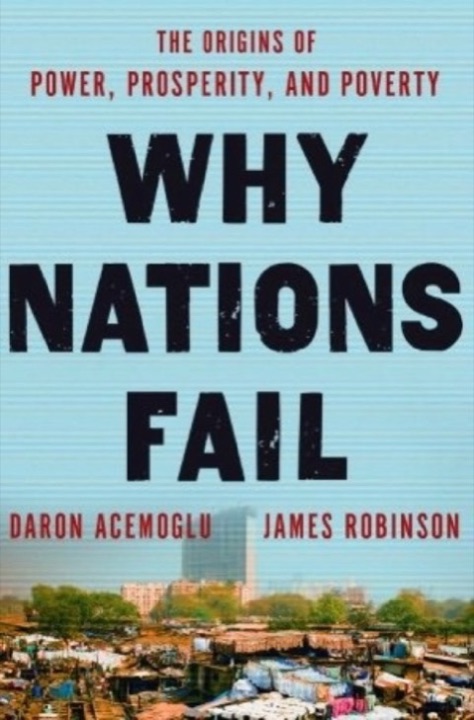
Why Nations Fail
Applying the lessons from "Why Nations Fail" by Daron Acemoglu and James A. Robinson to your life involves drawing parallels between the book's insights on institutions and your personal experiences, values, and aspirations. Here are some ways you might do this:
-
Inclusive Institutions in Personal Life: - Just as inclusive institutions lead to prosperity in nations, fostering inclusivity in your personal and professional relationships can lead to a more fulfilling life. Encourage open communication, participation, and collaboration with family, friends, and colleagues. This aligns with your values of kindness and empathy, ensuring that everyone feels valued and heard.
-
Critical Junctures and Personal Growth: - Recognize critical junctures in your life—moments that have the potential to lead to significant change. For example, your decision to pursue a career in medicine or your response to near-death experiences. Use these moments as opportunities to reassess and realign your goals and actions with your core values.
-
Distribution of Power and Leadership: - In your leadership roles, whether in your career or personal life, strive to distribute power and responsibility. Empower others to contribute and make decisions, fostering an environment where diverse perspectives are valued. This approach can lead to more innovative and effective outcomes.
-
Feedback Loops and Personal Development: - Create positive feedback loops in your life by reinforcing behaviors and habits that align with your goals and values. For instance, your commitment to daily exercise and personal reflection can create a cycle of physical and mental well-being, enhancing your resilience and persistence.
-
Learning from History and Experience: - Just as the book emphasizes learning from historical patterns, reflect on your past experiences to gain insights for the future. Your anecdote about the plane crash and your approach to handling criticism demonstrate your ability to learn from challenging situations and grow stronger.
-
Breaking Vicious Cycles: - Identify any negative patterns or "vicious cycles" in your life, such as impulsivity or lack of balance, and work to break them. Your daily self-evaluation and commitment to personal growth can help you create "critical junctures" that lead to positive change.
-
Role of Leadership and Agency: - Embrace your role as a leader in your family and community by using your influence to advocate for social issues you are passionate about, such as equality and anti-human trafficking. Your involvement in activism reflects your belief in the power of human agency to effect change.
-
Resilience and Adaptability: - Your resilience and humor are strengths that can help you navigate life's challenges. Like nations that adapt to changing circumstances, continue to approach life with optimism and adaptability, using setbacks as opportunities for growth.
By applying these lessons, you can continue to build a life that reflects your values, fosters inclusivity, and embraces opportunities for growth and change.
What the book covers
"Why Nations Fail: The Origins of Power, Prosperity, and Poverty" by Daron Acemoglu and James A. Robinson is a comprehensive exploration of the political and economic factors that contribute to the success or failure of nations. The authors argue that the key to understanding the disparities in wealth and prosperity among nations lies in their political and economic institutions.
Summary:
-
Core Thesis: - The central thesis of the book is that inclusive political and economic institutions lead to prosperity, while extractive institutions lead to poverty. Inclusive institutions are those that allow and encourage participation by the great mass of people in economic activities that make best use of their talents and skills and that enable individuals to make the choices they wish. In contrast, extractive institutions are designed to extract incomes and wealth from one subset of society to benefit a different subset.
-
Historical Analysis: - Acemoglu and Robinson provide a historical analysis to support their thesis, examining various case studies from different periods and regions. They discuss the success of nations like the United States and Western Europe, which developed inclusive institutions, in contrast to the failure of nations like those in sub-Saharan Africa and Latin America, which have been plagued by extractive institutions.
-
Critical Junctures: - The authors introduce the concept of "critical junctures," which are pivotal events that can lead to significant institutional changes. These junctures can set nations on divergent paths of development. For example, the Glorious Revolution in England is cited as a critical juncture that led to the development of inclusive institutions.
-
Role of Political Power: - The distribution of political power is crucial in determining the type of institutions that develop. When political power is concentrated in the hands of a few, extractive institutions are more likely to emerge. Conversely, when power is distributed more broadly, inclusive institutions are more likely to develop.
-
Feedback Loop: - The book discusses the feedback loop between political and economic institutions. Inclusive economic institutions support inclusive political institutions, and vice versa, creating a virtuous cycle. Conversely, extractive institutions reinforce each other, creating a vicious cycle of poverty and oppression.
-
Case Studies: - The authors provide numerous case studies to illustrate their points, including the contrasting development paths of North and South Korea, the impact of colonialism in Africa, and the economic rise of China.
Key Takeaways and Lessons:
-
Institutions Matter: - The quality of a nation's institutions is the primary determinant of its economic success or failure. Nations must strive to develop and maintain inclusive institutions to achieve sustainable prosperity.
-
Importance of Political Inclusivity: - Political inclusivity is crucial for economic development. Nations should work towards broadening political participation and ensuring that power is not concentrated in the hands of a few.
-
Role of Leadership and Agency: - While historical and structural factors are important, the role of leadership and human agency in shaping institutions cannot be underestimated. Leaders and policymakers have the power to influence the direction of institutional development.
-
Avoiding the Vicious Cycle: - Breaking out of the vicious cycle of extractive institutions requires significant effort and often external intervention. Nations trapped in this cycle need to find ways to create critical junctures that can lead to institutional change.
-
Learning from History: - Understanding historical patterns and the reasons behind the success or failure of nations can provide valuable lessons for current and future policymakers.
In conclusion, "Why Nations Fail" emphasizes the critical role of institutions in shaping the economic fortunes of nations. By fostering inclusive institutions, nations can create a foundation for long-term prosperity and stability.