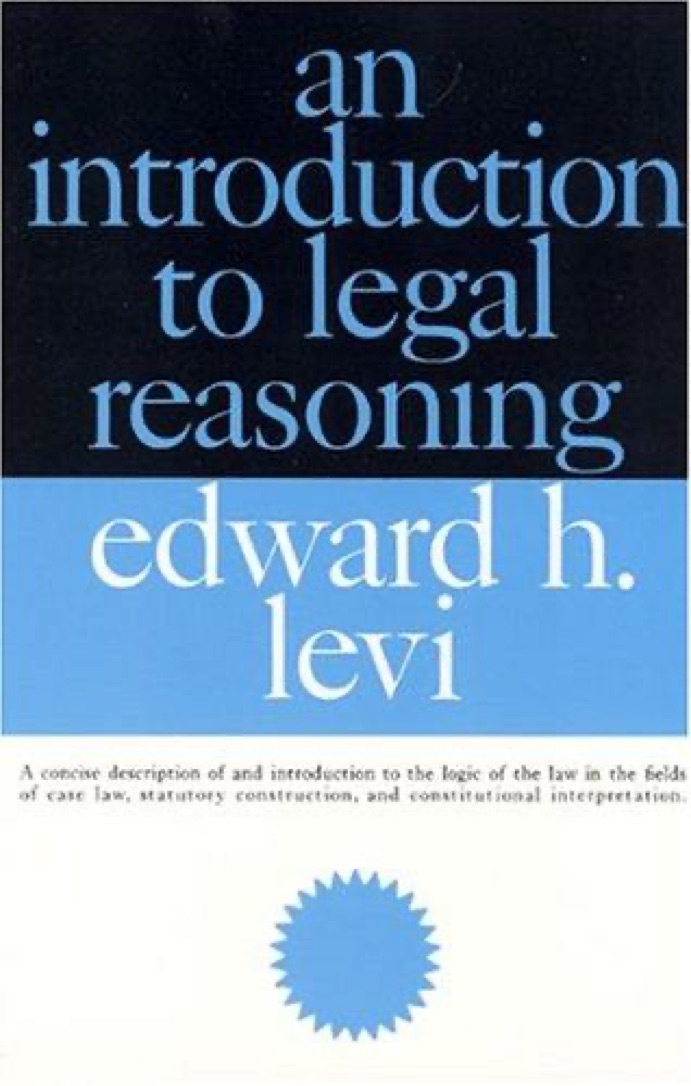
An Introduction to Legal Reasoning
Applying the lessons from "An Introduction to Legal Reasoning" by Edward H. Levi to your life can be transformative for how you navigate complex systems and professional decision-making. Here are some ways you might integrate these lessons:
- Mastering Analogical Thinking in Medicine: - As a physician, use "reasoning by example" to improve diagnostic accuracy. Instead of relying solely on rigid protocols, focus on identifying how a current patient’s presentation mirrors or diverges from historical cases. This allows you to navigate the "grey areas" of medicine where the standard rules may not perfectly apply to the specific pathology.
- Iterative Decision-Making in Healthcare Entrepreneurship: - In the startup world, view your business strategies as moving classifications rather than fixed mandates. Just as case law evolves, allow your operational precedents to shift as you encounter new market data or regulatory changes, ensuring your company remains responsive to the environment rather than trapped by past successes.
- Navigating Ambiguity in Professional Leadership: - Tolerate—and even leverage—the lack of absolute clarity in complex negotiations or long-term strategic planning. By keeping certain organizational "concepts" open-ended, you provide your team with the flexibility to innovate and adapt when they face challenges that were not anticipated at the outset of the venture.
- Evaluating Precedent in High-Stakes Environments: - In environments like the cockpit or the courtroom, understand the "lifecycle of a rule." Constantly evaluate whether the "precedents" you follow—such as checklists, legal strategies, or safety protocols—are still the most relevant given the current context. Recognizing when a situation has moved beyond the scope of a standard rule allows for a safer transition to a more appropriate framework.
- Synthesizing Lessons Through Lifelong Learning: - Adopt the "three-step pattern" of legal logic in your personal growth. When you encounter new information, look for similarities to what you already know, extract the underlying principle, and then apply it to your current challenges. This iterative process of synthesis ensures that your knowledge base remains a dynamic toolset for solving novel problems across multiple disciplines.
By integrating these lessons, you move beyond a static understanding of your professional fields and embrace a more sophisticated, evolutionary approach to problem-solving. Whether you are analyzing a legal brief, a medical chart, or a venture capital deal, Levi’s insights teach you that the most robust conclusions are reached not through rigid adherence to the past, but through the careful, comparative analysis of the present.
What the book covers
"An Introduction to Legal Reasoning" by Edward H. Levi is a foundational analysis of the intellectual structure of the law and the specific logic used by judges to resolve disputes. Levi argues that legal reasoning is not a simple application of static rules but a dynamic, evolutionary process he calls "reasoning by example." By examining how legal concepts shift over time, the book provides a masterclass in how society’s values are translated into a functioning, adaptable legal framework.
Summary:
- The Logic of Reasoning by Example: - Levi posits that the core of legal reasoning is the comparison of cases. Unlike deductive logic, where a general rule is applied to a specific instance, legal logic moves from case to case. The judge identifies similarities between the current matter and a prior one, extracts a rule of law inherent in that precedent, and then applies it to the new facts. This allows the law to remain flexible as new situations arise.
- The Three-Step Pattern of Legal Logic: - The author breaks down the process into three distinct phases: first, similarities are found between a past case and the present one; second, the rule of law inherent in the first case is stated; and third, the rule of law is made applicable to the second case. This process ensures that the law is not a set of rigid dictates but a living system that discovers its own principles through application.
- Case Law and the Creation of Precedent: - In the realm of case law, the judge is not bound by the specific wording of a previous judge but by the logic of the decision itself. This creates a "moving classification system" where the law can change as the importance of certain facts shifts. Levi illustrates how this prevents the law from becoming stagnant, allowing it to adapt to social changes without requiring constant legislative intervention.
- The Dynamics of Statutory Interpretation: - When dealing with statutes, the process changes because the words of the legislature are fixed. However, Levi explains that even here, reasoning by example is paramount. Judges must determine what the legislature meant by applying the words to specific, often unforeseen, contexts. The ambiguity of language is not a defect but a necessity that allows the statute to function in a complex world.
- The Shifting Standards of Constitutional Law: - The interpretation of the Constitution represents the most flexible form of legal reasoning. Because the Constitution is a broad framework, its terms—like "due process"—must be re-evaluated as societal standards evolve. Levi shows how the court’s reasoning moves through stages of stability and upheaval, reflecting the changing consensus of the American people over time.
- The Role of Ambiguity and Public Consensus: - A key argument is that legal concepts must remain "open-ended." If legal terms were defined with scientific precision, the law would break under the pressure of new circumstances. Ambiguity allows for a "forum of controversy" where competing interests can be negotiated and balanced, ensuring that the legal system remains relevant to the current era and the community's needs.
- The Movement and Lifecycle of Concepts: - Levi describes how a legal concept is born, reaches a period of stability, and is eventually discarded or transformed. This lifecycle is driven by the feedback loop between the courts and the public. As community values shift, the "examples" that once seemed similar now appear different, prompting a change in the rule of law to reflect new social realities.
The significance of Levi’s work lies in its demystification of the law as a purely deductive science. By highlighting the role of analogy and the necessity of incremental change, he demonstrates how the law balances the need for stability with the inevitability of progress. This book remains a vital resource for anyone seeking to understand how complex intellectual systems evolve through the tension between tradition and new information.