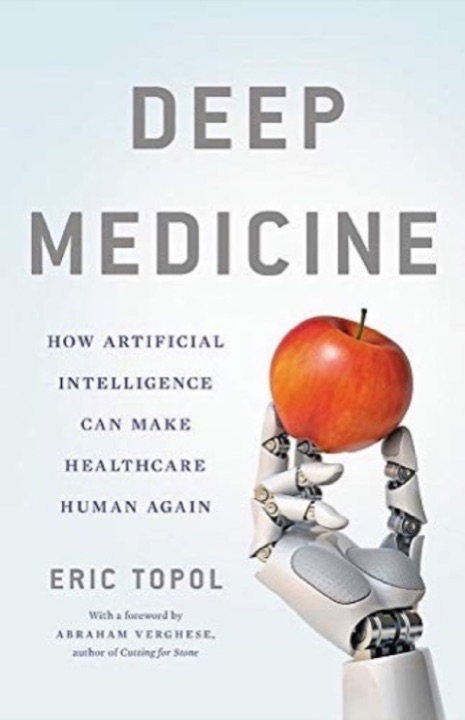
Deep Medicine: How Artificial Intelligence Can Make Healthcare Human Again
Applying the lessons from "Deep Medicine: How Artificial Intelligence Can Make Healthcare Human Again" by Eric Topol to your life can be both enriching and transformative, especially given your background and interests. Here are some ways you might integrate these insights:
-
Embrace AI as a Tool for Augmentation: - Given your experience in healthcare, consider how AI can enhance your practice. Explore AI tools that can assist in diagnostics or patient management, allowing you to focus more on patient interaction and empathy, which align with your core values of kindness and empathy.
-
Personalized Medicine: - Leverage AI to tailor treatment plans for your patients. By integrating genetic, environmental, and lifestyle data, you can offer more personalized care, improving patient outcomes and satisfaction.
-
Enhance Doctor-Patient Relationships: - Use AI to automate routine tasks, freeing up time to engage more deeply with your patients. This aligns with your desire to restore the human touch in healthcare and can help you maintain the empathy and communication you value.
-
Stay Informed on Ethical Considerations: - As you integrate AI into your practice, remain vigilant about ethical issues such as data privacy and algorithmic bias. Your strong ethical beliefs can guide you in ensuring that AI tools are used responsibly and fairly.
-
Advocate for AI in Underserved Areas: - Given your passion for social issues and activism, consider advocating for the use of AI to improve healthcare access in underserved regions. This aligns with your hope to see society overcome inequality and leverage technology for the betterment of mankind.
-
Continuous Learning and Adaptation: - Stay updated on the latest AI advancements in healthcare. Your mindset of being in a constant state of beta and lifelong learning will help you adapt to new technologies and integrate them effectively into your practice.
-
Balance Technology with Human Elements: - While embracing AI, ensure that you maintain the human elements of care that are important to you. Use technology to enhance, not replace, the personal connections you value in your interactions with patients and colleagues.
By applying these lessons, you can harness the potential of AI to improve your practice, enhance patient care, and contribute to a more humane and equitable healthcare system.
What the book covers
"Deep Medicine: How Artificial Intelligence Can Make Healthcare Human Again" by Eric Topol is a comprehensive exploration of how artificial intelligence (AI) can transform the healthcare industry. Topol, a renowned cardiologist and digital medicine researcher, delves into the potential of AI to enhance medical practice, improve patient outcomes, and restore the human touch in healthcare.
Summary:
-
Introduction to AI in Healthcare: - Topol begins by discussing the current state of healthcare, highlighting inefficiencies, high costs, and the depersonalization of patient care. He introduces AI as a transformative force that can address these issues by augmenting the capabilities of healthcare professionals.
-
AI's Potential in Diagnostics: - The book explores how AI can improve diagnostic accuracy through advanced imaging and pattern recognition. Topol provides examples of AI systems that outperform human experts in identifying diseases from medical images, such as radiographs and pathology slides.
-
Personalized Medicine: - AI's ability to analyze vast amounts of data can lead to more personalized treatment plans. Topol discusses how AI can integrate genetic, environmental, and lifestyle data to tailor therapies to individual patients, moving away from the one-size-fits-all approach.
-
Enhancing the Doctor-Patient Relationship: - A significant theme in the book is how AI can free up time for doctors by handling routine tasks, allowing them to focus more on patient interaction. Topol argues that this can restore empathy and communication in healthcare, which are often lost in the current system.
-
Challenges and Ethical Considerations: - Topol addresses the challenges of integrating AI into healthcare, including data privacy, algorithmic bias, and the need for rigorous validation of AI tools. He emphasizes the importance of maintaining human oversight and ensuring that AI serves as an aid rather than a replacement for healthcare professionals.
-
Case Studies and Real-World Applications: - Throughout the book, Topol provides numerous case studies and examples of AI applications in healthcare, from virtual health assistants to AI-driven drug discovery. These examples illustrate the practical benefits and limitations of AI technologies.
-
Future of Healthcare with AI: - Topol envisions a future where AI not only improves clinical outcomes but also democratizes healthcare by making it more accessible and affordable. He discusses the potential for AI to address global health disparities and improve healthcare delivery in underserved regions.
Key Takeaways and Lessons:
-
Augmentation, Not Replacement: AI should be viewed as a tool to augment the capabilities of healthcare professionals, not replace them. The human touch remains irreplaceable in patient care.
-
Empathy and Communication: By automating routine tasks, AI can give healthcare providers more time to engage with patients, enhancing empathy and communication.
-
Data-Driven Personalization: AI enables a shift towards personalized medicine, where treatments are tailored to individual patient profiles, improving efficacy and outcomes.
-
Ethical and Responsible AI Use: The integration of AI in healthcare must be guided by ethical considerations, ensuring patient privacy, data security, and fairness in AI algorithms.
-
Continuous Learning and Adaptation: The healthcare industry must be open to continuous learning and adaptation as AI technologies evolve, ensuring that they are effectively integrated into clinical practice.
-
Global Health Impact: AI has the potential to improve healthcare access and quality globally, particularly in resource-limited settings, by providing scalable and cost-effective solutions.
In conclusion, "Deep Medicine" presents a compelling vision of how AI can revolutionize healthcare by making it more efficient, personalized, and humane. Topol's insights highlight the importance of balancing technological advancement with the preservation of the human elements of care.