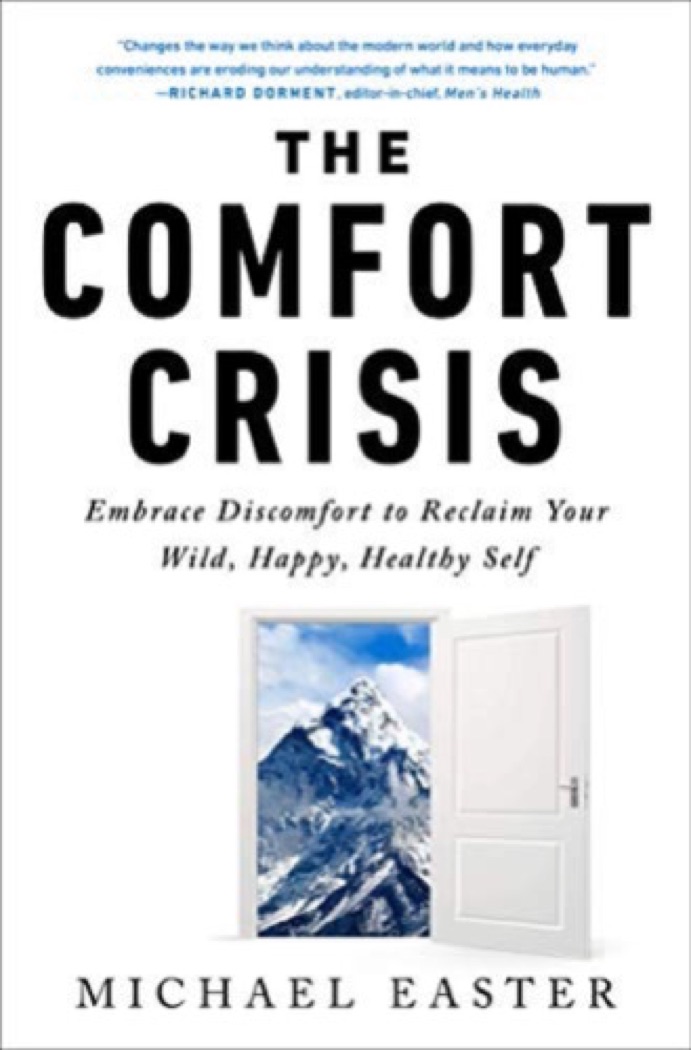
The Comfort Crisis: Embrace Discomfort To Reclaim Your Wild, Happy, Healthy Self
Applying the lessons from "The Comfort Crisis" by Michael Easter to your life can be a transformative journey that forces you to confront the self-imposed limitations of a high-convenience lifestyle. Here are some ways you might integrate these lessons:
- Design Your Own Misogi: - As a leader or entrepreneur, you should identify a challenge each year that lies well outside your comfort zone and has a high probability of failure. Whether it is a grueling endurance event or a high-stakes business pivot, the process of pushing through the "uncomfortable middle" builds a psychological reservoir of resilience that is invaluable in the high-pressure worlds of medicine and venture capital.
- Practice Tactical Boredom: - In your professional life, resist the urge to fill every gap in your schedule with digital consumption or administrative tasks. Allow yourself periods of "white space" during travel or between meetings to let your mind wander; this is often where the most creative solutions to complex healthcare or legal problems are born.
- Incorporate Ancestral Movement: - For the high-performing individual, rucking offers a time-efficient way to build functional strength and cardiovascular endurance without the high injury risk of high-impact sports. Carrying a weighted pack while taking a call or walking the dogs reinforces the physical grit necessary to sustain long hours in the clinic or the cockpit.
- Leverage the 20-5-3 Rule: - Systematically schedule your exposure to the natural world to maintain peak cognitive performance and mental clarity. Use the 20-minute park visits to reset after a difficult shift and the annual three-day wilderness immersion to disconnect from the grid entirely, allowing your brain to recover from the "directed attention fatigue" of modern leadership.
- Recalibrate Your Relationship with Hunger: - View hunger not as an emergency to be fixed immediately, but as a physiological state to be observed and mastered. Practicing this discipline helps you maintain focus and temperamental control during long surgeries or negotiations, ensuring that your decisions are driven by logic and strategy rather than biological impulse.
- Maintain a Perspective on Mortality: - Regularly reflecting on the finiteness of life—much like a pilot performing a pre-flight check—allows you to cut through the noise of daily stressors. This perspective fosters a "stay humble" mindset, ensuring your efforts remain focused on legacy-building and impactful service rather than ego-driven pursuits.
By integrating these lessons, you will find that the path to a more fulfilling and successful life is paved with the very discomforts you once sought to avoid, ultimately creating a more robust, capable, and present version of yourself.
What the book covers
"The Comfort Crisis" by Michael Easter is a compelling exploration of how our modern environment, designed for maximum ease and safety, is actually undermining our physical and mental well-being. Easter investigates the evolutionary roots of our survival instincts and argues that by intentionally reintroducing "productive discomfort" into our lives, we can unlock greater health, purpose, and resilience. The book follows Easter’s journey on an arduous month-long hunting expedition in the Alaskan wilderness, interspersed with interviews from top scientists, researchers, and special forces leaders to validate the benefits of leaving our comfort zones.
Summary:
- The Evolution of the Comfort Trap: - Easter posits that humans evolved in an environment of scarcity and physical peril, which hardwired us to seek out comfort and conserve energy whenever possible to ensure survival. However, in the modern era, where food is abundant and climate control is ubiquitous, this biological drive has created a mismatch that leads to chronic diseases, anxiety, and a loss of meaning.
- The Concept of the Misogi: - Drawing from Japanese tradition, the author highlights the "Misogi"—a radical challenge designed to test one’s limits where there is a 50% chance of failure. These self-imposed trials, which must be difficult and unique, serve as a psychological reset that expands a person's "perceived limit" and builds a level of grit that carries over into everyday life.
- The Benefits of Boredom: - In an age of constant digital stimulation, Easter argues that we have lost the ability to be bored, which is the primary catalyst for creativity and self-reflection. By intentionally putting away devices and allowing the mind to wander, we activate the "default mode network" in the brain, fostering innovative problem-solving and deeper mental clarity.
- Rucking and Physical Resilience: - The book champions "rucking"—carrying a weighted pack over distance—as the ultimate human exercise that bridges the gap between cardio and strength. Easter explains that humans are biologically built to carry weight, and this low-impact, high-reward activity builds functional strength while reconnecting us with our ancestral physical requirements.
- Hunger and Nutritional Awareness: - Easter examines the disappearance of true hunger in the developed world, noting that most people eat based on habit, social cues, or emotion rather than biological need. He suggests that experiencing occasional hunger and practicing intermittent fasting can improve metabolic health and help individuals recalibrate their relationship with food.
- The 20-5-3 Nature Rule: - To combat "Nature Deficit Disorder," the author presents a scientific framework for outdoor exposure: 20 minutes in a city park three times a week, 5 hours a month in semi-wild environments, and 3 days a year in true wilderness. This hierarchy of nature exposure is shown to significantly lower cortisol levels and improve cognitive function.
- Contemplating Mortality: - During a visit to Bhutan, Easter explores how the cultural practice of contemplating death multiple times a day leads to a more vibrant and less fearful life. He argues that acknowledging our own mortality helps us prioritize what truly matters and reduces the trivial stressors that often dominate modern existence.
Ultimately, "The Comfort Crisis" serves as a manifesto for modern living, urging readers to step outside their climate-controlled bubbles to find their best selves. By reclaiming the ruggedness that defined our ancestors, Easter demonstrates that we can achieve a more profound sense of vitality and a more authentic version of the human experience.