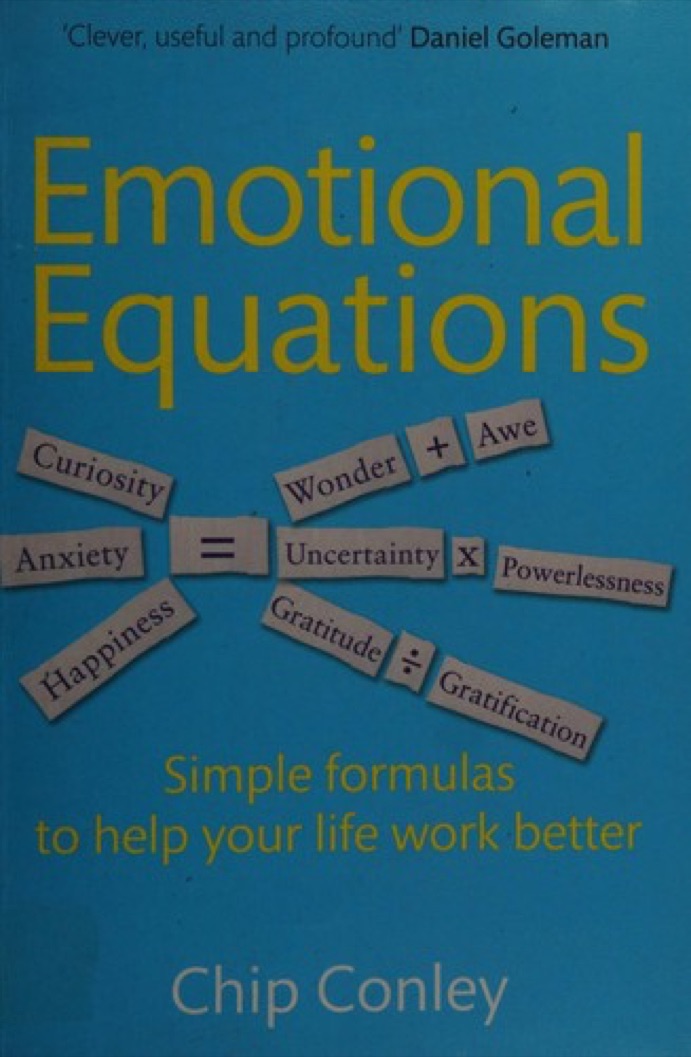
Emotional Equations: Simple Truths for Creating Happiness + Success
Applying the lessons from "Emotional Equations: Simple Truths for Creating Happiness + Success" by Chip Conley to your life can be a powerful way to bring a sense of order and agency to the high-pressure worlds of medicine, entrepreneurship, and leadership. Here are some ways you might integrate these lessons:
-
Engineering Resilience in the ER and Beyond: - Use the equation Despair = Suffering - Meaning to navigate the inevitable hardships of a medical career or a failing business venture. When faced with a tragic outcome or a professional setback, you should consciously hunt for the "why" behind the pain—whether it is a lesson learned for the next patient or a pivot point for a new company—to prevent suffering from turning into paralyzing despair.
-
Navigating Entrepreneurial Anxiety: - Recognize that as a founder or pilot, you deal with Uncertainty x Lack of Control daily. To lower your anxiety during a market shift or an in-flight emergency, you must aggressively separate what you can control (your preparation, your response, your communication) from what you cannot (the weather, the economy), and focus your energy solely on the former.
-
Managing Leadership Expectations: - Apply the Disappointment = Expectations - Reality formula to your management style. In your ventures, ensure that you are setting realistic, data-driven benchmarks for your team rather than idealistic ones; by narrowing the gap between what you project and what is actually achievable, you foster a culture of success and minimize team burnout.
-
Upholding Integrity in Law and Business: - View your professional reputation through the lens of Integrity = Actions / Values. You should regularly audit your daily decisions against your core principles to ensure the ratio remains balanced; when your actions perfectly reflect your values, you build the trust necessary to lead complex organizations and navigate legal complexities with a clear conscience.
-
Cultivating the Courage of Authenticity: - Remember that Authenticity = Self-Awareness x Courage. As a polymathic leader, you might feel pressure to conform to a specific "doctor" or "VC" persona, but true influence comes from the courage to show your multifaceted self. Use self-reflection to understand your unique strengths and have the bravery to lead from that honest place.
-
Redefining Success through Gratitude: - Shift your perspective on achievement using the Happiness = Wanting What You Have / Having What You Want equation. In the pursuit of the next acquisition or credential, you must take time to appreciate the infrastructure and milestones you have already built, ensuring that your drive for more does not eclipse your ability to enjoy the present.
By integrating these lessons, you can transform your emotional responses from reactive impulses into strategic assets, allowing you to maintain the "Stay Hungry, Stay Humble" mantra while navigating the complexities of a multi-disciplinary life with grace and logical precision.
What the book covers
"Emotional Equations: Simple Truths for Creating Happiness + Success" by Chip Conley is a transformative guide that bridges the gap between psychological complexity and mathematical clarity. Drawing on the author’s background as a successful hotelier and his personal struggles during the 2008 economic downturn, the book offers a series of "equations" designed to help readers navigate their internal landscapes. By breaking down abstract feelings into manageable variables, Conley provides a logical framework for understanding and influencing our emotional states to achieve greater equilibrium and fulfillment.
Summary:
-
The Logic of Emotions: - Conley introduces the concept that emotions can be understood as mathematical relationships where different variables interact to produce a specific feeling. By identifying the components of an emotion, such as Despair or Anxiety, individuals can begin to exert influence over their mental state rather than being a victim of it. - This systemic approach allows for a more objective analysis of subjective experiences, encouraging readers to dissect their reactions and determine which variables—such as meaning, control, or expectations—are within their power to change.
-
The Equation for Despair: - One of the book’s central formulas is Despair = Suffering - Meaning. Conley posits that while suffering is often an unavoidable part of the human experience, it only leads to despair when it lacks a perceived purpose or lesson. - By actively seeking or creating meaning within difficult circumstances, individuals can reduce the numerator of despair, effectively neutralizing the weight of their suffering and fostering a sense of resilience even in the most challenging professional or personal crises.
-
Managing Anxiety and Stress: - Conley defines Anxiety as the product of Uncertainty multiplied by a Lack of Control (Anxiety = Uncertainty x Lack of Control). This equation highlights why high-stakes environments often breed intense stress, as both variables are frequently elevated. - To mitigate anxiety, the book suggests focusing on "the knowns" to reduce uncertainty and identifying specific areas where one can assert agency to increase the sense of control, thereby lowering the overall emotional intensity.
-
The Mechanics of Disappointment: - The author explores Disappointment through the lens of Expectations minus Reality (Disappointment = Expectations - Reality). This simple subtraction illustrates how our internal benchmarks often set us up for failure before an event even occurs. - Conley argues for the cultivation of "unmet expectations" awareness, suggesting that by managing our projections and staying grounded in the present reality, we can experience more satisfaction and less resentment in our achievements.
-
Authenticity and Integrity: - The book delves into the components of character, defining Integrity as the alignment of Actions divided by Values. When there is a gap between what we do and what we believe, our integrity diminishes, leading to internal friction and external distrust. - Authenticity is presented as Self-Awareness multiplied by Courage; it requires not only knowing who you are but also having the intestinal fortitude to project that identity consistently to the world, regardless of external pressures.
-
The Path to Flourishing: - In the final sections, Conley moves toward positive psychology, examining equations for Joy, Curiosity, and Happiness. He suggests that Happiness is a result of Wanting What You Have divided by Having What You Want, emphasizing gratitude over acquisition. - By focusing on the denominators of these positive equations—such as appreciation and openness—individuals can create a sustainable foundation for long-term emotional health and professional vitality.
Ultimately, the book serves as a toolkit for emotional literacy, arguing that we are the architects of our own internal experience. By applying these logical constructs to our often chaotic feelings, we gain the clarity necessary to lead more intentional, balanced, and impactful lives.